Most people reading an se ranking review are trying to answer one question: can a mid-priced tool do the job of the expensive ones without cutting corners you’ll regret? That’s the right question, and this se ranking review answers it plainly — what SE Ranking does genuinely well, where it quietly falls short, roughly what you’ll pay, and the type of user who should look elsewhere.
SE Ranking has been around long enough to stop being the scrappy underdog and become a real fixture, especially with agencies. It sells itself on affordability and flexibility, and for the most part it delivers on both. But affordable is not the same as best-for-you, so let’s get specific.
What SE Ranking is
SE Ranking is an all-in-one SEO platform that covers the core jobs: keyword research, rank tracking, competitor analysis, site auditing, and backlink monitoring. It also folds in white-label reporting and a client portal, which is a large part of why agencies gravitate to it. The pitch is that you get most of what a Semrush or Ahrefs offers at a lower monthly cost, with pricing that flexes based on how many keywords you track and how often you refresh them.
That flexible pricing model is the tool’s signature. Instead of paying a flat premium for a fixed feature set, you dial the plan up or down around your actual tracking volume. For a small shop watching every dollar, that granularity is genuinely useful — you’re not subsidizing a huge keyword database you’ll never touch.
What SE Ranking does well
Rank tracking is the standout. It’s accurate, it handles local and mobile positions cleanly, and it lets you check rankings across specific locations down to the city or ZIP level. If you or your clients care about “am I ranking in Austin versus Dallas,” this is one of the better tools at that price for the job. The daily position updates feel reliable rather than jittery, and the historical charts make it easy to show a client the trend line over months.
The reporting is the other real strength. White-label reports look professional, schedule themselves, and can go out on your own domain and branding — the kind of polish that lets a freelancer or small agency look bigger than they are. The client portal means you can hand over a login instead of exporting a PDF every week, which saves real hours over a year.
The interface deserves credit too. It’s less dense than Ahrefs and less sprawling than Semrush, so a new user can find rankings and run an audit without a training session. For teams onboarding junior staff or non-technical clients, that gentleness matters more than it sounds.
Where SE Ranking falls short
The honest weaknesses cluster around data depth. SE Ranking’s backlink index and keyword database are respectable, but they are not in the same league as Ahrefs or Semrush at the top end. If your work lives on deep link audits, disavow files, or hunting the long tail of a competitor’s backlink profile, you’ll eventually feel the ceiling. The numbers are directionally fine for most sites; they’re just not the deepest index available, and serious link builders will notice.
Costs can also creep in ways the headline plan hides. Because pricing scales with tracked keywords and update frequency, a growing agency portfolio can push the bill up faster than expected, and some capabilities sit in add-ons rather than the base plan. It’s still cheaper than the premium suites, but “affordable” deserves an asterisk once you’re managing dozens of projects.
The bigger gap is strategic rather than a bug. SE Ranking was built for the search world of a few years ago — Google positions, backlinks, on-page audits. Its AI writing tools are competent but bolted on, and it doesn’t meaningfully answer the newest question SEOs face: are you showing up when someone asks ChatGPT, Perplexity, or Google’s AI Overviews instead of typing a query? That’s not a knock on SE Ranking specifically — most legacy tools share the blind spot — but it’s the gap to weigh in 2026.
Pros and cons at a glance
Here’s the short version before you read the pricing and verdict below.
| Category | Strengths | Weaknesses |
|---|---|---|
| Rank tracking | Accurate, granular local/mobile, reliable daily updates | Cost scales with keyword volume and refresh rate |
| Reporting | Strong white-label reports and client portal | Some polish sits behind add-ons |
| Data depth | Solid for most small-to-mid sites | Backlink and keyword index trail Ahrefs/Semrush |
| Ease of use | Clean, approachable interface | — |
| AI & AI-search | Basic AI writing included | No real AI-search visibility tracking |
How much SE Ranking costs
SE Ranking sits in the low-to-mid band of the market — noticeably cheaper than the enterprise-leaning suites, and its flexible model means the entry point is friendly for a solo operator or a first client. Expect the base tiers to land well below what a comparable Semrush or Ahrefs plan runs, with the exact figure depending on how many keywords you track and how often you refresh them. Annual billing knocks the effective monthly rate down further, as it does with most tools in this category.
The practical takeaway: for a freelancer or small agency doing standard rank tracking and reporting, SE Ranking is one of the better value plays available. For a heavy link-analysis workflow, the money you save here you may spend again on a second tool for the depth it lacks.
Who SE Ranking is for — and who should look elsewhere
SE Ranking is a strong fit if you’re a freelancer or a small-to-mid agency whose bread and butter is rank tracking, local SEO, site audits, and client reporting — and whose clients value clean, branded dashboards. On those jobs it punches above its price, and switching from a pricier suite to it rarely feels like a downgrade.
Look elsewhere if deep backlink intelligence is the core of your work, in which case Ahrefs still earns its higher band, or if you want one platform for every marketing channel, where Semrush’s breadth justifies its cost. And if your real bottleneck is producing content and staying visible in AI search, that’s a different tool category entirely.
The AI-native alternative worth weighing
If the blind spot above is the deciding factor for you, SEO Rocket is worth a look alongside SE Ranking. It runs on Ahrefs-grade data for the traditional jobs — keyword research, rank tracking, competitor gaps, site audit — but you drive it in plain language rather than tabs, and the same tool drafts your content and tracks whether your brand gets cited in ChatGPT, Perplexity, and AI Overviews through its Brand Radar feature. That AI-search visibility is the piece SE Ranking doesn’t answer.
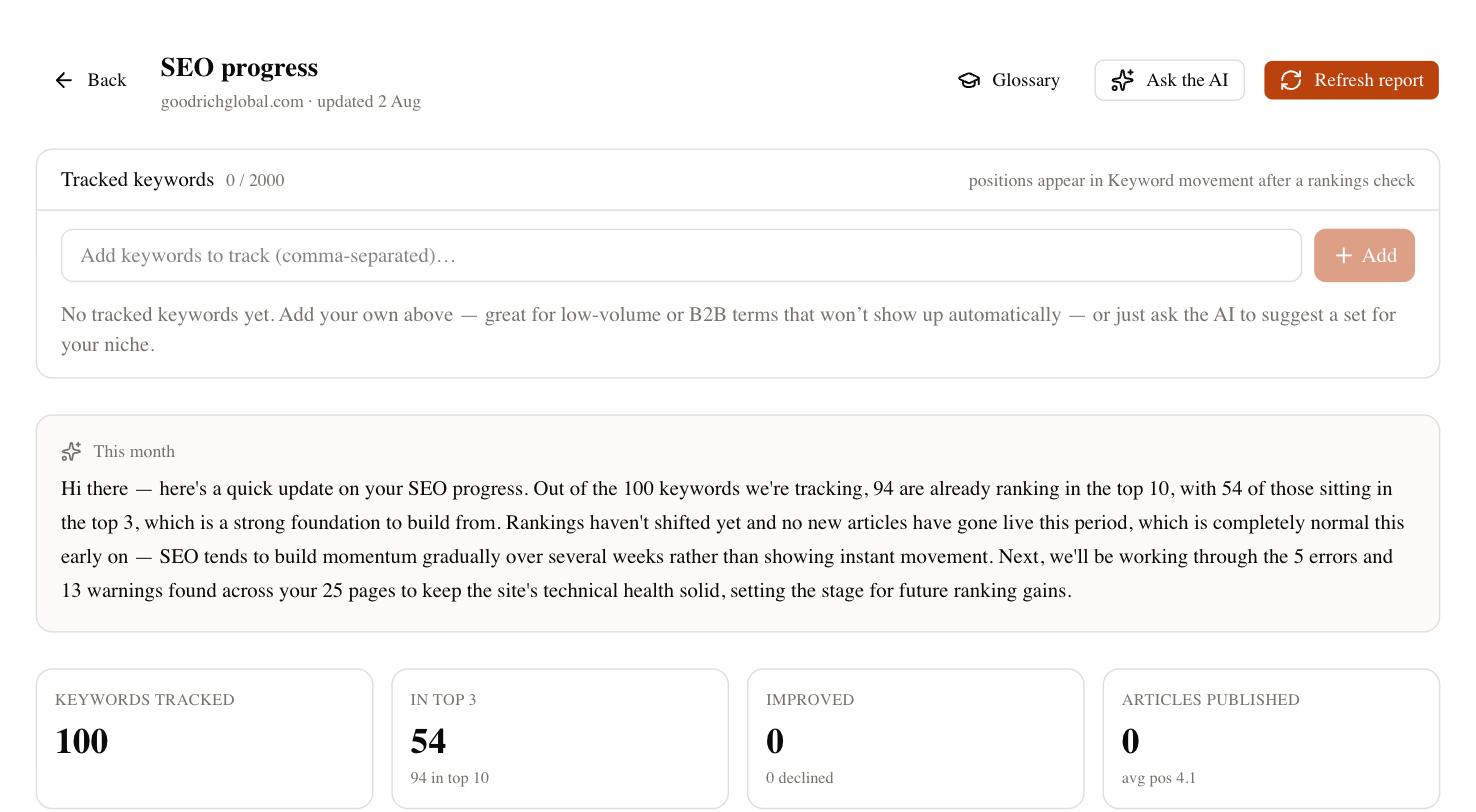
To be fair, SE Ranking still wins on white-label maturity — its reporting and client portal are more established, and for a pure rank-tracking-and-reporting agency that consolidation matters. The honest split is this: if your week is mostly tracking positions and sending branded reports, SE Ranking is a safe, affordable choice. If your week is increasingly about producing content and being found in AI answers, an AI-native tool covers more of the job in one subscription. Either way, run your own site and two competitors through the tool for a full ranking cycle before you commit — positions jitter a few spots day to day, and the tool that answers your real questions fastest is the right one for you.