Teams that switch from MarketMuse to SEO Rocket are usually not chasing a flashier interface — they’re trying to stop paying for topic modeling software that never talks to their rank tracker, their backlink data, or their AI-search visibility. MarketMuse built its reputation on genuinely deep topic modeling: content inventories, topic authority scoring, and a research engine that maps entire content clusters rather than one article at a time. That depth is real and it’s worth acknowledging up front, because SEO Rocket is not trying to out-model MarketMuse at the topic-graph level. It’s trying to be the one place your keyword research, content, technical health, backlinks, and rankings actually live together.
This guide covers what MarketMuse does that’s hard to replace, why teams still switch, a direct feature and pricing comparison, a migration plan, and where MarketMuse remains the better tool.
What MarketMuse does well
MarketMuse’s Content Inventory and Topic Model features are its real differentiator: it can crawl an entire domain, score every page’s topical authority against a target subject, and surface content gaps at the site-architecture level rather than the single-keyword level. Its Research application generates a topic model — a weighted list of related concepts and questions — pulled from a much broader analysis than a single SERP scrape, which is genuinely useful for planning a content cluster or pillar-page strategy months in advance. For enterprise content teams doing large-scale content audits and planning six-month editorial roadmaps around topical authority, MarketMuse’s modeling depth is a specific strength that a chat-first, brief-to-draft tool like SEO Rocket doesn’t attempt to replicate one-for-one.
Why teams switch anyway
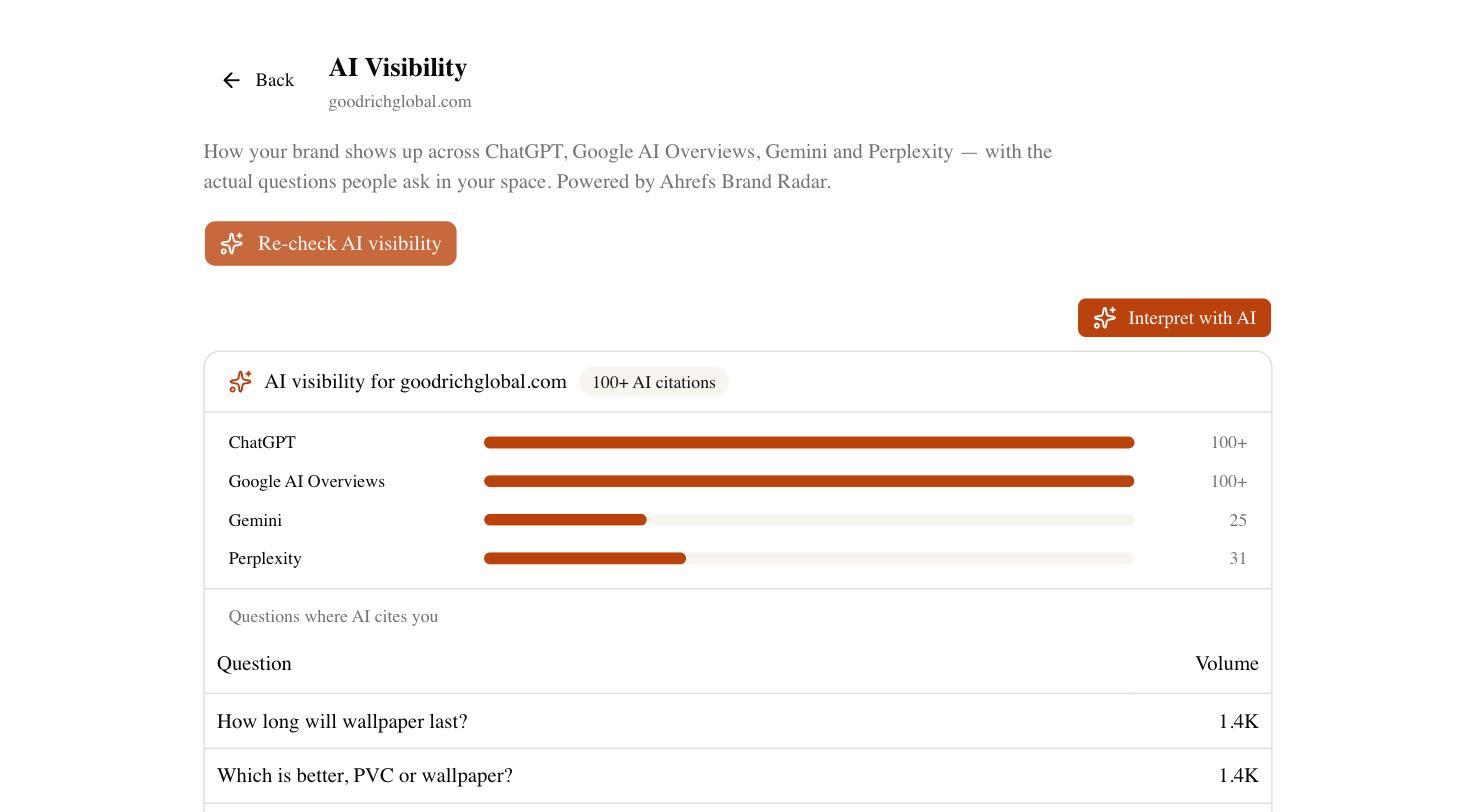
MarketMuse is priced and built for enterprise content operations, and a lot of teams end up using a fraction of its topic-modeling depth while still paying for the full platform — and separately paying for backlink tools, rank trackers, and keyword research elsewhere, because MarketMuse’s own keyword data and backlink coverage are thin compared to a dedicated SEO data provider. The other recurring reason: MarketMuse has no visibility into AI-search citations. It can tell you how topically complete your content is relative to competitors, but it can’t tell you whether ChatGPT, Google AI Overviews, Gemini, or Perplexity are actually citing your domain when someone asks a related question — a growing share of how people discover brands now. SEO Rocket consolidates the keyword research, content drafting, backlink analysis, technical audits, rank tracking, and AI-search visibility that MarketMuse either doesn’t cover or covers thinly, all powered by Ahrefs Enterprise data, in one chat-first workspace.
Feature comparison
| Capability | MarketMuse | SEO Rocket |
|---|---|---|
| Topic modeling / content inventory | Yes — deep, site-wide topical authority scoring | Content Gap analysis at the competitor level, less site-wide modeling depth |
| Content brief generation | Yes, from topic model | Yes, from SERP and keyword data via AI Content Writer |
| AI content drafting | Limited / add-on tier | Built in, Claude-powered, full draft from brief |
| Keyword research depth | Basic, secondary to topic modeling | Full Keywords Explorer — volume/KD/CPC + semantic Keyword Graph |
| Backlink / referring domains | Not included | Full Site Explorer on Ahrefs Enterprise data |
| Rank tracking | Not included | Included |
| Technical site audits | Not included | Included, plus free PageSpeed test |
| AI-search visibility (LLM citations) | Not available | Included — AI Visibility / Brand Radar |
| Best for | Enterprise content teams planning topical clusters | Teams needing content plus full SEO in one login |
What survives the switch, what doesn’t
The strategic thinking behind MarketMuse’s topic modeling — mapping a subject area before you write, rather than one keyword at a time — is a habit worth keeping regardless of which tool you use. SEO Rocket’s Content Gap analysis, run against two or three real competitor domains, approximates a version of this at the competitive level rather than the pure semantic-modeling level. It won’t produce the same site-wide topical authority score MarketMuse generates, and if that specific enterprise-grade output is contractually or operationally required for your content team, that’s a real gap to plan around, not something SEO Rocket papers over.
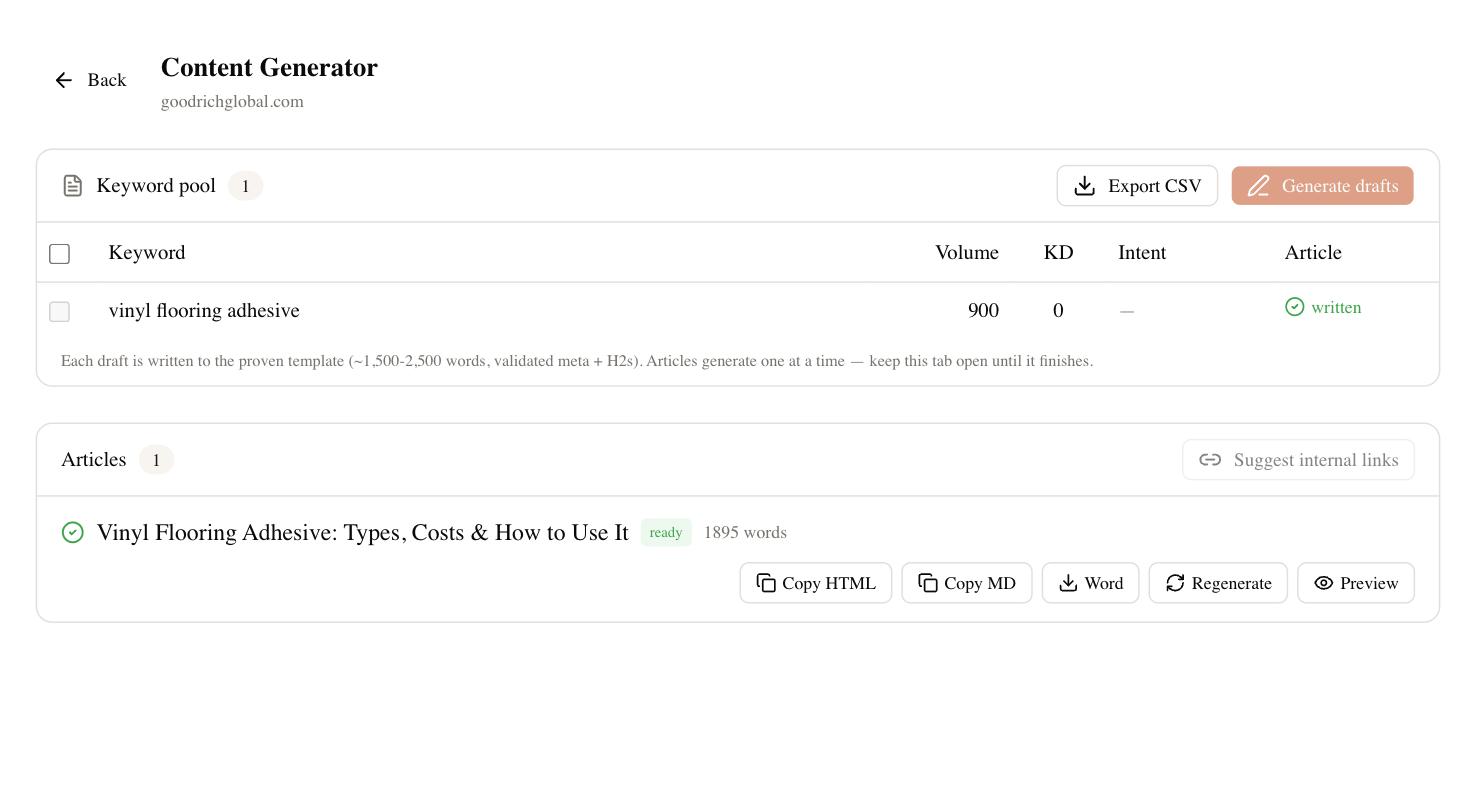
What changes cleanly: everything downstream of the brief. Instead of a topic model handed off to a separate writing process and a separate SEO stack, the brief, the draft, the keyword data, the backlink profile, and the rank tracking sit in one account.
Step-by-step migration
- Export your MarketMuse content inventories and topic models for any active clusters, and keep the underlying subject-area research — it’s still useful reference material even after you switch tools.
- Set up SEO Rocket at app.seorocket.ai, add your site, and let the initial technical audit run.
- Rebuild your priority keyword and topic list in Keywords Explorer, cross-checking volume and difficulty against your MarketMuse-era research.
- Run Content Gap analysis against your real competitors to approximate the cluster-planning MarketMuse’s topic model previously handled.
- Generate briefs and drafts with the AI Content Writer for your next content batch, using your existing subject-area research as extra input to the process.
- Turn on rank tracking for the pages tied to your priority topics.
- Connect Google Search Console and GA4 to see real traffic and conversion data against the content plan, not just topical completeness scores.
- Reassess MarketMuse after one quarter — some enterprise teams keep a MarketMuse seat for quarterly cluster planning while running day-to-day content and SEO through SEO Rocket.
Pricing comparison
| Plan | MarketMuse (approx. 2026) | SEO Rocket |
|---|---|---|
| Entry paid tier | Standard, ~$149/mo | Pro, $49/mo — 3 sites, 400 credits/mo |
| Mid tier | Team, higher usage and users | Growth, $99/mo — 10 sites, 1,000 credits/mo |
| Top tier | Premium / Enterprise, custom pricing | Agency, $199/mo — 25 sites, 2,500 credits/mo, or Enterprise custom |
| Free tier | Free trial only, no permanent free tier | Free — 1 site, 50 credits |
| Scope at entry price | Topic modeling and briefs, thin keyword/backlink data | Content, keywords, backlinks, technical audit, rank tracking, AI visibility |
Prices are approximate as of 2026 and enterprise tools like MarketMuse often quote custom pricing above entry level — confirm current numbers directly before budgeting. SEO Rocket’s annual billing saves roughly 8% (about one month free), metered by credits rather than a fixed content quota.
Who should NOT switch
If you run a large enterprise content operation whose editorial process depends on MarketMuse’s site-wide topic modeling and content inventory scoring — genuinely mapping topical authority across hundreds of pages before committing to a content roadmap — don’t drop MarketMuse for a general SEO platform without validating that gap first. SEO Rocket’s Content Gap analysis is a real tool but it operates at the competitor-comparison level, not MarketMuse’s semantic topic-graph level, and for teams whose value proposition is that modeling depth, the switch isn’t a clean one-for-one.
FAQ
Does SEO Rocket replace MarketMuse’s topic modeling exactly?
Not exactly. SEO Rocket’s Content Gap analysis approximates cluster planning at the competitor level; it doesn’t generate the same site-wide topical authority score MarketMuse produces.
Why do teams still switch despite that gap?
Because most teams use a fraction of MarketMuse’s modeling depth while paying separately for keyword research, backlinks, and rank tracking elsewhere — SEO Rocket consolidates those into one subscription.
Can I keep MarketMuse for quarterly planning and use SEO Rocket day-to-day?
Yes — that hybrid is common among enterprise teams who value MarketMuse’s cluster modeling but want day-to-day content, backlinks, and rank tracking in one simpler workspace.
Is SEO Rocket cheaper?
At comparable entry tiers, yes, and it includes backlink data, rank tracking, and AI-search visibility that MarketMuse doesn’t offer. Verify current pricing for your team size before deciding.
Bring your existing topic research along and see how it fits into a full SEO workflow. Try SEO Rocket and run a Content Gap analysis against the competitors already in your MarketMuse research.