If you’re weighing whether to switch from Serpstat to SEO Rocket, you’re probably running a fairly typical setup: rank tracking, keyword research, and a backlink audit or two, all spread across Serpstat’s tab-heavy interface, with the actual writing and strategy work happening somewhere else — Google Docs, a separate AI writer, a spreadsheet for reporting. This guide is for people at that stage. It walks through what Serpstat does well, why teams look for an alternative, what the migration actually involves, and where Serpstat is still the better pick.
To be upfront about the angle: we built SEO Rocket, so read the comparison with that in mind. We’ve tried to be specific about trade-offs rather than just listing reasons to switch.
What Serpstat does well
Serpstat earned its user base honestly. It’s one of the most complete all-in-one suites at its price point — keyword research, rank tracking, site audit, backlink analysis, and PPC competitor research all live under one subscription, which is unusual at the Individual plan’s price. The site audit module in particular is thorough, with a large checklist of technical issues and decent prioritization. Its keyword database covers a wide set of international markets, and the interface, while dense, gives power users a lot of filtering and segmentation control once they learn it.
Serpstat is also a reasonable choice for agencies managing many small projects on a budget, since its per-project limits are generous relative to cost, and its API is well documented for teams that want to pull data into their own dashboards.
Why people look to switch
The complaints we hear most aren’t about data quality — they’re about workflow. Serpstat is a collection of separate modules. You research keywords in one tab, check the audit in another, track rankings in a third, and none of it talks to each other or to the content you’re actually producing. There’s no writing tool, so keyword research output has to be manually carried into whatever you use to draft articles. And Serpstat has no visibility into how AI systems like ChatGPT, Google AI Overviews, or Perplexity represent your site — a gap that matters more every quarter as more search behavior moves into AI answers.
The other recurring theme is speed to action: getting from “here’s a keyword opportunity” to “here’s a drafted, optimized article” in Serpstat requires exporting data and switching tools multiple times. SEO Rocket was built to collapse that into one chat-driven workflow, backed by the same caliber of underlying data.
Feature comparison
| Capability | Serpstat | SEO Rocket |
|---|---|---|
| Keyword research | Yes, strong international coverage | Yes — volume, KD, CPC, plus a visual 2D/3D semantic Keyword Graph |
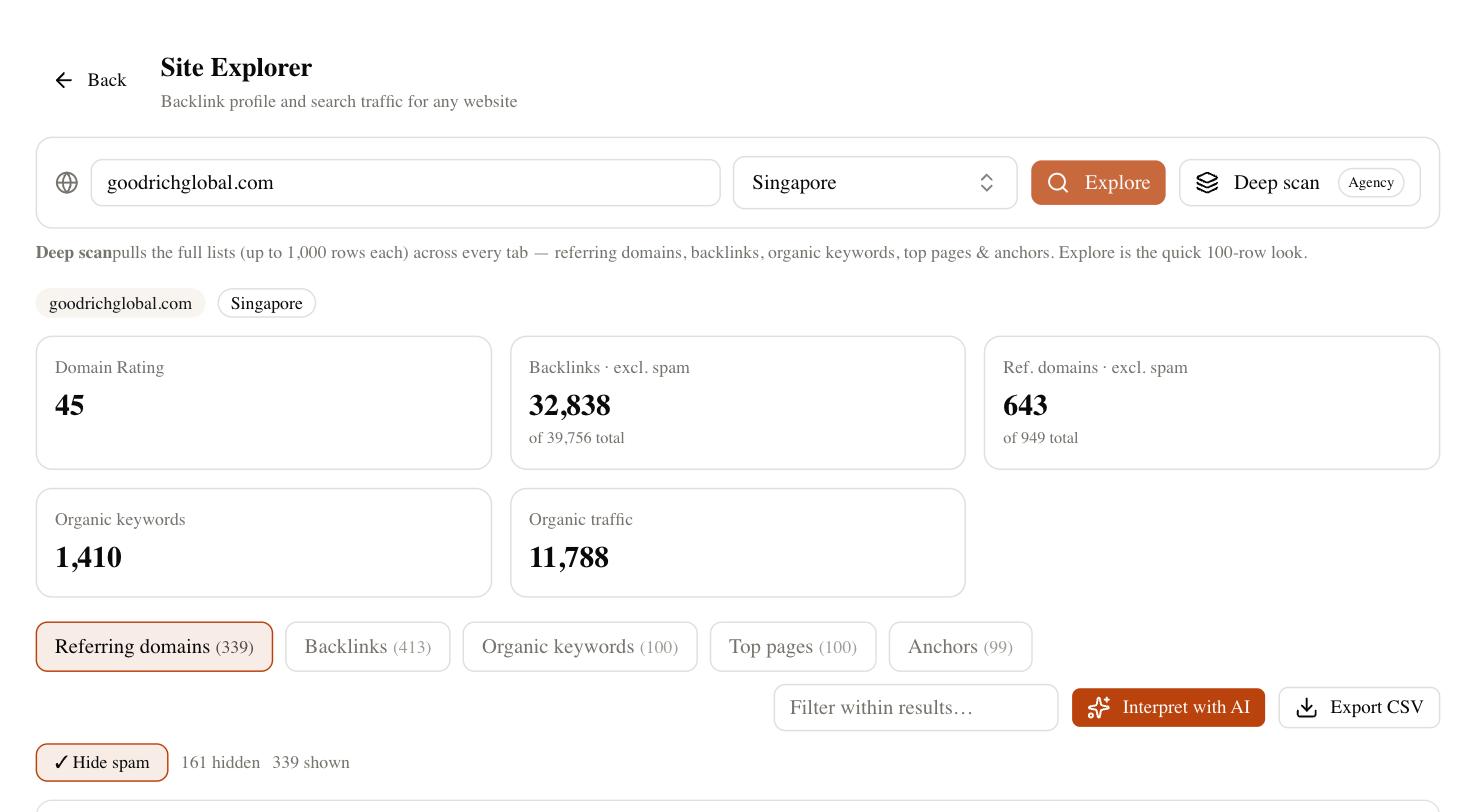
| Backlink / domain analysis | Yes, Serpstat’s own index | Yes — Site Explorer on Ahrefs Enterprise data |
| Rank tracking | Yes | Yes, chat-driven or dashboard |
| Technical site audit | Yes, deep checklist | Yes, plus PageSpeed and a free Website Speed Test |
| Content gap analysis | Yes | Yes |
| AI content writer | No native writer | Yes — Claude-powered, built on your keyword data |
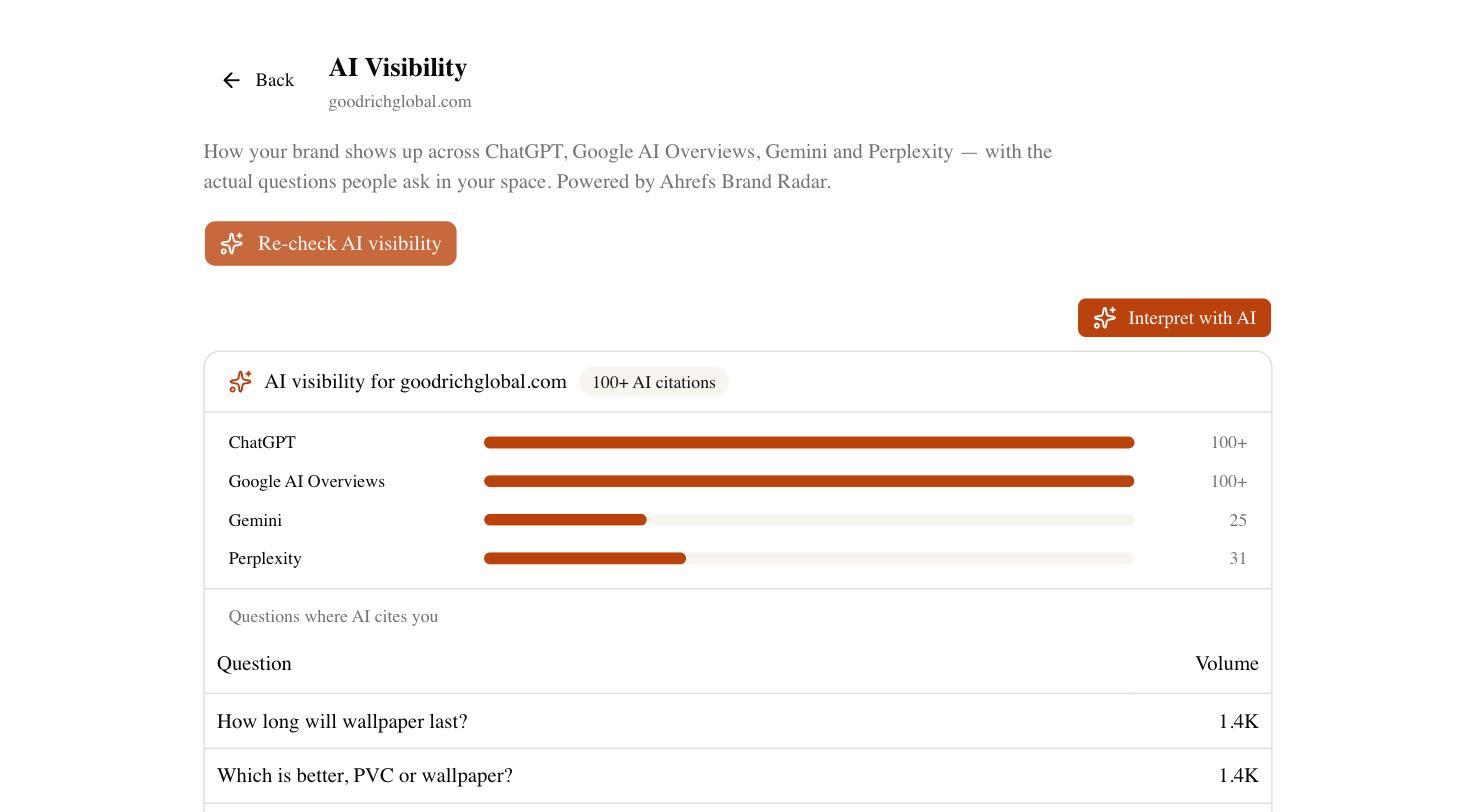
| AI Visibility / GEO tracking | No | Yes — Brand Radar tracks citations in ChatGPT, AI Overviews, Gemini, Perplexity |
| PPC / advertising research | Yes | Not a focus |
| Interface model | Multi-tab dashboard | Chat-first, with dedicated tool pages |
What you keep, what changes
You keep the core research capability: keyword volumes, difficulty scoring, backlink profiles, and technical audits are all present in SEO Rocket, backed by Ahrefs Enterprise data rather than Serpstat’s own index — the numbers you’re used to seeing will shift somewhat, which is normal when switching data providers and not a sign either tool is wrong.
What changes is the interaction model. Instead of navigating between separate audit, keyword, and rank-tracking sections, you can ask for any of it in chat (“audit my site,” “find content gaps against competitor.com,” “track these ten keywords”) and get results plus the option to act on them immediately — draft an article, fix a flagged issue, add a keyword to tracking. You gain AI Visibility tracking, which Serpstat doesn’t offer at all. You lose Serpstat’s PPC/advertising research module, since SEO Rocket is focused on organic and AI search rather than paid.
Step-by-step migration
- Export your data from Serpstat. Go to each module — Rank Tracker, Site Audit, Keyword Research — and export the relevant lists as CSV. Prioritize your tracked keyword list and your top organic keyword report; these are what you’ll recreate first.
- Create a project in SEO Rocket. Sign up at app.seorocket.ai, add your domain, and let the initial site snapshot run — it pulls your current technical state, indexed pages, and top keywords automatically.
- Set your target market. SEO Rocket infers your country from your domain, but confirm it in project settings if you rank in multiple regions — this affects which keyword index the tool queries.
- Recreate rank tracking. Import your CSV of tracked keywords, or paste the list into chat and ask SEO Rocket to set up tracking — it will add them and start pulling positions.
- Connect Google Search Console and GA4. This links your actual click and conversion data to the keyword and content data, which Serpstat can’t do since it has no first-party integration with your analytics.
- Run a content gap analysis against the competitors you were tracking in Serpstat, to pick up where your last audit left off.
- Keep Serpstat active for a billing cycle while you confirm rank tracking has stabilized and reporting matches expectations, then cancel.
Pricing comparison
Prices are approximate as of 2026; always check current pricing on each vendor’s site before deciding.
| Plan tier | Serpstat | SEO Rocket |
|---|---|---|
| Entry paid plan | Individual, ~$59/mo | Pro, $49/mo (3 sites, 400 credits/mo) |
| Free tier | Very limited trial | Free plan: 1 site, 50 starter credits, $0 |
| Mid tier | Team plan, higher cost | Growth, $99/mo (10 sites, 1,000 credits/mo) |
| Agency tier | Available, priced per seat | Agency, $199/mo (25 sites, 2,500 credits/mo) |
| Annual discount | Available | ~8% off (one month free) |
SEO Rocket’s credit model means your monthly allowance resets and one-time top-ups never expire, so occasional heavy months don’t require jumping a plan tier permanently.
Who should NOT switch
If PPC and paid-search competitor research is a core part of your workflow, Serpstat’s advertising module is more developed than anything SEO Rocket offers — we don’t try to compete there. If your team is deeply invested in Serpstat’s API for custom internal dashboards and that integration works well, the switching cost may outweigh the benefit. And if your primary use case is broad international keyword research across many smaller markets where Serpstat’s database has particular depth, it’s worth testing both tools on your specific markets before moving.
FAQ
Will my rankings history transfer over?
No. Rank tracking history is tool-specific. You’ll start a new tracking baseline in SEO Rocket from the day you add your keywords, though your Search Console history (once connected) fills in some of the gap.
Do I need to migrate everything at once?
No — many teams run both tools in parallel for two to four weeks to compare data and confirm rank tracking accuracy before cancelling Serpstat.
Is the backlink data as complete as Serpstat’s?
SEO Rocket’s Site Explorer runs on Ahrefs Enterprise data, which has one of the largest backlink indexes in the industry — generally larger than Serpstat’s own crawl, though exact counts always differ between any two providers.
Does SEO Rocket do PPC keyword research?
No, SEO Rocket is focused on organic and AI-search visibility, not paid advertising research.
If you want to see how your own site looks in SEO Rocket before committing, start with the free plan at app.seorocket.ai — it includes a site snapshot and 50 starter credits, no card required.