This is a slightly different comparison than the others we write, and it’s worth saying that upfront: if you’re looking to switch from Similarweb to SEO Rocket because you expect the same tool at a lower price, you’re going to be disappointed. Similarweb is a traffic and market-intelligence platform first; SEO Rocket is an SEO and AI-search execution platform. They overlap at the edges but solve different core problems. This guide is for the specific group of people for whom that overlap matters — usually SEO teams who bought Similarweb mainly for competitor traffic estimates and organic keyword data, not for market research or investment analysis.
We built SEO Rocket, so we have a stake in this comparison — but the honest answer for a lot of Similarweb’s actual use cases is “don’t switch, use both, or don’t switch at all.” Read on for where that line falls.
What Similarweb does well
Similarweb’s traffic estimation and market-intelligence data is genuinely best-in-class, and it’s not close. Its ability to estimate total site traffic (not just organic search traffic), break it down by channel — direct, referral, social, paid, email — and benchmark it against named competitors is a category of data most SEO tools don’t attempt at all. Investors, market researchers, competitive-intelligence teams, and executives evaluating acquisition targets or market share rely on Similarweb specifically because it models whole-web behavior, not just search rankings. Its app intelligence, industry-level benchmarking, and audience-overlap analysis are also unique capabilities that no SEO-focused tool, including SEO Rocket, is trying to replicate. If your job requires answering “how much total traffic does this company get and where does it come from,” Similarweb remains the standard.
Why people switch (for the SEO use case specifically)
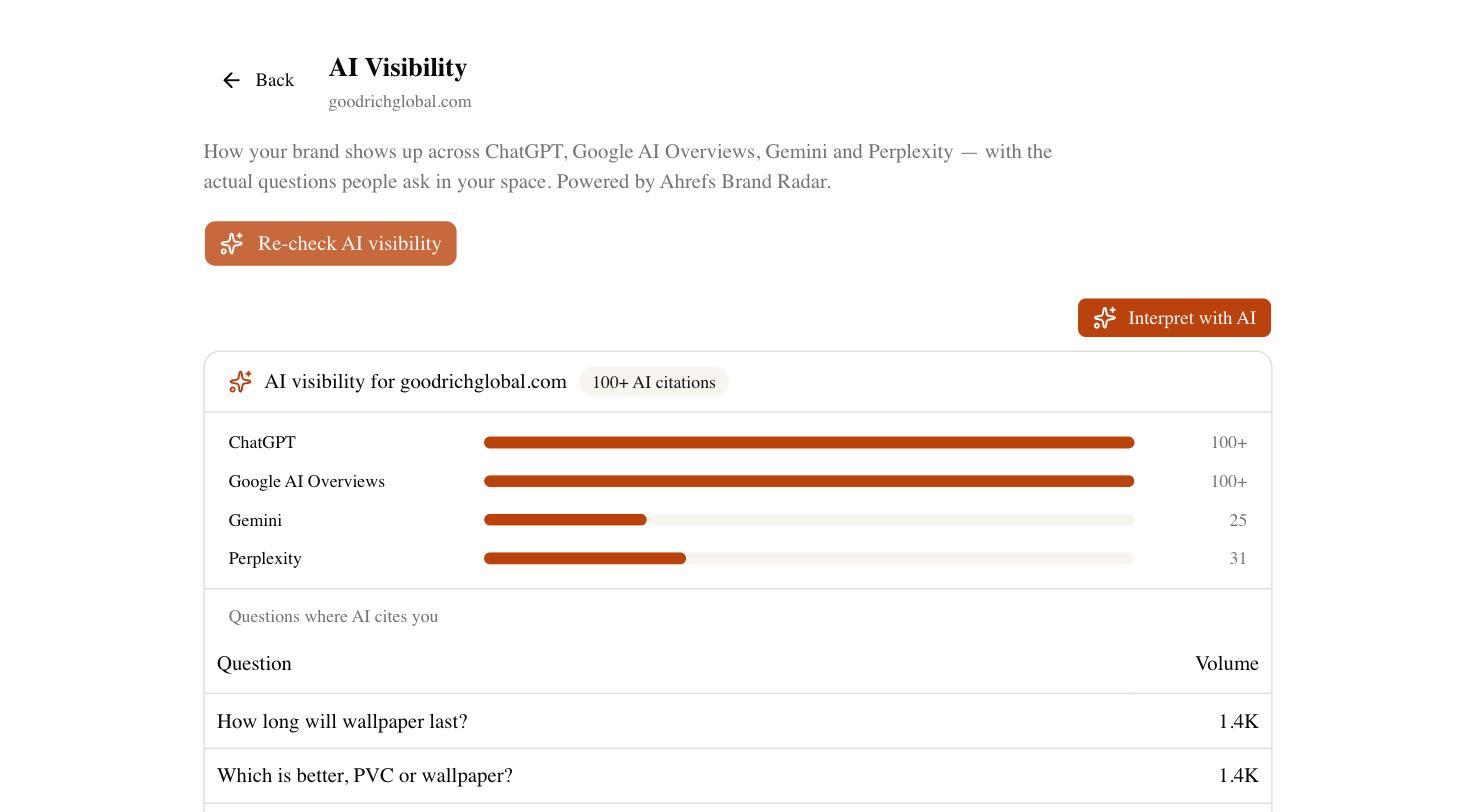
The switch conversation comes from a narrower group: teams who were using Similarweb mainly for its organic-search-adjacent features — organic keyword estimates, some competitor SEO comparison — while paying for the full market-intelligence platform to get there. Similarweb’s pricing for paid access is notoriously opaque and, for most SEO-focused teams, expensive relative to the SEO-specific slice of the product they actually use; the entry point for real data typically requires a custom quote rather than a published price. There’s also no content production tooling, no technical site audit, and no way to track AI Visibility — how often your brand is cited by ChatGPT, Google AI Overviews, Gemini, or Perplexity — in Similarweb. Teams doing hands-on SEO work, not market research, often find they’re paying enterprise prices for traffic-estimation data when what they actually need is keyword research, technical audits, rank tracking, and content production in one workflow.
Feature comparison
| Capability | Similarweb | SEO Rocket |
|---|---|---|
| Total site traffic estimation (all channels) | Yes — industry-leading | No — not our focus |
| Traffic channel breakdown (direct, social, paid, etc.) | Yes | No |
| Market share / audience overlap analysis | Yes | No |
| Organic keyword research | Basic, secondary feature | Yes — volume, KD, CPC, 2D/3D Keyword Graph |
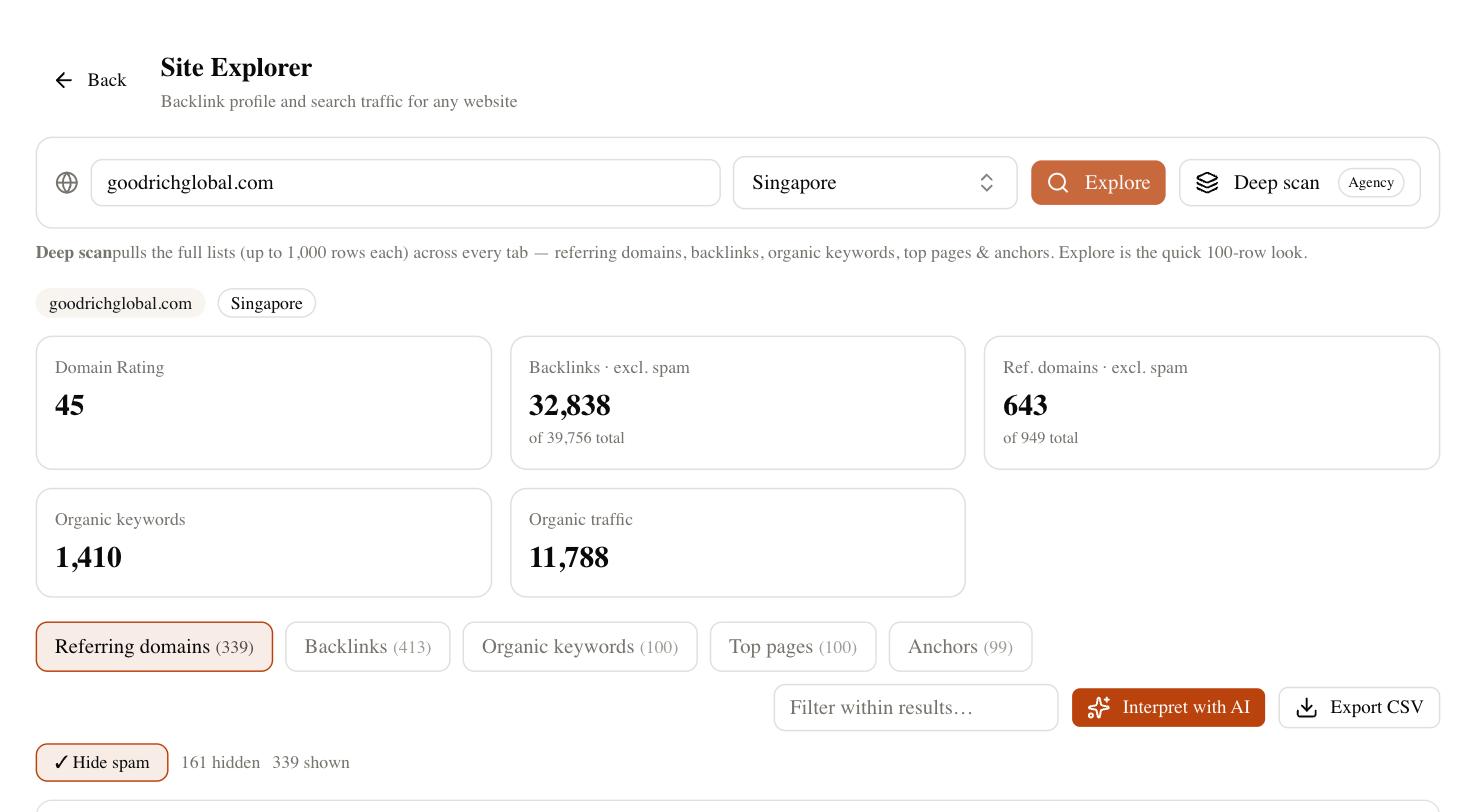
| Backlink analysis | Limited | Yes — full Site Explorer on Ahrefs Enterprise data |
| Technical site audit | No | Yes — plus PageSpeed and free Website Speed Test |
| Rank tracking | No | Yes |
| AI content writer | No | Yes — Claude-powered |
| AI Visibility / GEO tracking | No | Yes — Brand Radar |
| App / industry intelligence | Yes | No |
What you keep, what changes
Be clear-eyed here: if you switch entirely, you lose Similarweb’s core capability — whole-site traffic estimation and channel breakdown — and there is no substitute for that inside SEO Rocket or, frankly, inside most SEO tools. What you gain is a platform actually built to do SEO work: keyword research and rank tracking with a real backlink index behind it, technical audits, content production, and AI-visibility tracking, none of which Similarweb offers. For many teams the honest outcome isn’t “switch,” it’s “keep a lighter Similarweb plan (or drop to their free tier) for competitive traffic checks, and move the SEO execution work to a purpose-built tool.” Only fully drop Similarweb if traffic-channel intelligence was never actually essential to your role.
Step-by-step migration
- Audit what you actually use Similarweb for. Pull the last three months of reports you generated — if they’re mostly organic keyword or competitor SEO checks, you’re a good candidate to move that work. If they’re channel-mix or market-share reports, keep Similarweb for those specifically.
- Export any SEO-relevant data — competitor keyword lists, organic traffic estimates you’ve been tracking — as a baseline reference, even though the underlying data source will differ once you’re on Ahrefs Enterprise data in SEO Rocket.
- Set up your SEO Rocket project at app.seorocket.ai, add your domain, and let the automatic site snapshot run.
- Confirm your target market in project settings.
- Set up rank tracking for the keywords you were manually estimating rankings for in Similarweb, since it has no dedicated rank tracker.
- Connect Search Console and GA4 to get real organic click and conversion data, filling the gap left by Similarweb’s estimate-based traffic numbers.
- Run a technical site audit and content gap analysis — both net-new capabilities you didn’t have in Similarweb.
- Downgrade, rather than cancel, Similarweb if your team still needs occasional traffic-channel or market-share data for reporting to leadership.
Pricing comparison
Prices are approximate as of 2026 and Similarweb in particular is often custom-quoted — confirm current pricing directly with each vendor before deciding.
| Plan tier | Similarweb | SEO Rocket |
|---|---|---|
| Free tier | Yes, very limited data and lookups | Free plan: 1 site, 50 starter credits, $0 |
| Entry paid plan | Not publicly listed — typically requires a sales quote, often four figures monthly for meaningful access | Pro, $49/mo (3 sites, 400 credits/mo) |
| Mid / growth tier | Custom, enterprise-oriented | Growth, $99/mo (10 sites, 1,000 credits/mo) |
| Agency tier | Custom | Agency, $199/mo (25 sites, 2,500 credits/mo) |
| Pricing transparency | Largely opaque, sales-quote based | Published pricing, self-serve signup |
This is the starkest pricing gap in any comparison we’ve written: Similarweb’s real paid tiers are typically enterprise-negotiated and not published, while SEO Rocket’s full range is self-serve and listed publicly. That said, the two tools are not interchangeable — you’re not paying for the same thing.
Who should NOT switch
If your job function is market research, competitive intelligence, investment analysis, or executive reporting on total market traffic and channel mix, do not drop Similarweb — nothing in SEO Rocket, or in most SEO-focused tools, replaces that data. If you regularly use Similarweb’s app-intelligence or audience-overlap features, those are outside SEO Rocket’s scope entirely. And if your organization already has budget allocated and sign-off for Similarweb at the enterprise level, replacing it with a $49–199/month SEO tool is not an apples-to-apples decision your finance team will accept — position SEO Rocket as an addition for execution, not a replacement for market intelligence.
FAQ
Does SEO Rocket estimate total website traffic like Similarweb?
No. SEO Rocket focuses on organic search and AI-search visibility, not whole-site traffic across all channels. For channel-level traffic estimation, Similarweb remains the stronger tool.
Can I use both tools together?
Yes, and for many teams that’s the right answer — Similarweb for market and competitor traffic intelligence, SEO Rocket for keyword research, technical audits, rank tracking, content production, and AI-visibility tracking.
Why doesn’t Similarweb have published pricing?
Similarweb sells to a wide range of buyers, from marketers to investment analysts, and typically prices based on data volume and use case, which pushes most real accounts into custom sales quotes rather than fixed public tiers.
Is Ahrefs Enterprise data comparable to Similarweb’s organic estimates?
They measure different things — Ahrefs Enterprise data (which powers SEO Rocket) is built specifically around search — keywords, rankings, and backlinks — while Similarweb’s estimates model total site traffic across all channels using a broader, different methodology. Neither is a strict substitute for the other.
If your work is mostly SEO execution rather than market research, you can try SEO Rocket free at app.seorocket.ai and judge for yourself whether it covers what you actually use Similarweb for.