
Anyone who has managed a website for more than a few years has felt the effects of Google algorithm updates — a sudden ranking drop, a mysterious traffic surge, or an SEO forum suddenly buzzing about “another update rolling out.” Google changes its search ranking systems constantly, but a handful of updates were significant enough to earn public names, reshape how entire industries approached SEO, and leave a lasting mark on best practice. This guide walks through that history in order, explains what each major update actually targeted, and — because history is only useful if it changes what you do next — outlines how to align a site with durable, white-hat practices rather than chasing the next update.
Why Google updates its algorithm at all
Google’s search ranking systems are not a single fixed formula; they are a large, interconnected set of systems that get refined continuously to better match search intent, reward genuinely useful content, and push back against manipulation. Most of these refinements are small and unannounced — Google runs thousands of ranking-related changes in a typical year. The updates covered here are the exceptions: changes large enough, or disruptive enough, that Google either confirmed them directly or the SEO community observed and named them because the impact was too widespread to ignore. Some were built to catch a specific type of manipulation (like spammy links). Others were fundamental upgrades to how Google understands language and intent. Knowing the difference matters, because the right response to each is different.
The major named updates: a timeline
The table below lists the most significant updates in roughly chronological order, what each was aimed at, and its current status. Dates are approximate to the year (and month where widely documented) rather than exact release dates, since Google’s own confirmed rollout windows sometimes span days or weeks.
| Update | Year | What it targeted | Status today |
|---|---|---|---|
| Panda | Feb 2011 | Thin, low-quality, and duplicate content; content farms | Folded into the core ranking algorithm |
| Penguin | Apr 2012 | Manipulative link schemes and over-optimized anchor text | Real-time and part of core since Penguin 4.0 (2016) |
| Hummingbird | Aug/Sep 2013 | Semantic search and query intent (a core algorithm rewrite, not a penalty) | Foundational to how Google still parses queries |
| Pigeon | 2014 | Local search relevance, tying local results more closely to core ranking signals | Ongoing influence on local/map pack results |
| RankBrain | 2015 | Machine-learning system to interpret ambiguous or novel queries | Still an active part of Google’s ranking systems |
| Possum | 2016 | Local pack filtering based on business address/proximity, reducing duplicate-looking local results | Ongoing influence on local search |
| Fred | 2017 | Community nickname for a series of updates targeting ad-heavy, low-value content sites monetized over user value | Principles absorbed into ongoing quality systems |
| Medic | Aug 2018 | Broad core update that heavily affected health, wellness, and other YMYL (Your Money or Your Life) sites; raised the bar on E-E-A-T | Precedent for how core updates treat YMYL content |
| BERT | 2019 | Natural-language understanding model for parsing nuance and context in queries | Still part of Google’s language-understanding stack |
| Page Experience | 2021 | Core Web Vitals, mobile-friendliness, HTTPS, and other user-experience signals | Ongoing ranking signal, less decisive than initially feared |
| MUM | 2021 | Multitask Unified Model — more powerful multimodal and multilingual query understanding | Underpins later AI-driven search features |
| Helpful Content | 2022 | Content created primarily to rank rather than to genuinely help readers | Merged into Google’s core ranking systems in 2024 |
| Ongoing core & spam updates | Continuous | Broad quality reassessments and spam-fighting refinements, several times a year | Active and ongoing |
A recurring pattern is visible in the “status” column: many of these named updates were never permanent, standalone systems. Google frequently starts with a targeted update, refines it over subsequent releases, and eventually folds its logic into the broader core algorithm. That’s worth remembering the next time a new named update appears — it’s rarely a one-off event, and it’s rarely fully separate from everything that came before it.
The content-quality era: Panda and the Helpful Content update
Panda, in February 2011, was Google’s first major public strike against low-quality content at scale — thin pages, duplicated or scraped text, and “content farms” producing high volumes of shallow articles purely to capture search traffic. Sites affected by Panda often had thousands of near-identical, low-value pages. Roughly a decade later, the Helpful Content update (2022) tackled a more modern version of the same problem: content written primarily to satisfy search engines and ad revenue rather than genuine reader needs, even when it was well-written and not technically “thin.” Both updates share the same underlying message — content built for algorithms first and people second is a long-term liability, not a shortcut.
The link-integrity era: Penguin
Penguin launched in April 2012 to address a different problem: link manipulation. Through the 2000s, buying links, joining link farms, and stuffing anchor text with exact-match keywords was a common way to inflate rankings artificially. Penguin devalued or penalized sites with unnatural link profiles, and its earlier versions were notorious for being slow to update — a site could be stuck in “Penguin penalty” limbo for months awaiting a refresh. Since Penguin 4.0 in 2016, it runs in real time as part of the core algorithm, meaning link cleanup and recovery can reflect in rankings much faster than in the earlier penalty-cycle era.
The understanding era: Hummingbird, RankBrain, BERT, and MUM
A separate lineage of updates wasn’t about penalizing bad actors at all — it was about Google getting fundamentally better at understanding language. Hummingbird (2013) rewrote the core algorithm to interpret the meaning and intent behind a query rather than just matching individual keywords, laying groundwork for conversational and long-tail search. RankBrain (2015) added machine learning to help interpret queries Google hadn’t seen before. BERT (2019) improved understanding of nuance, context, and the relationships between words in a sentence. MUM (2021) pushed further into multimodal, multilingual understanding. None of these were penalties — sites didn’t “recover” from them the way they recovered from Panda or Penguin. They simply raised the bar for how precisely content needed to match genuine search intent to be found at all.
The local and experience-focused updates
Not every major update was global in scope. Pigeon (2014) tied local search results more closely to standard web ranking signals, and Possum (2016) refined how Google filtered and diversified local pack results based on business location. On the user-experience side, the Page Experience update (2021) formally introduced Core Web Vitals, mobile-friendliness, HTTPS, and freedom from intrusive interstitials as confirmed ranking signals — though in practice, strong content has consistently outweighed marginal page-experience gains. Fred, an unofficial community name for a 2017 wave of updates, hit sites that prioritized ad revenue and affiliate monetization over genuine user value, echoing themes that later matured into the Helpful Content update.
How to align with Google’s algorithm long-term
Trying to reverse-engineer each individual update is a losing game — Google runs broad core updates several times a year, plus continuous smaller refinements, and doesn’t publish exact mechanics. A more durable strategy is to align with the principles every major update has reinforced:
- Write for people first. Content should genuinely answer the query, demonstrate real expertise or experience, and hold up whether or not an algorithm is watching.
- Earn links, don’t manufacture them. A backlink profile built from genuine relationships and citation-worthy content survives every Penguin-style refresh; a purchased or farmed one doesn’t.
- Keep technical health solid. Crawlability, mobile usability, and reasonable page speed remove friction that can undercut otherwise good content.
- Match content to real search intent, not just keyword frequency — this is what Hummingbird, RankBrain, and BERT were all pushing sites toward.
- Treat E-E-A-T seriously, especially on YMYL topics like health, finance, or legal advice, where Google’s quality bar is highest.
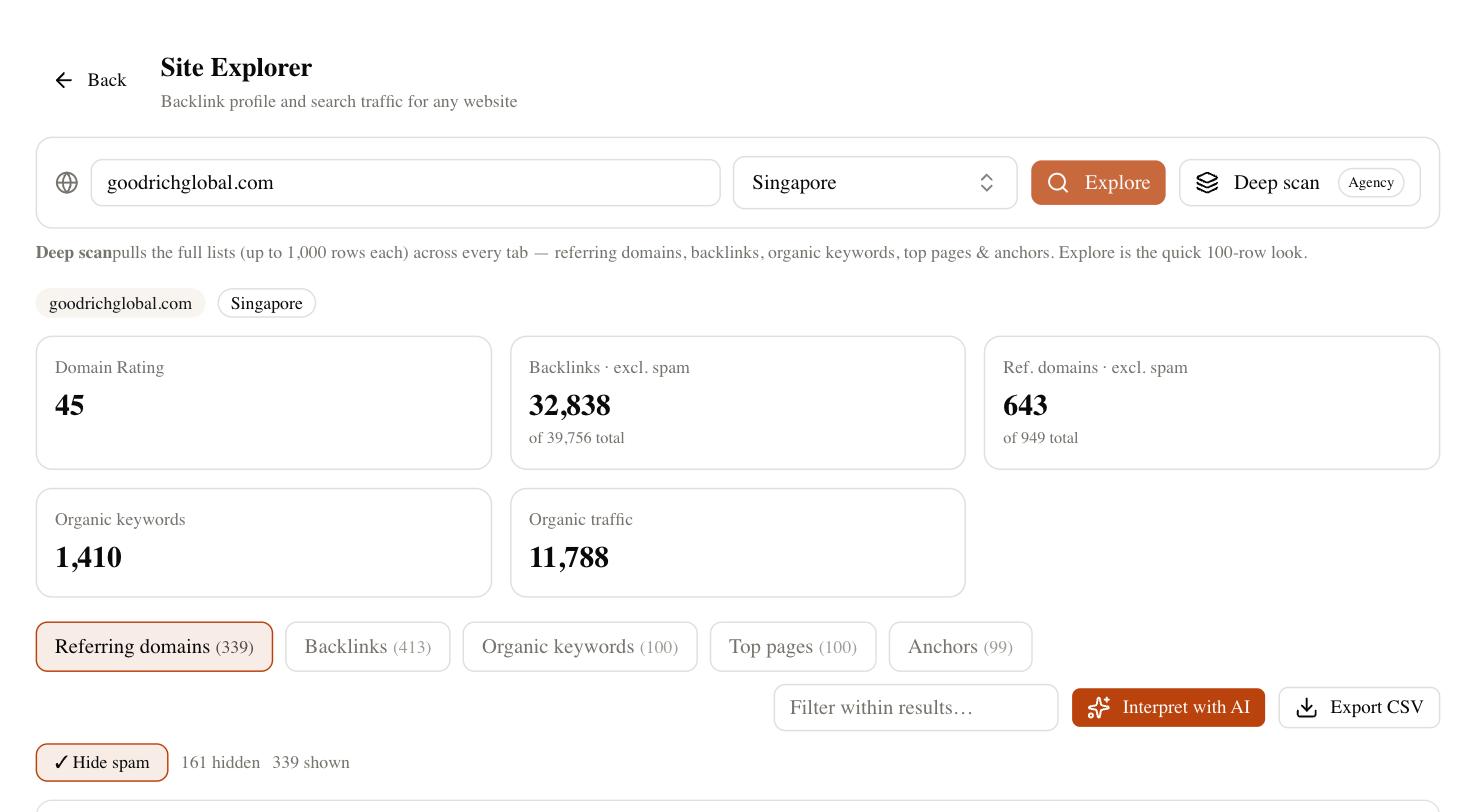
Auditing a site against all of this manually is slow, and it’s easy to miss a technical issue or a spammy backlink hiding in a large link profile. This is where a tool like SEO Rocket can help — its chat-first workflow runs site audits, content-quality checks, and backlink analysis with spam classification in one place, so alignment with these principles is something you can verify continuously rather than guess at after a ranking drop. A free plan is available, with paid plans starting from $49/month for teams that want deeper, ongoing monitoring.
What this history tells us about the next update
The clearest lesson from more than a decade of named Google algorithm updates is that the target keeps narrowing toward the same idea: is this genuinely useful, trustworthy, and well-matched to what the person searching actually wants? Sites that treated any single update as a one-time hurdle to clear often got caught again by the next one. Sites that treated the pattern — quality content, earned authority, technical soundness, real intent-matching — as an ongoing discipline have tended to weather each new update with far less disruption. That’s the real takeaway: the specific update names will keep changing, but the underlying direction of travel has been remarkably consistent since Panda first launched in 2011.