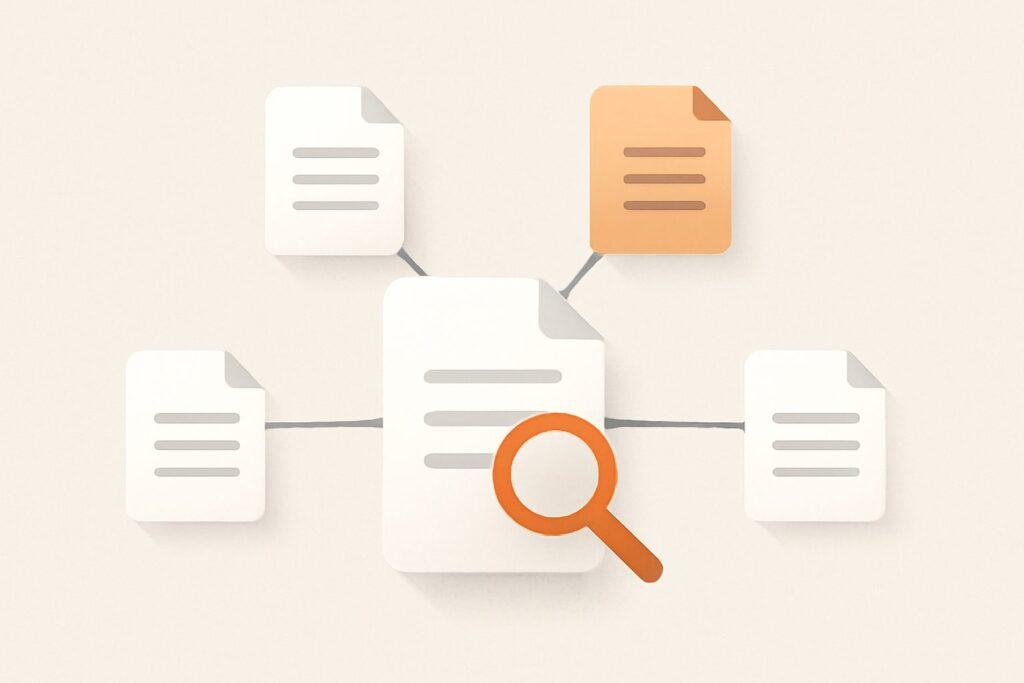
Most guides show you a content cluster example as a tidy hub-and-spoke diagram and stop there — a pillar in the middle, spokes radiating out, arrows everywhere. That picture is not wrong, but it teaches the shape while hiding the mechanism, and the shape is the easy part. The reason clusters work has almost nothing to do with the diagram and everything to do with how internal links move authority and how Google reads a group of pages as evidence that you know a subject. Copy the diagram and you get a folder of thin posts that never rank. Copy the mechanism and you get compounding topical authority. This is a worked example of the second kind.
What a Content Cluster Actually Is
A content cluster is one broad pillar page that targets a competitive head term, a set of supporting posts that each answer one specific long-tail question inside that topic, and a deliberate web of internal links connecting them. The pillar earns the links and the rankings for the money keyword; the supporting posts rank for the long tail and pass relevance and authority back up to the pillar. Done right, the whole group ranks better than the sum of its pages would in isolation. That last clause is the entire point — and it’s why a random content cluster example you find online often fails to reproduce: the pages exist, but the linking and the topical coverage don’t do any work.
The Worked Example: A Beginner Marathon Site
Let’s build a real one. Imagine a running blog trying to rank for “marathon training plan for beginners” — a term with genuine volume, commercial adjacency (shoes, coaching, gels), and brutal competition from established running publishers. A single 2,000-word post won’t touch page one against sites with years of topical history. A cluster can, over time, because it lets you compete on the long tail first and consolidate authority upward.
Here is the map for this content cluster example:
- Pillar: /marathon-training-plan-for-beginners/ — a comprehensive guide to the whole journey, structured so each major section can hand off to a deeper post.
- Cluster post: /how-many-miles-before-a-marathon/ — answers a precise long-tail query with a clear number-led answer.
- Cluster post: /what-to-eat-before-a-long-run/ — fueling, a sub-question every beginner searches.
- Cluster post: /how-to-prevent-runners-knee/ — injury prevention, high intent, low competition.
- Cluster post: /couch-to-marathon-timeline/ — the “how long will this take” question.
- Cluster post: /best-beginner-running-shoes/ — the commercial spoke that monetizes the traffic.
Six pages, one topic, one intent spine. That’s a cluster you can actually build in a month, not a 40-post content plan you’ll abandon in week two.
Choosing a Pillar That Can Hold a Cluster
The pillar topic has to pass one test: does it generate at least eight to ten genuine sub-questions that real people search? “Marathon training plan for beginners” does — pace, mileage, fueling, injury, gear, timeline, recovery, race day. If a topic only spawns two or three real sub-queries, it’s a supporting post itself, not a pillar. This is the most common failure I see: someone picks a pillar that’s actually a long-tail term, then invents filler spokes to fill the diagram. The filler posts have no search demand, so they never rank, so they never pass authority, so the cluster collapses.
The way to validate this before you write a word is to pull the real “questions” and “matching terms” reports for your seed keyword and count how many have non-trivial volume. This is where SEO Rocket‘s AI keyword research earns its keep — it runs your seed against live Ahrefs data and returns 100–150 keyword ideas segmented by volume, difficulty, and intent, so you can see the sub-question landscape as data rather than guessing which spokes are real.
Mapping the Supporting Posts to Search Intent
Each spoke should own exactly one query and its close variants — no more. The moment two posts target the same intent, they start competing with each other in the index, and Google may bounce between them or rank neither well. In our marathon content cluster example, “how many miles before a marathon” and “how long should my longest run be” are the same intent; they must be one post, not two. “What to eat before a long run” and “best marathon race-day nutrition” are different enough (training vs. race day) to justify separate pages.
Draw the intent line before you draw the link line. A useful rule: if you’d answer two queries with substantially the same paragraphs, merge them. If a searcher would be annoyed to land on the same page for both, split them.
Wiring the Internal Links (The Part That Does the Work)
Links are where a cluster stops being a folder and becomes a ranking system. Two directions matter, and both must exist:
- Pillar → spoke: The pillar’s mileage section links out to /how-many-miles-before-a-marathon/ with descriptive anchor text like “how many miles to run before race day,” not “click here.” This tells Google the linked page is the authoritative deep-dive on that sub-topic.
- Spoke → pillar: Every supporting post links back up to the pillar, usually in the intro or a “part of our complete beginner marathon guide” line, using the pillar’s target phrase as anchor. This is the flow that consolidates authority on the money keyword.
- Spoke ↔ spoke: Related spokes link to each other where it genuinely helps the reader — the fueling post links to the injury post if under-fueling causes injury. Don’t force it; forced sibling links dilute rather than concentrate relevance.
The mechanism underneath is straightforward. Internal links pass a share of a page’s authority (the PageRank inheritance everyone forgets applies internally too) and, just as important, they pass topical context: the anchor text and surrounding words tell Google what the destination is about. A cluster wired this way makes every page a little witness for every other page. That’s how a young site earns “topical authority” without waiting years for external links to accumulate.
Why the Model Ranks: The Mechanism, Not the Magic
Three forces combine. First, coverage: when your site answers the head term and the eight questions orbiting it, Google’s systems see comprehensive treatment of the topic, which correlates with the helpfulness signals its 2023–2024 systems reward. Second, link consolidation: the spokes rank for low-competition long-tail terms quickly (often within weeks on a healthy site), start attracting a trickle of external links and engagement, and channel that equity up to the pillar. Third, internal relevance: the descriptive anchors create a dense semantic map that helps Google understand and rank the pillar for its hard head term. None of this is a trick Google is trying to catch — it’s the structure Google is explicitly trying to reward.
Cluster Sizing: When to Stop, When to Split
Here’s a decision rule most guides skip. Start a cluster at five to eight spokes — enough to demonstrate depth, small enough to finish. Add spokes only when keyword research surfaces a real sub-question you haven’t covered. Two signals tell you a pillar has outgrown itself and should split into two pillars:
- Your spokes start splitting into two distinct intents that barely link to each other — e.g., “marathon training” spokes and “marathon nutrition” spokes forming separate islands. That’s two clusters wearing one coat.
- The pillar page balloons past what one URL can coherently cover, forcing you to link out for basic points. When the pillar can’t summarize a sub-topic in a paragraph before handing off, that sub-topic wants its own mini-pillar.
Bigger is not better. A focused six-post cluster with tight linking outranks a sprawling thirty-post “topic hub” where half the pages target invented queries and the link graph is a hairball.
The Honest Caveats Nobody Puts in the Diagram
Clusters are not free wins, and pretending otherwise wastes months. The real trade-offs:
- Keyword cannibalization is the number-one way clusters backfire. Overlapping spokes compete, and you end up with two page-twos instead of one page-one. Audit intent overlap ruthlessly before publishing.
- Timeline is slow. Expect long-tail spokes to rank in weeks to a couple of months, and the pillar to climb over three to six months as the internal equity matures and a few external links land. Anyone promising the pillar ranks in “30 days” is selling something.
- Thin spokes drag the whole cluster down. If a supporting post is a 400-word afterthought published to fill the diagram, it can transmit “low quality” signals upward as easily as authority. Every spoke has to earn its own rankings.
- Internal links don’t rescue bad content. The wiring concentrates authority; it doesn’t manufacture it. A cluster of pages that each lose to the weakest page-one competitor will lose as a group too.
Turning the Example Into a Repeatable Workflow
The marathon build generalizes to any niche as a five-step loop. First, validate the pillar by counting real sub-questions in keyword data — not by intuition. Second, assign one intent per spoke and kill overlaps before they exist. Third, draft each page to beat the actual weakest competitor on page one for its target query, not an imagined ideal. Fourth, wire the bidirectional links with descriptive anchors as you publish, not as a cleanup task six months later. Fifth, track the whole cluster’s movement together, because a cluster is a system and single-page spot checks lie.
This is the loop SEO Rocket was built to run end to end: keyword research to find the pillar and its real spokes, competitor and content-gap analysis to see which sub-topics rivals rank for that you don’t, a validation-gated AI writer so no spoke ships thin, and rank tracking plus AI-visibility monitoring to watch the pillar climb as the spokes mature. It’s the same playbook proven across 1,000,000+ ranking pages — clusters built for the mechanism, not the diagram, priced around $50/month with a free tier to start.
Frequently Asked Questions
How many posts should a content cluster have?
Start with five to eight supporting posts around one pillar — enough to signal genuine depth, few enough to actually finish and link well. Add spokes only when keyword research surfaces a real, searched sub-question you haven’t covered. A tight, fully-linked cluster of six beats a sprawling, half-wired cluster of thirty every time.
What’s the difference between a pillar page and a cluster post?
The pillar targets the broad, competitive head term and summarizes the whole topic, handing off to deeper pages. Each cluster post targets one specific long-tail query in depth and links back to the pillar. The pillar is the destination; the spokes are the roads that feed it authority and relevance.
How long does a content cluster take to rank?
Long-tail cluster posts often reach page one in weeks to a couple of months on a healthy site. The pillar’s competitive head term usually takes three to six months as internal link equity consolidates and a few external links arrive. Clusters compound slowly, then hold.
Can internal links alone make a cluster rank?
No. Internal linking concentrates and directs authority, but it can’t create quality that isn’t there. If each page still loses to the weakest page-one competitor, the cluster loses as a group. Wire the links, but win on content first.