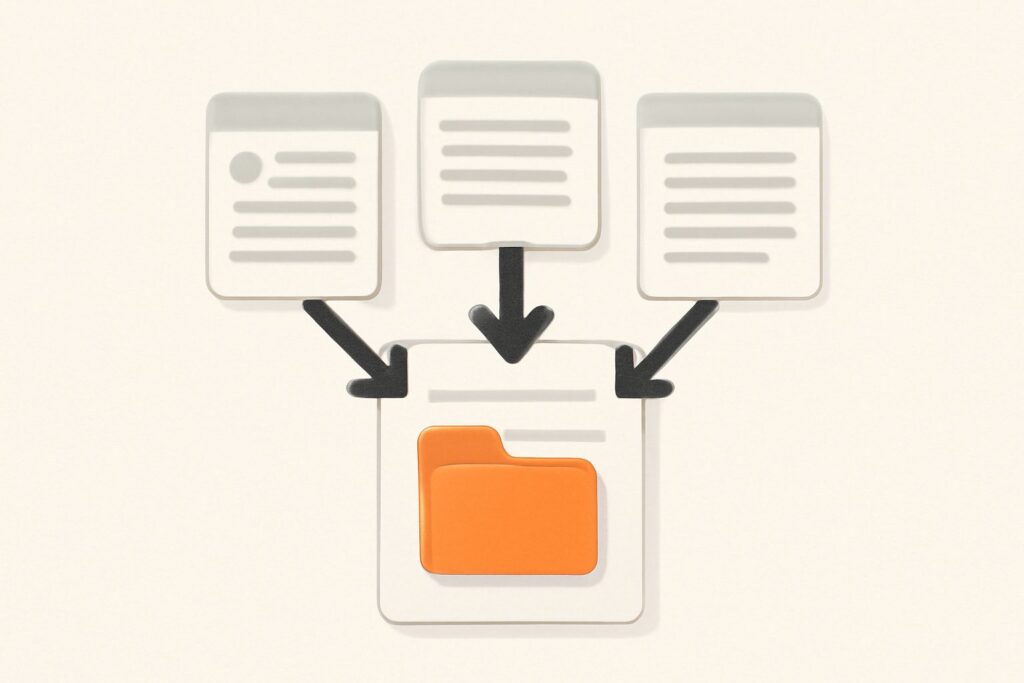
Most sites don’t have a content problem — they have a fragmentation problem. Five thin blog posts each half-covering the same topic, competing with each other for the same query, splitting the links and the authority three ways. Content consolidation is the fix: you merge those overlapping pages into one page that’s genuinely better than any of them, then redirect the rest into it. Done properly it isn’t a cleanup chore — it’s one of the highest-leverage moves in SEO, because you’re not creating anything new. You’re concentrating value you already earned but scattered too thin to rank.
What Content Consolidation Actually Is
Content consolidation means combining two or more pages that target the same or heavily overlapping intent into a single stronger page, and 301-redirecting the retired URLs into the survivor. The point isn’t to delete words — it’s to stop making Google choose between near-duplicate pages, and to pool the ranking signals those pages accumulated separately.
It is different from a refresh (updating one page in place) and different from pruning (removing dead weight with no salvageable value). Consolidation applies when you have multiple pages that each have some equity — a few links, a bit of traffic, a partial ranking — but none is authoritative enough to win alone. Merging content lets the strongest version absorb the rest.
Why Merging Pages Works: The Mechanism
Three things happen when you consolidate pages seo teams have let sprawl, and understanding them is what separates a deliberate move from a hopeful one.
- Link equity concentrates. If three URLs each earned a handful of backlinks, a 301 redirect passes that equity to one destination. One page with the combined links outranks three pages splitting them almost every time.
- Cannibalization resolves. When multiple pages target one query, Google rotates which one it shows, and none builds sustained authority for the term. Collapse them into one and you give the algorithm a single, obvious answer to rank.
- Site-wide quality signals improve. Google’s helpful-content assessment looks at the whole site. A pile of thin, overlapping pages drags the average down. Fewer, deeper pages lift it — which can help URLs you never touched.
That third effect is the one most guides miss. Consolidation isn’t only about the merged page ranking better; it’s about removing the thin-content ballast that quietly suppresses everything else.
The Signal You’re Hunting: Keyword Cannibalization
The clearest trigger for content consolidation is keyword cannibalization — two or more of your own URLs ranking for the same query and trading places. You’ll see it as a page that flickers between position 8 and position 15 week to week, or a search query in your analytics that maps to three different landing pages. Neither page commits to the term because Google keeps splitting the credit.
You can spot this in Search Console by filtering a query and checking how many of your URLs appear for it, or with rank tracking that flags multiple ranking URLs per keyword. SEO Rocket’s rank tracking surfaces exactly this — when it shows two of your pages orbiting the same keyword, that’s a consolidation candidate, not a content-gap to fill with a fourth post.
When to Consolidate — and When Not To
Not every overlap should be merged. Use a decision rule instead of instinct. Consolidate when all of these hold:
- Two or more pages serve the same search intent (informational vs commercial matters — a “what is X” guide and a “buy X” page should stay separate even if they share a keyword).
- The pages compete for overlapping queries or you can see cannibalization in the data.
- At least one page has salvageable equity (links, rankings in the top 50, or steady traffic) worth preserving via redirect.
- A merged page would genuinely be more useful than any single existing one — deeper, more complete, better structured.
Do not consolidate when the pages serve distinct intents, target different funnel stages, or rank well independently for different terms. Forcing distinct topics together produces an unfocused mega-page that ranks for nothing. Consolidation concentrates relevance; dilution destroys it. When in doubt, ask whether a searcher who wanted page A would be satisfied landing on the merged page. If yes, merge. If no, keep them apart.
How to Run a Consolidation Audit
Before you merge anything, inventory what you have. A structured audit prevents you from redirecting a page that was quietly your best performer.
- Crawl the site and export every URL with its title, word count, and internal-link count. A real-crawler site audit — the kind SEO Rocket runs — flags thin, duplicate, and orphan pages that are prime consolidation targets.
- Pull performance for each URL: sessions, top queries, ranking positions, backlinks, conversions over the last 6–12 months.
- Cluster by intent. Group URLs that answer the same question. These clusters are your candidate merges.
- Pick the canonical page in each cluster — usually the one with the most links or the best existing ranking, not necessarily the longest.
The output is a simple map: which URLs die, which one survives, and what each dying page contributes to the survivor.
The Merge Itself, Step by Step
Merging content is editorial work, not a copy-paste job. The goal is one coherent page, not a Frankenstein of stitched sections.
- Choose the survivor URL. Keep the strongest one; retire the rest.
- Harvest the best material from the pages you’re retiring — unique examples, data, sections, angles the survivor lacks.
- Rewrite into one flow. Integrate that material so the page reads as a single argument. Cut genuine duplication; keep genuine additions.
- Improve on all originals. The merged page should clear a higher bar than any input — that’s the information gain Google’s systems reward.
- 301-redirect every retired URL to the survivor.
- Update internal links that pointed at the old URLs so they point directly at the survivor.
Redirects, Canonicals, and Internal Links: The Plumbing
The technical layer is where consolidations leak value if you’re sloppy. Use a 301 (permanent) redirect, not a 302, so link equity transfers fully. Redirect each retired URL directly to the survivor — never chain redirects through intermediate URLs, which bleeds equity at each hop.
Update every internal link that referenced the old pages; relying on the redirect to catch them wastes crawl budget and dilutes the signal. Remove the retired URLs from your sitemap and let the survivor stay. A canonical tag is a hint, not an order — for true consolidation you want the redirect, which is a directive Google must honor, plus you reclaim the crawl budget the duplicates were burning.
A Worked Example
Say a marketing blog has four posts: “Email Subject Line Tips,” “Best Email Subject Lines,” “How to Write Subject Lines,” and “Subject Line Examples.” Each gets a trickle of traffic, each ranks somewhere between position 9 and 20 for “email subject lines,” and Search Console shows all four surfacing for the same core query on different days — textbook cannibalization.
The audit shows post two has the most backlinks; it becomes the survivor. You harvest the examples from post four, the how-to framework from post three, and the quick-tips list from post one, then rewrite everything into one definitive guide with a clear structure and the combined examples. The other three 301-redirect into it, internal links get repointed, and the retired URLs leave the sitemap. Within a couple of months the single page tends to settle several positions higher than any original held — because Google finally has one page to rank instead of four to arbitrate. (Illustrative ranges, not a guaranteed result; outcomes depend on competition and link profile.)
Consolidation vs Pruning vs Refresh
These three cleanup moves get conflated, and picking the wrong one wastes effort. Refresh a page when it’s the right page but the content has decayed — update it in place. Prune a page when it has no salvageable value: negligible sessions, no rankings in the top 50, no links, no conversions, and no stronger sibling to merge into — redirect or remove it. Consolidate when several pages each hold partial value and would be stronger as one. The decision hinges on how much equity exists and whether a better home for it exists elsewhere on the site.
Scaling Consolidation Without Losing Quality
On a large site the temptation is to batch-merge by keyword overlap alone. Resist it. The intent check is non-negotiable, and every merged page still needs the editorial rewrite that produces real information gain — a mechanically stitched page fails the quality test the whole exercise is meant to pass. Where AI helps is in the discovery layer: finding the clusters, the cannibalization, and the thin pages at scale. SEO Rocket’s site audit and rank tracking do that grunt work, and its validation-gated writer holds the rebuilt pages to a real floor — minimum length, enforced title and meta limits, required section count, and a repair loop — but the editorial judgment of what to merge, and the human pass on the result, stays with you. This is the same playbook proven across 1,000,000+ ranking pages: concentrate value, then make the survivor genuinely deserve to rank.
How Long Results Take
Consolidation is not instant. Google needs to recrawl the redirects, drop the retired URLs, and reassess the survivor — typically a few weeks to a couple of months before rankings stabilize. Expect a brief dip as the dust settles; that’s normal, not a sign you erred. Track the survivor’s position for the target cluster and watch that the retired URLs fall out of the index. If a merged page underperforms after two to three months, the usual culprit is a bad intent match — you merged pages that should have stayed separate.
Frequently Asked Questions
Does content consolidation hurt rankings?
Not when done correctly. You may see a short dip while Google recrawls and reassesses, but a well-merged page with 301s in place typically ends up ranking higher than any of the originals. Rankings suffer only if you merge pages with mismatched intent or forget to redirect.
Should I use a redirect or a canonical tag?
For true consolidation, use a 301 redirect. It’s a directive that transfers link equity and removes the duplicate from the index. A canonical is only a hint and leaves the old URL live — useful for parameter duplicates, not for retiring content you’re merging away.
How many pages should I merge into one?
There’s no fixed number — merge as many as genuinely share intent. Two thin posts or six near-duplicates can all collapse into one, as long as the result reads as a single focused page and doesn’t become an unfocused catch-all trying to rank for everything.
What if both pages rank well already?
Then don’t consolidate. If two pages each rank strongly for different queries, they’re serving distinct intents and merging them risks losing both positions. Consolidation is for splitting equity, not for combining winners.