
Doorway pages are pages created specifically to rank for narrow search terms — usually city names, service variations, or slight keyword permutations — that funnel every visitor toward the same destination, offer, or handful of pages regardless of which “doorway” they entered through. A landscaping company might spin up “landscaping-in-austin,” “landscaping-in-dallas,” and “landscaping-in-houston” pages that are 90% identical templates with the city name swapped in, all pointing to the same contact form. The idea has been around since the earliest days of local SEO, and it still gets pitched today by agencies promising fast rankings across dozens of city or service pages. This guide covers why the tactic is tempting, why Google built an entire algorithm update specifically to filter it out, and what actually works for ranking across multiple locations or services.
What Counts as a Doorway Page
Google’s own definition is specific: doorway pages are pages, or sets of pages, built to rank for specific, similar search queries, where multiple similar pages funnel users to the same end destination and none of them individually adds unique value. The telltale signs are a template swapped only by city, ZIP code, or service keyword; content that reads identically across pages except for the location name; and a site structure where dozens or hundreds of these near-duplicate pages exist purely to capture long-tail search volume rather than to serve a distinct audience need. It’s worth noting this is different from a legitimate multi-location business page — a real local page for a business with an actual office, staff, and service area in that city is not a doorway page, even if it shares a template with other location pages, as long as it reflects genuinely distinct information.
Why the Tactic Is Tempting
Doorway pages scale fast. Instead of doing the harder work of building genuine authority in each market, an agency or in-house team can generate a template, run a find-and-replace on the city name, and publish fifty pages in an afternoon. For local service businesses — plumbers, lawyers, movers, contractors — the promise is compelling: rank in every city you’d theoretically serve, without having to write fifty genuinely different pages of content. Early on, this worked reasonably well because Google’s algorithms weren’t sophisticated enough to distinguish templated near-duplicates from genuinely useful local pages. That gap has closed substantially.
How Google Treats Doorway Pages Today
Google has run specific algorithm updates targeting doorway pages since at least 2015, and the practice is explicitly named in Google’s spam policies as a violation that can result in manual action. The detection isn’t subtle: Google’s systems compare content similarity across a site’s own pages, and when dozens of URLs differ only by a swapped city name or keyword with everything else — headings, body copy, structure, even the local “testimonials” — identical, that pattern is easy to flag programmatically, without needing a human reviewer to look at every page individually. When a manual action for doorway pages hits, it typically doesn’t target one URL; it targets the entire pattern, which can mean losing rankings across every page in the set simultaneously, not just the worst offenders.
The Real Cost, Beyond the Penalty
Even setting the penalty risk aside, doorway pages tend to underperform on their own terms. Because the content is thin and interchangeable, these pages rarely earn backlinks, rarely get shared, and rarely rank well for anything beyond the exact long-tail phrase they were built for — competitive local terms still go to sites with genuine depth. They also dilute a site’s overall quality signals: when a large share of a domain’s pages are near-duplicates with almost no unique content, that can drag down how Google evaluates the rest of the site too, a phenomenon sometimes described informally as “site-wide quality dilution.” The pages become a maintenance burden as well — someone has to keep fifty near-identical templates updated, and stale, thin duplicates are exactly the kind of content that erodes user trust when a visitor notices the same three paragraphs on every city page.
| Doorway pages (the shortcut) | Genuine local/topic pages (the durable approach) | |
|---|---|---|
| Content per page | Templated, near-identical, city name swapped | Unique details: local service area, pricing nuance, real testimonials, local landmarks or context |
| Ranking durability | Vulnerable to doorway-specific algorithm filtering | Resilient — reflects genuine topical and local relevance |
| Link and share potential | Near zero — nothing distinct to link to | Real — unique pages attract natural links and local citations |
| User experience on arrival | Generic, funnels everyone to the same form | Tailored to the specific search intent that brought the visitor |
| Effort required | Low upfront, but high long-term risk | Higher upfront, but compounds in value over time |
The Honest Verdict
Doorway pages might produce a short-lived bump in impressions right after publishing, especially for very low-competition long-tail city terms where almost nothing else is competing. But that bump rarely survives a content-quality algorithm update, and when it goes, it tends to go all at once across the whole set rather than page by page — which makes it a poor foundation to build a local SEO strategy on. If you’re a genuinely multi-location business, the instinct behind doorway pages (rank in every city you serve) is completely correct; it’s the execution — templated near-duplication — that’s the problem, not the goal.
What to Build Instead
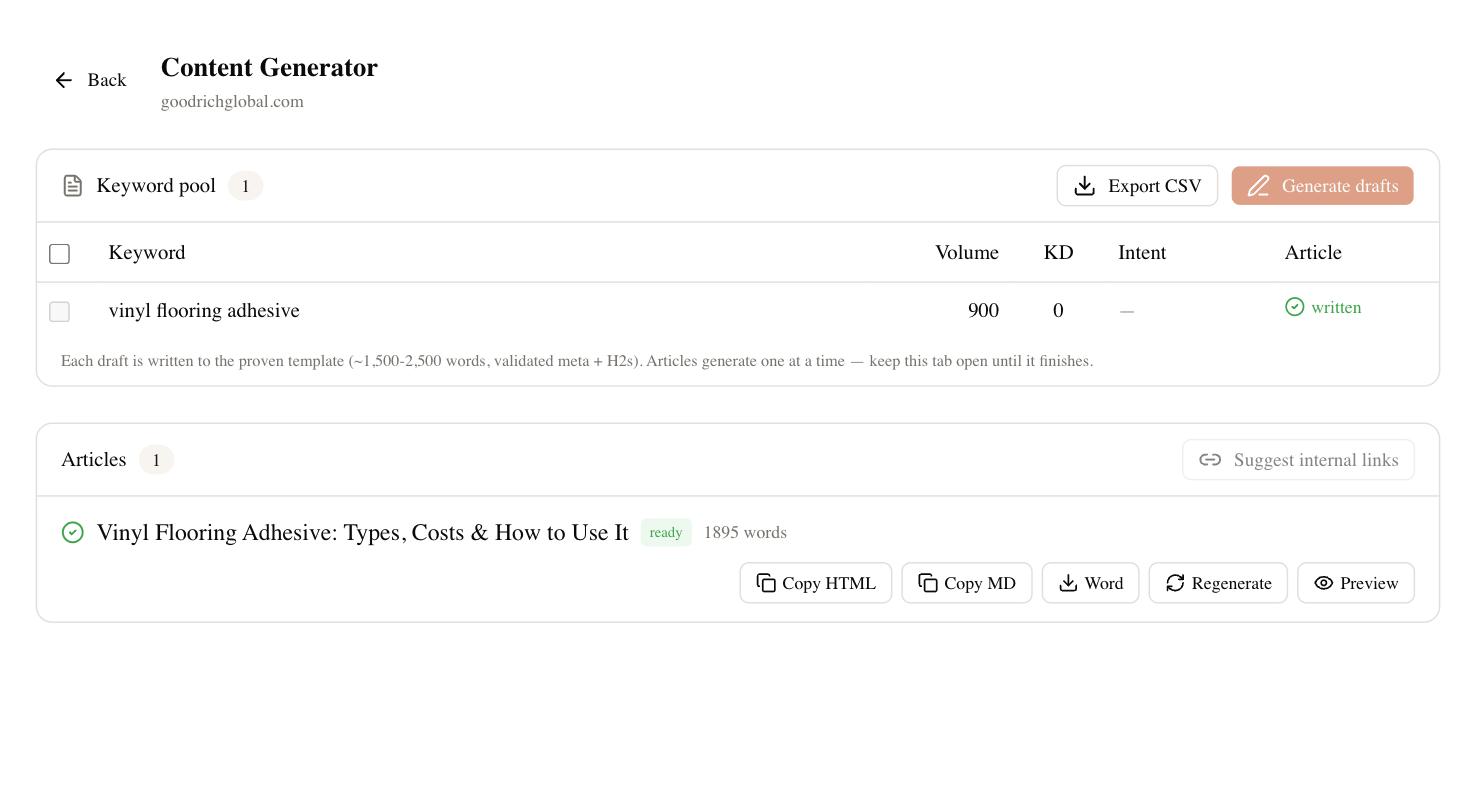
The durable version of “rank in every city” is a set of genuinely distinct local or service pages, each answering a real, different question a searcher in that specific context would have. That means real local detail — actual service area boundaries, pricing that reflects regional differences, photos or case studies from that specific location, staff or team members who work there, and FAQ content that addresses location-specific concerns rather than generic boilerplate. It’s more work per page, but it’s work that compounds: a genuinely useful local page can earn its own backlinks, its own reviews, and its own organic growth over time, instead of depending entirely on a template surviving the next algorithm update. If the constraint is genuinely time and resources rather than willingness, tools like SEO Rocket’s Content Generator can help produce original, SEO-validated content for each location or service variation faster than writing from scratch — while a Content Gap analysis against local competitors surfaces which topics and questions are actually worth covering per market, rather than guessing at a template and hoping it’s differentiated enough.
How to Audit Your Own Site for Doorway-Page Risk
If you already have a set of location or service pages and you’re not sure whether they cross the line, run a simple content-similarity check: strip out the city or keyword name from three or four of your pages and compare what’s left. If the remaining content is word-for-word identical or close to it, you have a doorway-page pattern, regardless of intent. The fix isn’t necessarily deleting the pages — it’s adding genuine, page-specific substance until each one earns its place on its own, distinct merits rather than existing purely as a keyword-matching wrapper around the same core page.
Frequently Asked Questions
Are location pages for a real multi-location business automatically doorway pages?
No. A real business with genuine operations in each city can have distinct local pages without any penalty risk, as long as each page reflects real, differentiated information rather than a template with the name swapped.
Can doorway pages hurt rankings on the rest of my site?
They can contribute to a broader quality-perception problem if they make up a large share of your indexed pages, since Google’s quality evaluation isn’t purely page-by-page.
How many near-duplicate pages does it take to trigger a problem?
There’s no official threshold — it’s about pattern and proportion, not a specific count. A handful of thin, templated pages on an otherwise strong site is a different risk profile than a site built primarily out of them.
Is it better to consolidate doorway pages into one strong page?
Often yes, if the locations or variations don’t warrant genuinely separate content. One strong, comprehensive page with proper local schema can outperform ten thin doorway pages combined.
If you’re trying to rank across multiple locations or service variations without falling into the doorway-page trap, SEO Rocket’s Content Generator and Content Gap tools can help you build genuinely distinct, SEO-validated pages backed by real keyword data. Start free at app.seorocket.ai.