Ask ten SEOs how long does SEO take and you’ll get ten different answers, because the honest one is uncomfortable: it depends on where you’re starting, how competitive your market is, and how consistently you actually do the work. What nobody can promise you is a fixed date. What you can do is understand the mechanics well enough to set a sane expectation and then move faster than most of your competition.
So when people ask how long does SEO take, the useful reframe is this: SEO is not a switch that flips on a certain day. It’s a compounding process where early effort pays back slowly and later effort pays back fast. This guide walks through the realistic timeline, the levers that actually shorten it, and a numbered plan you can start today.
The honest timeline: what to expect and when
For most sites, meaningful movement takes months, not weeks. A brand-new domain with no history and no links will generally feel slower than an established site that already has authority and just needs better pages. That’s the single biggest variable, and it’s why blanket promises are worthless.
Here’s a rough shape of what typically unfolds, assuming you’re publishing genuinely useful content and earning some links along the way. Treat these as directional, not guaranteed.
- Weeks 1 to 8: Groundwork. You’re fixing technical issues, publishing initial pages, and getting crawled and indexed. You’ll see very little ranking movement, and that’s normal — this is the part that tests people’s patience.
- Months 3 to 6: Early signals. Long-tail and low-competition terms start ranking. Traffic is still modest, but the trend line begins to bend upward and you can see which topics are catching.
- Months 6 to 12: Compounding. Pages that were stuck on page two climb, older content gains authority, and the terms you actually care about start appearing. This is usually when SEO starts feeling worth it.
- Month 12 and beyond: Momentum. A site with consistent output and a growing link profile keeps widening its lead. Rankings you fought for get harder for competitors to take back.
Competitive commercial keywords sit at the far end of that range or beyond. If you’re chasing a term that established brands have defended for years, expect the long road. If you’re going after specific, lower-volume questions your buyers actually type, results can land much sooner.
Why SEO takes as long as it does
The delay isn’t arbitrary. Search engines need to crawl your pages, evaluate them against everything else already ranking, and then watch how real users respond over time. Trust is earned, not assigned — a page has to prove it deserves the position before it holds it. That evaluation loop simply takes time to run.
Links add another lag. When another site references yours, that signal has to be discovered and weighed, and its full effect often shows up weeks later rather than the same day. Content maturity works the same way: a page frequently ranks better at six months old than it did at six weeks, without a single edit, purely because it has accumulated signals. Competition compounds the wait too — you’re not being scored in a vacuum, you’re being ranked against every other page trying to answer the same query, and some of those pages have a years-long head start you have to close.
What actually speeds SEO up
You can’t skip the process, but you can compress it. The sites that see results fastest tend to share a few habits, and none of them are secret.
Start with keywords you can realistically win
The fastest wins come from targeting terms where the weakest page-one result is beatable — not the terms with the biggest volume. If you’re a new site trying to rank for a head term that three national brands own, you’ll wait a very long time. Pick the specific, lower-competition questions first, win those, and use the authority they build to go after harder terms later.
Fix the technical basics before you scale content
If search engines can’t crawl, index, or render your pages properly, nothing else matters. A clean site structure, working internal links, fast load times, and a valid sitemap remove the friction that quietly stalls otherwise-good content. This is unglamorous work that pays for itself immediately.
Publish consistently, not occasionally
Ten strong pages over three months beats forty thin pages dumped in one week. Consistency signals an active, maintained site and gives search engines a steady stream to evaluate. It also gives you the data to see what’s working while there’s still time to double down.
A step-by-step plan you can start today
Reading about timelines doesn’t move rankings. Here’s the sequence that does, in the order that gets you results with the least wasted effort.
- Audit what you already have. Before writing anything new, run a site audit to catch the technical problems holding you back — broken links, unindexed pages, slow templates, missing metadata. Fixing existing pages is almost always faster than earning new ones.
- Build a keyword list sorted by winnability. Pull the terms your buyers actually search, then filter aggressively for ones where the current page-one results are weak. In SEO Rocket you can ask for this in plain language and get real, Ahrefs-grade difficulty and volume data back, so you’re prioritizing on evidence rather than a hunch.
- Map keywords to pages. Assign one primary intent per page. Overlapping pages compete with each other and slow everyone down. A clear map prevents that and shows you the gaps worth filling.
- Publish your first cluster. Write genuinely useful pages for your easiest, highest-intent terms first. Depth and accuracy beat word count — answer the question better than the page currently ranking.
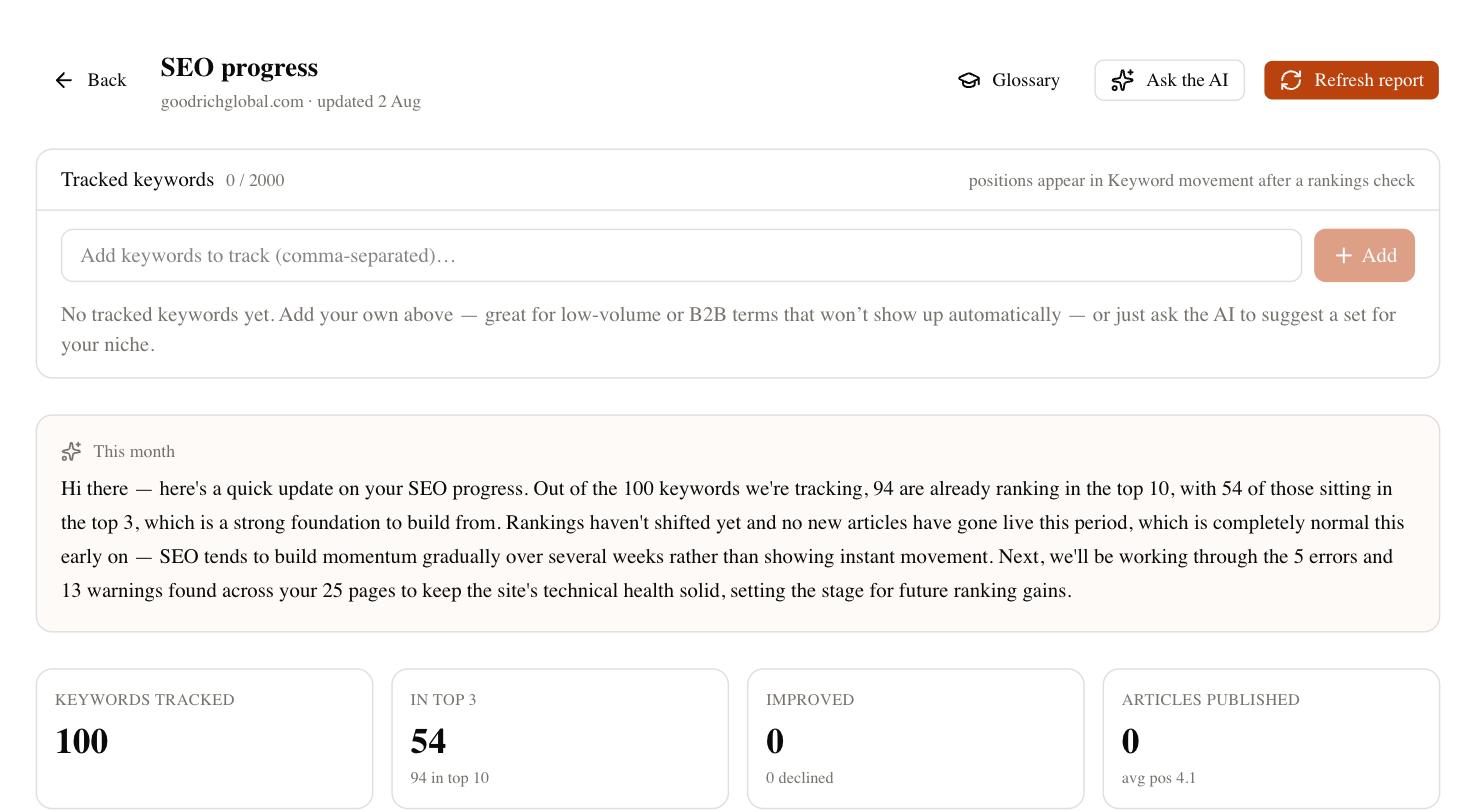
- Set up rank tracking on day one. You can’t manage what you can’t see. Start tracking your target keywords immediately so you have a baseline, then watch the deltas week over week.
- Earn a few real links. Reach out where a mention is genuinely warranted — partners, suppliers, relevant roundups, original data. A handful of quality links moves you more than a hundred low-value ones.
- Review, prune, and expand every month. See what’s climbing, improve what’s stuck on page two, and cut or merge what’s going nowhere. This monthly loop is where compounding actually happens.
How to measure progress before rankings arrive
The hardest part of the early months is that top-line rankings lag your effort, which makes it easy to conclude nothing is working when plenty is. The fix is to watch leading indicators instead of only the final scoreboard.
Early on, look at whether new pages are getting indexed, whether impressions are rising even before clicks do, and whether you’re inching from position 40 toward position 15 on target terms. Those small moves are the early warning that the strategy is right. Rank tracking makes this visible: a keyword drifting from page four to page two week over week is progress, even though it hasn’t earned a click yet. Watching those deltas keeps you from abandoning a plan that’s actually working.
One honest caveat worth repeating: rankings jitter. A term can bounce a few positions day to day for no reason you did anything about, so judge the trend over weeks, not the number on any single morning. Tracking smooths that noise into a signal you can act on.
When to expect a return on the investment
For most businesses, SEO starts paying for itself somewhere in the six-to-twelve month window, and keeps compounding well past that. The reason it’s worth the wait is durability — unlike ads, which stop the moment you stop paying, rankings you’ve earned keep sending traffic long after the work is done. That back-loaded payoff is exactly why patience is the strategy, not a consolation prize.
The people who quit at month three are the ones who never see it. The people who treat those first months as an investment — auditing, publishing, tracking, and adjusting — are the ones still collecting the return two years later. So the real answer to how long SEO takes is that the first results come in months, the meaningful ones come near the end of your first year, and the compounding never really stops if you keep feeding it.
The takeaway
SEO takes months, not weeks, and there’s no honest way around that. But the timeline isn’t fixed — it bends toward whoever picks winnable targets, fixes the technical basics, publishes consistently, and measures the right leading indicators instead of staring at rankings that haven’t caught up yet. Start with an audit, build a keyword list you can actually win, publish your first cluster, and turn on rank tracking today. Do that, and by the time the slow-starters are asking whether SEO even works, you’ll already have the data showing it does.