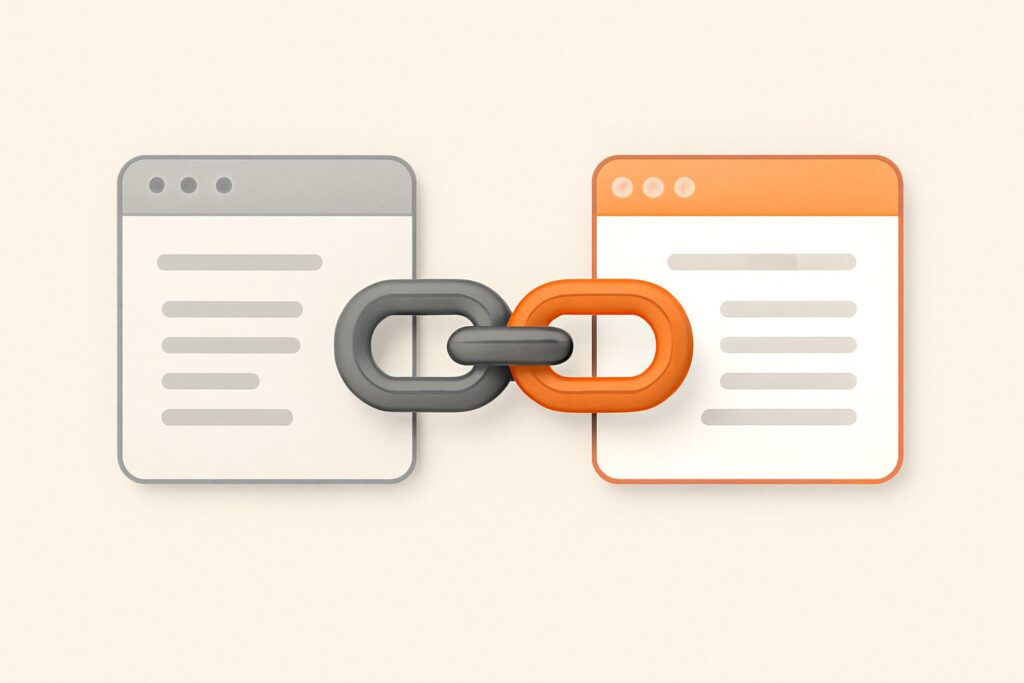
Most explanations of internal vs external links stop at a one-line summary: internal links keep visitors on your site, external links point away from it. That framing is technically true and completely useless, because it tells you nothing about how each link type moves rankings — or why a site can have hundreds of internal links and still bury its most important page. To use links deliberately you have to understand the three distinct jobs they do: routing authority, defining crawl paths, and signalling relevance. Once you separate those, the internal-versus-external question stops being about “where the link goes” and starts being about which signal you’re trying to send.
The Three Link Types Most Guides Blur Together
Before comparing anything, get the taxonomy straight, because a lot of confusion in the internal vs external links debate comes from collapsing three different things into two buckets. There are really three link types in SEO, and they behave differently:
- Internal links — links from one page on your domain to another page on the same domain. They connect your own content and pass authority around inside your site.
- External outbound links — links from your pages to a different domain. These send a small amount of authority and a relevance signal out to someone else.
- External inbound links — links from another domain pointing to you, usually called backlinks. These are the ones that build your site’s authority in the first place.
So when people frame link types as “internal vs external,” the external side is actually two very different animals: links you place (outbound) and links you earn (inbound). Conflating them is the single biggest source of bad advice on this topic.
What Internal Links Actually Do
Internal links do three jobs at once, and each maps to a real ranking mechanism. First, they distribute PageRank — the authority a page accumulates from its own inbound links flows through internal links to the pages it points at. A homepage that has collected most of your backlinks is a reservoir; internal links are the pipes that carry that equity to the pages you actually want to rank. Second, they create crawl paths. Google’s crawler discovers and re-crawls pages by following links, so a page with no internal links pointing to it — an “orphan page” — may sit undiscovered or rarely refreshed no matter how good it is. Third, they pass context through anchor text and surrounding copy, telling Google what the destination page is about.
The practical upshot: internal linking is the one lever where you have total control and it costs nothing. You decide which pages receive the most internal links, from where, and with what anchor text. Most sites waste this. They link every page to the homepage and the blog index, and leave their money pages — the ones that should rank — sitting three clicks deep with two internal links pointing at them.
What External Outbound Links Do (and Why They Help You)
Linking out to other sites feels counterintuitive — you’re sending a visitor and a sliver of authority elsewhere. But outbound links are a legitimate quality and relevance signal. When you cite a primary source, a study, or an authoritative reference, you’re doing what genuinely helpful pages do, and you’re telling Google your content sits in a credible neighbourhood. There is no penalty for linking to good sites; the myth that outbound links “leak” ranking power in a way that hurts you is decades out of date for normal editorial linking.
What outbound links do not do is directly boost your own rankings the way inbound links do. Their value is contextual: they make your content more trustworthy and better connected to the topic, which supports relevance rather than raw authority. The one real risk is linking to spam, link farms, or paid placements — associating with a bad neighbourhood, or selling followed links, can be treated as participation in a link scheme.
Inbound vs Outbound: The Distinction That Trips People Up
This is the part of internal vs external links that most articles get wrong. The external links that build your authority are inbound — other people’s sites linking to you. The external links you place from your own content are outbound, and they help mainly through relevance and trust, not authority transfer. So “external links are good for SEO” is only half a sentence: earning inbound external links is one of the strongest ranking factors there is, while placing outbound external links is a modest, mostly qualitative benefit.
Getting the inbound vs outbound distinction right changes where you spend effort. You control outbound and internal links entirely — those are optimisation and hygiene. Inbound links are earned through content and outreach, which is slower, harder, and where the real competitive gap usually lives. A site rarely loses because it linked out too little; it loses because rivals earned more and better inbound links.
Anchor Text Works Differently for Each Link Type
Anchor text — the clickable words in a link — is a relevance signal for every link type, but the rules differ. For internal links, you have full control, so use descriptive, keyword-relevant anchors that honestly describe the destination (“keyword research workflow,” not “click here”). There’s little penalty risk internally because it’s your own site organising itself. For inbound external links, the opposite caution applies: a natural backlink profile has varied anchors — brand names, bare URLs, generic phrases, and only some exact-match keywords. A profile stuffed with exact-match commercial anchors from external sites is a classic footprint of bought or manipulated links and can trigger devaluation. You can’t fully control what anchor text other sites use, and that’s healthy — variety is the signal of an earned profile.
How Many Outbound Links Is Too Many?
There’s no magic number, and anyone quoting a hard cap is guessing. The honest answer is that outbound links should match what the content genuinely needs. A 2,000-word research piece citing eight sources is normal and good. The same article with forty outbound links, half of them to unrelated commercial sites, reads like an affiliate doorway and dilutes the page. Google’s own guidance points at intent: are you linking to help the reader, or to manipulate a signal or fulfil a paid placement? For any link you were paid to place or that’s part of an exchange, mark it appropriately (see below) — undisclosed paid links are a link-scheme violation regardless of count.
Should You Nofollow Your External Links?
The nofollow, sponsored, and ugc attributes tell Google how to treat a link. Since 2019 these are hints, not strict directives — Google may still crawl and consider them — but they remain the correct way to signal intent. Use rel="sponsored" for paid or affiliate links, rel="ugc" for user-generated content like comments, and nofollow when you want to reference a site without vouching for it. For ordinary editorial outbound links to sources you trust, leave them followed — that’s the natural state and the whole point of a citation. You almost never need to nofollow internal links; the old “PageRank sculpting” trick of nofollowing your own internal links stopped working over a decade ago and just wastes crawl signals.
An Internal Linking Strategy That Compounds
The highest-leverage internal-linking pattern is the topic cluster: a comprehensive “pillar” page targeting a broad term, surrounded by narrower “cluster” articles that each link up to the pillar and across to close siblings. This does three things at once — it concentrates authority on the page you most want to rank, it proves topical depth to Google, and it gives crawlers a dense, logical path through the subject. A worked micro-example: if your pillar targets “link building,” cluster pages on broken-link building, resource-page links, and anchor text each link back to the pillar with a descriptive anchor, and the pillar links down to each. The pillar accumulates internal equity from every cluster piece, while the clusters inherit topical context from the pillar.
The decision rule for any new page: before publishing, ask which three to five existing pages should link to it, and which existing pages it should link to. If the answer is “none,” the page is either off-topic or orphaned — fix that before you worry about backlinks.
The Mistakes That Quietly Cost Rankings
Across both link types, the same errors recur. Orphan pages — content with zero internal links — get crawled late or not at all. Over-linking the homepage while starving money pages misroutes your authority. Exact-match anchor text repeated identically across dozens of internal links looks engineered even on your own site. On the external side, the big ones are linking out to spammy or irrelevant domains, buying followed links without a sponsored tag, and chasing raw backlink count while ignoring relevance — one editorial link from a genuinely relevant site outweighs fifty from unrelated directories. Note too that “domain authority” is a third-party metric from Moz, not a Google signal; use it as a rough directional gauge, never as a target.
How to Audit Both Link Types
You can’t optimise what you can’t see, so audit internal and external links separately. For internal structure, crawl your own site to find orphan pages, over-deep pages, and money pages with too few internal links — SEO Rocket’s real-crawler site audit surfaces exactly these, so you can spot the page that should rank but has no internal links feeding it. For inbound external links, pull your referring domains and run a backlink audit to catch clearly toxic links and understand where your authority actually comes from. And for the gap that matters most, competitor backlink and link-gap analysis shows who links to your rivals but not to you — a named prospect list for outreach, which is the slow human work no tool can do for you. SEO Rocket helps you find, prioritise, and audit link targets on real Ahrefs data for around $50/month with a free tier; it won’t run outreach or sell links, because that relationship-building is the moat, not the shortcut.
This is the same discipline behind a playbook proven across 1,000,000+ ranking pages: internal links organised deliberately, outbound links used honestly as citations, and inbound links earned rather than bought. None of it depends on a trick, which is exactly why it holds through core updates.
Frequently Asked Questions
Are internal or external links more important for SEO?
They do different jobs, so ranking them is the wrong frame. Inbound external links (backlinks) are among the strongest authority signals and are usually where competitive gaps live. Internal links decide how that earned authority flows to your pages and whether they get crawled at all. You need both: backlinks build the reservoir, internal links direct it.
Do outbound external links hurt my rankings?
No — linking out to relevant, credible sources is a normal quality signal and there’s no penalty for editorial outbound links. The only real risk is linking to spam or link farms, or placing paid links without a sponsored tag, which can count as a link scheme. Link out when it genuinely helps the reader.
What’s the difference between inbound and outbound links?
Inbound links point to your site from other domains (backlinks) and build your authority. Outbound links point from your site to other domains and mainly add relevance and trust. Internal links stay within your own site and route authority between your pages. All three are “links,” but only inbound external links directly grow your ranking power.