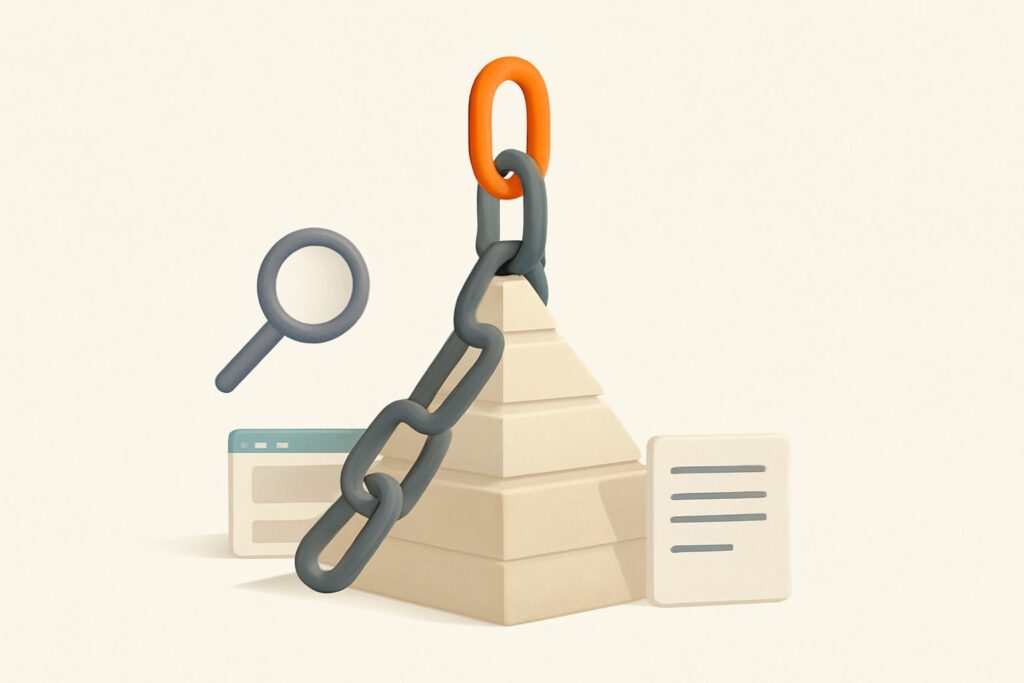
Tiered link building is what people reach for when they’ve decided links are the bottleneck but can’t get anyone reputable to link to them. The pitch is clever: instead of pointing spammy links directly at your site, you point them at other links, which point at other links, which finally point at you. The spam gets “laundered” through the layers, and your money site stays clean. It’s a tidy theory. In practice, the link pyramid is one of the more reliable ways to waste a budget, and understanding why is worth more than any tutorial promising the opposite.
What Tiered Link Building Actually Is
Tiered link building is a structure, not a single tactic. You build a pyramid of links in layers — usually three — where each layer’s job is to strengthen the layer above it. The closer a layer sits to your website, the more careful and clean it’s meant to be. The further away, the dirtier and more automated it’s allowed to get, on the assumption Google won’t look that far down the chain. It’s a link pyramid built on the hope that distance equals deniability.
The whole model treats PageRank like water flowing downhill in reverse — authority is supposed to pool at the bottom and get pumped up through the tiers until it reaches the page you actually care about. That’s the mechanism people are really asking about when they search tiered backlinks or “link pyramid.” Here’s how the layers break down.
Tier 1, 2, and 3 Backlinks Explained
The three-tier model divides your links by quality and proximity to the money site:
- Tier 1 — links pointing directly at your site. These are supposed to be the highest quality: guest posts, niche edits, or contextual links from real-looking sites. This is the layer Google sees first and judges hardest.
- Tier 2 — links pointing at your Tier 1 links. The goal is to “boost” those Tier 1 pages so they pass more authority. Quality drops here: web 2.0 properties, low-end directories, profile links, comment links.
- Tier 3 — links pointing at Tier 2, usually mass-produced by automated tools that blast thousands of forum profiles, wiki pages, and bookmarking sites. Nobody pretends Tier 3 is clean; its entire purpose is volume.
When someone talks about a tiered link building strategy or a “tier 1 2 3 backlinks” setup, this is the architecture. The Tier 1 layer is the display window; Tiers 2 and 3 are the warehouse of spam you hope Google never inventories.
Why the Pyramid Is Supposed to Work
The logic has a certain engineer’s appeal. Direct spam links get you a manual action fast, so you don’t send spam directly. Instead you send it at intermediary pages that aren’t yours — if those get flagged, it’s not your domain that eats the penalty. Meanwhile the automated bottom tiers generate link volume cheaply, and volume, historically, moved rankings. In 2011 this genuinely worked, because Google’s link graph was cruder and PageRank flowed more mechanically than it does now.
That’s the crux of the problem: tiered link building is a strategy optimized for a version of Google that stopped existing over a decade ago. Every assumption underneath it has since been invalidated.
Why It Fails in 2026
Start with the foundation. Google’s Penguin algorithm, folded into the core ranking systems in 2016, stopped simply counting links and started evaluating their quality in real time — and critically, it began ignoring bad links rather than always penalizing for them. That single change guts the pyramid. If Google devalues your Tier 3 spam to zero, no authority flows up to Tier 2, so nothing flows to Tier 1, so your money site gets nothing. The pyramid doesn’t launder authority; it manufactures it from links that carry none.
Then there’s the automation footprint. The tools that build Tier 2 and Tier 3 leave the same fingerprints across every campaign that uses them — identical anchor patterns, the same recycled platforms, spun content that reads like a translation of a translation. Google’s spam systems recognize these signatures, and association is a signal. A Tier 1 link sitting on top of an obvious spam pyramid looks worse, not better, than the same link standing alone. You’re not protecting your Tier 1 links; you’re contaminating them.
The Real Cost of Tiered Backlinks
Price out a tiered campaign honestly and it’s a bad trade. You pay for Tier 1 placements, pay for or run the Tier 2 and 3 tooling, and spend weeks managing the build. In return you get, at best, a temporary bump that a core update erases, and at worst an unnatural-links manual action that costs the majority of your organic traffic and two to four months of reconsideration-request purgatory to undo. The automated tiers can also attract attention you didn’t want — a spam pyramid pointing at your brand is the exact pattern used in negative-SEO attacks, and you built it yourself.
The subtler cost is opportunity. Every hour spent architecting a link pyramid is an hour not spent building a page that could earn links on its own. The pyramid feels productive because it’s complex and measurable, but complexity isn’t durability. The most sophisticated tiered strategy still rests on the assumption that Google’s link evaluation stops improving, and it hasn’t stopped improving once since 2012.
What to Build Instead
The durable version of “more links” is fewer, better links pointed at pages that deserve them — no laundering required, because there’s nothing to hide. That reduces to two jobs: know which links are actually worth chasing, and make your pages worth linking to. Both are workflows SEO Rocket handles directly.
For the link side, its competitor and backlink analysis shows the real links your rivals earned across up to five competitors, with anchor-text breakdowns and named outreach targets — genuine prospects you can pitch instead of a warehouse of spam to funnel. The content-gap analysis surfaces the topics competitors rank for that you don’t, which is where your next link-worthy page should go. You spend your effort on Tier 1 quality with no fragile pyramid holding it up.
The Page That Makes Links Unnecessary to Fake
People build pyramids because their pages can’t attract links honestly. Fix the page and the whole apparatus becomes unnecessary. SEO Rocket’s AI article writer enforces hard validation gates — a 1,000-word minimum, title and meta limits, a required section count, and an automatic repair loop that catches thin content before it ships. Combined with AI keyword research and rank tracking that follows top-100 trends instead of daily noise, it’s the same playbook proven across 1,000,000+ ranking pages: research the demand, build a page that beats the weakest competitor on page one, earn real links, and watch the trend. Tiered link building is an elaborate answer to a question — “how do I rank without deserving to?” — that Google spent a decade making unanswerable. Build the thing that deserves to rank, and you never need the pyramid.