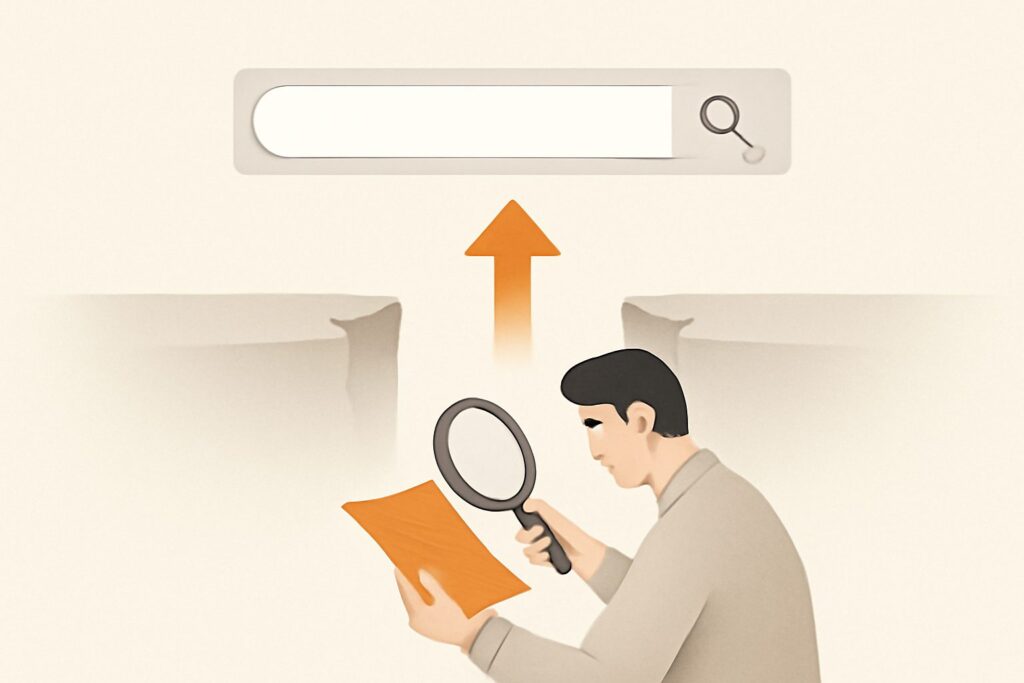
Most teams first meet the attribution gap as a mystery in their dashboard: organic and paid are flat or down, revenue is holding, and “direct” traffic is quietly ballooning with no campaign to explain it. The instinct is to blame tracking hygiene — a broken UTM, a missing tag. It usually isn’t. What you’re looking at is the measurement shadow of agentic search: language models and AI agents now sit between the searcher and your page, and the handoff they make to your analytics is lossy by design. The clicks still happen. The credit just doesn’t survive the trip.
What the Attribution Gap Actually Is
The attribution gap is the growing distance between the influence a page has on a decision and the influence your analytics can record. In classic search, that distance was near zero: someone queried Google, clicked a blue link carrying a referrer, landed on your page, and fired a JavaScript tag that stitched the whole path together. Agentic search severs almost every link in that chain. The model reads your content during training or live retrieval, synthesizes an answer, sometimes cites you, sometimes sends a click, and increasingly acts on the user’s behalf without a human ever loading your page. Each of those steps strips a piece of the evidence trail.
This isn’t a bug to be patched with better tag management. It’s a structural consequence of how ChatGPT, Perplexity, Gemini, Claude, Copilot, and the new wave of agentic browsers mediate the web. Understanding the gap means understanding the mechanism at each leak point, not hunting for a single misconfigured setting.
Why Traditional Analytics Goes Blind
Two technical facts explain most of the damage. First, referrer stripping: AI assistants frequently omit or flatten the HTTP referrer when they send a click to your site. When the referrer is empty and no campaign parameter is attached, GA4 has no honest choice but to bucket the visit as “direct” — the same bucket as someone typing your URL from memory. Independent analyses of AI-referred traffic have found that a large share, often a majority, lands in direct rather than in any AI channel. Treat the exact percentages you see quoted with caution, but the direction is not in dispute.
Second, no JavaScript execution. When an agent retrieves your page to read it — as opposed to handing a human a browser — it typically fetches raw HTML and never runs your analytics script. The visit is real and influential; your client-side tag simply never fires. So the page that fed the answer box that won the customer shows up in your reports as exactly nothing. That is the heart of the problem: the most important impression is often the one your tools are structurally incapable of counting.
The Four Layers Where Attribution Leaks
It helps to stop thinking of this as one gap and start mapping it as four distinct leak points, because each one needs a different instrument to close it.
- The citation layer — your brand or URL appears inside an AI answer, but no click occurs. Pure influence, zero session. Invisible to any click-based tool.
- The click layer — the AI sends a visit, but with a stripped referrer, so it misfiles as direct. Visible as traffic, invisible as attribution.
- The agent-visit layer — an agent fetches your page to reason over it, executes no JavaScript, and leaves only a line in your server log. Visible only server-side.
- The agentic-transaction layer — an agent completes an action (a purchase, a signup, a booking) with no human browser session on your property at all.
The mistake most teams make is trying to close all four with GA4, which can only ever see part of layer two. Once you separate the layers, it becomes obvious that no single dashboard reassembles the picture — you need one signal per layer.
Agent-Mediated Attribution: The Hardest Case
Agentic attribution is where the gap stops being an analytics inconvenience and becomes a strategic blind spot. When an agent researches “best project-management tool for a 12-person agency,” it may read a dozen pages, weigh them, and surface two or three recommendations — and the pages it discarded are as invisible as the ones it chose. You have no session, no bounce, no scroll depth, nothing. The influence is entirely upstream of anything you can instrument on your own site.
This is the defining feature of AI agent attribution: the decision-shaping happens inside a system you don’t own and can’t tag. You can’t fix that by instrumenting harder. You can only fix it by measuring the one thing that is actually observable — whether the model knows you, recommends you, and cites you when the relevant question is asked.
Agentic Transactions: When the Session Never Exists
The frontier of lost attribution in AI is the autonomous transaction. Agentic commerce protocols now let an assistant complete a checkout or subscribe to a service on a user’s behalf. In that flow there may be no browser, no JavaScript, no thank-you page, and no order-confirmation pixel — the revenue simply appears, detached from any path you can trace back to the content that earned it. Traditional last-click attribution doesn’t just underperform here; it has no object to attribute to.
This is early and still small in absolute terms, so resist over-rotating your whole measurement stack toward it today. But the mechanism is worth internalizing now, because it is the logical endpoint of the trend: the more capable agents become, the more of the buying journey moves off your property, and the more your on-site analytics measures the shrinking tail rather than the growing head.
Why “Direct” Traffic Is Now a Lie You Can Partly Decode
Before agentic search, a spike in direct traffic meant brand strength — people knew your name and came straight to you. That reading is now unreliable, because direct has become the default landfill for de-referred AI clicks. But the bucket isn’t opaque. Cross-reference sudden direct growth against three tells: it disproportionately hits your informational and comparison pages rather than your homepage; it correlates with landing paths deep in your content rather than at the root; and it rises in step with your visibility inside AI answers. When those line up, you’re not looking at brand loyalty — you’re looking at the click layer wearing a disguise.
Reconstructing Attribution From Server Logs
Server-side log analysis is the single most reliable instrument for the agent-visit layer, because it sees what JavaScript can’t. Every request hits your server and leaves a record, whether or not a tag fires. The practical move is to segment your access logs by the crawler and agent identifiers the major AI systems now declare — the fetchers used by OpenAI, Anthropic, Perplexity, Google, and Apple all announce themselves in the user-agent field, and several assistants have started tagging their live-fetch traffic distinctly (Gemini’s mobile app, for instance, began carrying its own identifier in early 2026).
Rather than paste raw log lines, think of each request as a small record with fields: which system fetched it, which URL, when, and how often. Watching those counts over time tells you which pages the models actually read to build answers — a proxy for influence you can get no other way. When live-fetch volume on a page climbs while its GA4 sessions stay flat, that page is doing agentic work your front-end will never show you.
Self-Reported Attribution: The Underrated Signal
The most honest fix for the citation layer is also the least technical: ask. A single “How did you hear about us?” field on signup, checkout, or a demo form recovers attribution the machines destroyed, because the human remembers what their analytics forgot — “ChatGPT recommended you,” “I saw you in an AI Overview.” Self-reported attribution is noisy and under-samples, but it captures the pure-influence cases that leave no digital trace at all, and it’s the only method that can credit a citation that never produced a click. Run it as a rolling directional signal, not a precise dashboard, and weight it against your other layers.
Measure Visibility, Not Just Clicks
The strategic reframe that resolves most of the anxiety around this problem is this: in a world where the click is optional but the recommendation is decisive, the metric that matters is presence inside the answer. Are you cited when a buyer asks the model the questions that precede a purchase? At what rate, against which competitors, on which prompts? That is measurable even when the click isn’t — you can pose the buyer’s real questions to the assistants on a schedule and record whether you appear, how you’re framed, and who is cited alongside you.
This is exactly what SEO Rocket’s AI-visibility tracking is built to measure: how often your brand shows up and gets cited across ChatGPT, Gemini, Google AI Overviews, and Perplexity for the prompts your customers actually use. It won’t hand you a last-click revenue figure — nothing honestly can for this surface — but it turns the invisible top of the agentic funnel into a trend you can watch, defend, and improve. Pairing that share-of-answer signal with server-log fetch data and a self-reported field gets you a defensible three-layer read where a single analytics tool gives you a misleading one.
Reporting the Gap to Clients and Stakeholders
The hardest part of this shift is often organizational, not technical: a stakeholder who has been trained for fifteen years to equate “sessions” with “results” now sees flat sessions and assumes the work is failing. The fix is to change the report, not the reality. Show visibility share inside AI answers as a leading indicator, server-log fetch trends as evidence the models are consuming your content, self-reported AI mentions as ground truth, and direct-traffic composition as the decoded proxy — then connect all four to the revenue line that’s holding despite “declining” organic. SEO Rocket’s client dashboard is designed to package that AI-visibility story for exactly this conversation, so the reporting layer stops being the place where good work goes to look bad. And because being cited depends on being genuinely useful, the same platform’s validation-gated AI writer exists to help produce the kind of thorough, structured content that models actually quote.
Frequently Asked Questions
Is the attribution gap the same as dark traffic?
It overlaps but isn’t identical. “Dark traffic” is any visit misfiled as direct because a referrer was lost — email clients, messaging apps, and secure-to-insecure hops all contribute. The gap in agentic search is the AI-specific and now dominant driver of that misfiling, plus something older dark traffic never included: influence that produces no click or session at all.
Can I close the attribution gap completely?
No, and any tool promising a clean last-click revenue number for AI search is overselling. The realistic goal is triangulation, not certainty: combine AI-visibility tracking, server-log analysis, and self-reported attribution so each layer covers another’s blind spot. You’re reconstructing a probable picture from partial evidence, which is a different discipline than the deterministic tracking teams grew up with.
Does llms.txt help with attribution?
Not directly, and it’s worth being precise here. The proposed llms.txt convention is about guiding how models access your content, not about tracking or crediting visits — and Google has said it does not use it as a ranking signal. Treat it as an emerging, optional hygiene file, never as an attribution or ranking lever.
Should I block AI crawlers to protect my content?
Rarely, if visibility is your goal. Blocking the fetchers that feed retrieval-augmented answers removes you from the very surface you’re trying to measure and appear on. The defensible position for most publishers is to be readable, be cite-worthy, and measure your presence — not to wall yourself out of the answer and then wonder why you’re never recommended.
The Takeaway
The attribution gap is not a temporary reporting glitch to wait out — it’s the new baseline of a web where models mediate discovery and agents increasingly act without loading your pages. The teams that stay calm are the ones who stop demanding that a single click-based tool explain a world that no longer runs on clicks. Map the four leak layers, instrument each with the one signal that can actually see it, and report visibility as the leading indicator it now is. The credit didn’t vanish. Your old instrument just stopped reading it — and the fix is a better set of instruments, applied with the same rigor a playbook proven across 1,000,000+ ranking pages brings to any measurement problem.