Bottom of funnel SEO content is the writing that meets someone at the moment they’re deciding what to buy — not learning about a problem, not weighing options in the abstract, but choosing between you and the two other names on their shortlist. It’s the least glamorous content you’ll produce and, page for page, usually the most valuable, because bottom of funnel SEO content catches traffic that already has a wallet open.
Most blogs are top-heavy: dozens of “what is” explainers and almost nothing aimed at the buyer who’s ready. This guide covers what bottom-of-funnel actually means, how to structure a page that converts, a concrete example, and — honestly — which parts matter and which are busywork.
What “bottom of funnel” really means
The funnel is a rough map of intent, not a rigid pipeline. At the top, someone has a symptom and is searching to understand it. In the middle, they know the category of solution and are comparing approaches. At the bottom, they’ve decided they need a product like yours and are down to logistics: which vendor, which plan, does it do the one thing I care about, and can I trust it. Content that serves that last stage is bottom-of-funnel — often shortened to BOFU.
The tell is the search itself. Top-of-funnel queries are broad and educational. Bottom-of-funnel queries name a category, a competitor, a price, or a decision. Someone typing “how do backlinks work” is reading. Someone typing “best rank tracker for agencies” is buying — they’ve just narrowed it down enough that they need a nudge, not a lecture. The line isn’t always clean, and one query can pull a mix of intents, but if the words point at a purchase decision, treat the page as bottom-of-funnel and write to close.
How BOFU differs from top- and mid-funnel content
The mistake is treating all three the same and writing 2,000 educational words for a query where the reader wanted a decision in ninety seconds. Each stage rewards a different job.
- Top of funnel — teaches. Wide reach, low intent, long payback. Its job is to introduce you to people who don’t yet know they have a problem.
- Middle of funnel — frames the options. “X vs Y,” “types of,” “how to choose.” The reader is comparing approaches and starting to trust a source.
- Bottom of funnel — closes. Alternatives pages, comparison pages, pricing explainers, integration and use-case pages, “best tool for [specific job]” roundups. Lower volume, far higher conversion.
Because the traffic is smaller, people undervalue BOFU pages. That’s backwards. A page that gets 200 visits a month from people comparing you to a named competitor will out-earn a viral explainer that gets 20,000 curious readers who leave and never come back.
The keywords that signal bottom-of-funnel intent
You don’t need a taxonomy to spot buying intent — you need to read the query like a salesperson. A handful of patterns reliably sit at the bottom of the funnel, and each maps to a page type you can build.
- Alternatives — “[competitor] alternatives.” The searcher already wants the category and is unhappy with one option. High intent, and you get to argue your own case.
- Versus — “[you or a rival] vs [rival].” A direct comparison request from someone deciding today.
- Best-for — “best [category] for [audience or job],” like “best SEO tool for consultants.” Specific enough that the reader is picturing themselves using it.
- Pricing and cost — “[category] pricing,” “how much does [thing] cost.” Money in the query is intent in the query.
- Use-case and integration — “[tool] for [platform],” “does [tool] do [task].” The last objection before a purchase.
Notice these are lower in volume than “what is SEO.” That’s the point. You’re trading reach for readiness, and readiness is what pays the invoice.
How to structure a bottom-of-funnel page — with an example
A good BOFU page answers the decision fast, then earns trust by being honest about trade-offs. Say you sell a rank tracker and you’re targeting “best rank tracker for agencies.” Don’t open with a definition of rank tracking — the reader knows. Open with the answer and a one-line reason, then support it.
A structure that works
- Direct answer up top — name your pick and, in one sentence, why. The reader who’s in a hurry converts here.
- The honest comparison — a short table or list of real options, including where a rival genuinely fits better. Acknowledging trade-offs is what makes the recommendation believable.
- The specific fit — connect features to the exact job in the query. For agencies that means white-label reports, per-client dashboards, and predictable per-project cost, not a generic feature dump.
- Objection handling — price, data accuracy, migration effort. Answer the thing that stalls the deal.
- A clear next step — one obvious action, not five competing links.
Keep it tight. A BOFU page that respects the reader’s time — clear headline, scannable comparison, one call to action — will usually out-convert a longer page that buries the decision under a wall of background nobody asked for.
What actually matters, and what doesn’t
Plenty of BOFU advice is padding, so here’s the honest split. What matters: matching the page to the exact intent behind the query, being genuinely useful and fair about competitors, loading fast, and making the next step obvious. Search engines and buyers both reward a page that answers the question it ranked for. Trust is the whole game at this stage — one overclaim and the reader bounces to the comparison page you didn’t write.
What matters less than people claim: hitting a magic word count, stuffing the exact keyword a fixed number of times, or chasing a readability score. A 700-word comparison that nails the decision beats a 2,500-word one that pads to look authoritative. Depth should come from covering real objections, not from filler. And no page converts a reader who arrived on the wrong query — intent match beats everything downstream of it. The same logic applies to internal polish most teams over-invest in: a slightly awkward sentence costs you nothing if the recommendation is clear and fair, while a beautifully written page that dodges the honest trade-off costs you the sale.
Finding the BOFU gaps your competitors already own
The fastest way to build a bottom-of-funnel plan is to see which buying-intent keywords your competitors rank for and you don’t — then work down that list. That’s a content-gap analysis, and doing it by hand across a few rivals is slow. This is where SEO Rocket fits: you point it at your site and two or three competitors, and it returns the keywords they capture that you’re missing, on real Ahrefs-grade data, in plain language rather than a wall of tabs.
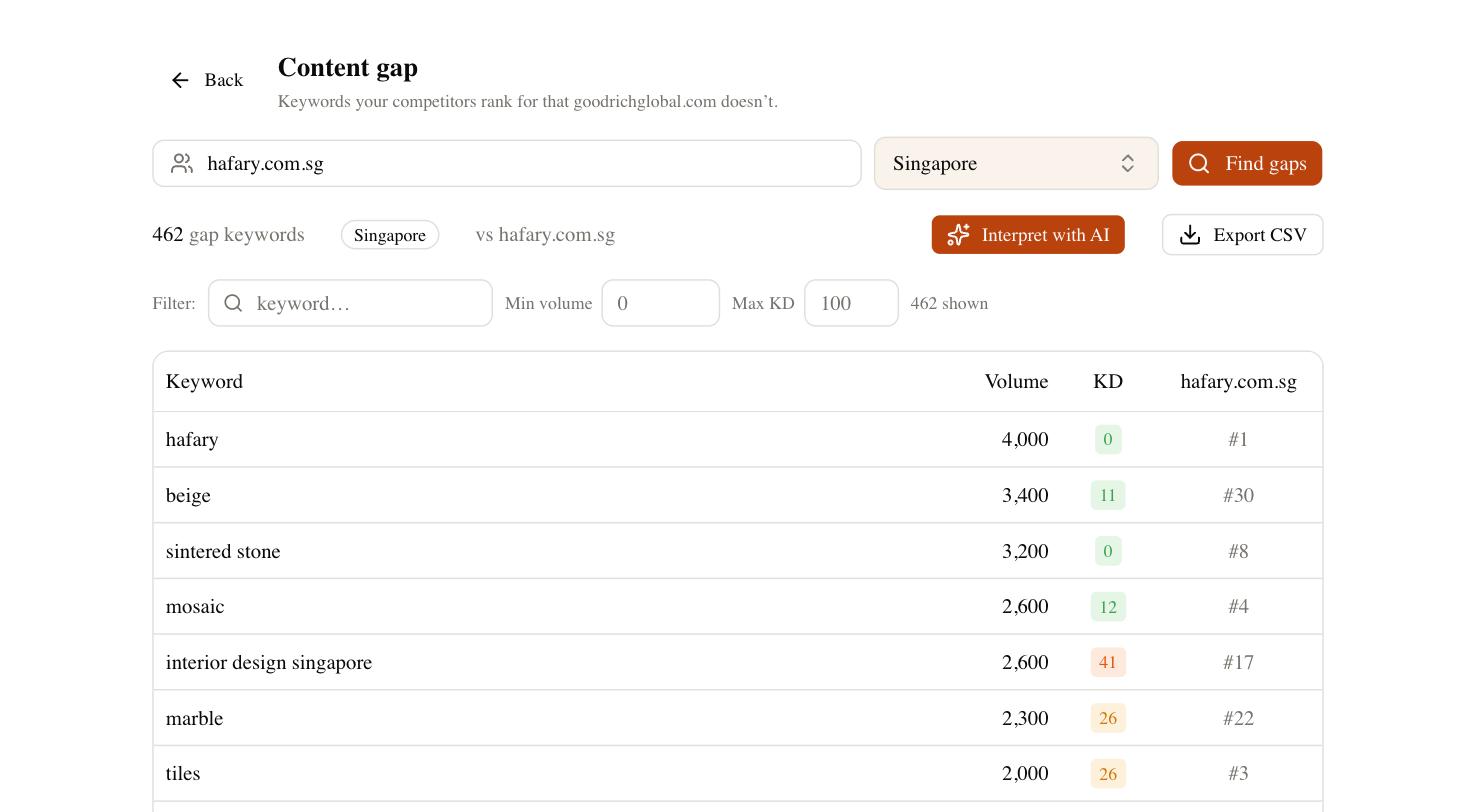
Filter that gap list for the intent patterns above — alternatives, versus, best-for, pricing — and you have a ranked backlog of pages that are proven to attract buyers, because a competitor is already being found for them. From there the same workflow drafts the page and later tracks whether it’s climbing, so you’re not stitching three tools together to ship one comparison page. The point isn’t automation for its own sake; it’s spending your writing time on the pages most likely to convert instead of guessing.
A simple workflow to ship your first BOFU pages
Start narrow. Pull your competitor gap list, filter it to the five clearest buying-intent queries, and write those first — one alternatives page, one versus page, one best-for page is a strong opening trio. Answer the decision in the first screen, be honest about who each rival suits, and give one call to action. Then give the pages a full ranking cycle before you judge them; positions jitter a few spots day to day and comparison pages often take a beat to settle.
Bottom-of-funnel work rarely produces a traffic spike you can screenshot, which is exactly why it’s underbuilt and underpriced. Do it well and you own the search results people see at the moment they’ve decided to spend money. That’s the quiet compounding engine behind most sites that convert well — not the viral explainer, but the unglamorous comparison page waiting where the buyer lands.