If you want to know how to appear in Google AI Overviews, start by dropping the idea that it’s a separate game from ranking well. The AI Overview that sits above the blue links is assembled from pages Google already trusts enough to surface — it summarizes them and cites a handful. So the honest version of how to appear in Google AI Overviews is less “learn a new discipline” and more “do the fundamentals well, then optimize for being quotable.” That distinction matters, because a lot of what you’ll read online treats AI search as a reason to throw out everything that worked. It isn’t.
What an AI Overview actually is
An AI Overview is a generated answer Google shows at the top of some results, stitched together from multiple web pages and footnoted with links to the sources it drew from. It doesn’t appear on every query — Google tends to trigger it on informational, multi-part, and “explain this to me” searches, and to hold back on straightforward navigational or transactional ones. When it does appear, it pushes the traditional results down the page, which is exactly why it feels threatening.
The mechanism underneath is worth understanding because it tells you what to do. Google retrieves a set of candidate pages, the way it always has, then a language model reads them and composes an answer, citing the passages it leaned on. You are not writing for the model directly. You are writing pages that get retrieved and are easy to quote. Those are two different jobs, and the second one is where most sites leave value on the table.
“SEO is dead” is the wrong takeaway
Every platform shift brings out the same headline, and this one is no exception. It’s wrong in the way it’s usually stated, but there’s a real point buried inside it worth taking seriously. The lazy version says AI answers everything, nobody clicks, so stop doing SEO. The nuanced version is more useful: for a certain slice of queries — quick facts, definitions, unit conversions — the Overview does satisfy the searcher without a click, and that traffic was never very valuable anyway. It was already going to featured snippets and knowledge panels.
What survives, and arguably gets more valuable, is the query where someone needs to make a decision, compare options, or trust a source before they act. On those searches the Overview is a starting point, not an ending point, and the citation next to it is a high-intent door into your site. So the work doesn’t die. It moves. You stop chasing thin informational traffic that AI now absorbs, and you concentrate on being the source the AI quotes on the questions that lead somewhere.
What actually earns a citation
There’s no submission form and no ranking factor you can toggle. But the pattern in what gets cited is consistent enough to plan around, and none of it is exotic. Overviews pull from pages that already rank on the first page for the query or a close variant — being retrievable is the price of entry. From that pool, the model favors passages that answer the specific question cleanly, in a self-contained chunk it can lift without needing the rest of the page for context.
That last part is the lever most people miss. A paragraph that opens by restating the question and then answers it directly is far easier to quote than the same information spread across three sections and a table. You’re not gaming anything — you’re making your best answer legible. The sites that win citations tend to share a few habits:
- They answer the question in the first sentence or two of a section, then expand — rather than building up to the answer at the end.
- They cover the obvious follow-up questions on the same page, so one URL can satisfy a multi-part query.
- They demonstrate genuine expertise — original data, first-hand testing, a clear author — rather than rephrasing what ten other pages already say.
- They keep facts current and specific, because vague or stale claims are exactly what a careful model routes around.
On-page moves that move the needle
Start with the pages that already rank in the top handful for queries where an Overview shows up — those are your realistic candidates, and you can find them fast. For each one, read your own content the way the model does: can it grab a clean two-sentence answer to the headline question without stitching fragments together? If not, rewrite the opening of that section so the answer comes first. This single change does more than any amount of schema tinkering.
Structure helps the model parse you. Clear headings phrased as the questions people actually ask, short answer paragraphs directly beneath them, and lists or steps where the content is genuinely a list or a sequence. Add the supporting depth after the direct answer, not before it. Where you have real numbers — a price you tested, a timeline you measured, a result you can stand behind — use them, because specificity is what separates a quotable source from filler the model skips.
Things that help less than people claim
Schema markup is worth having for eligibility and rich results, but treat it as hygiene, not a growth lever — a well-structured page that answers the question earns citations without exotic markup, and no amount of JSON-LD rescues a page that buries its answer. Chasing word count is another trap: longer isn’t more quotable, tighter is. And stuffing “AI” or the query into every sentence does nothing except make the page worse to read.
Track whether it’s actually working
Here’s the uncomfortable part of AI search: it’s hard to see. Overviews don’t always trigger, they vary by user and location, and Search Console doesn’t break out whether a click came through an Overview citation. You can end up optimizing blind, which is how people convince themselves nothing works. The fix is to measure the surface directly rather than guessing from traffic.
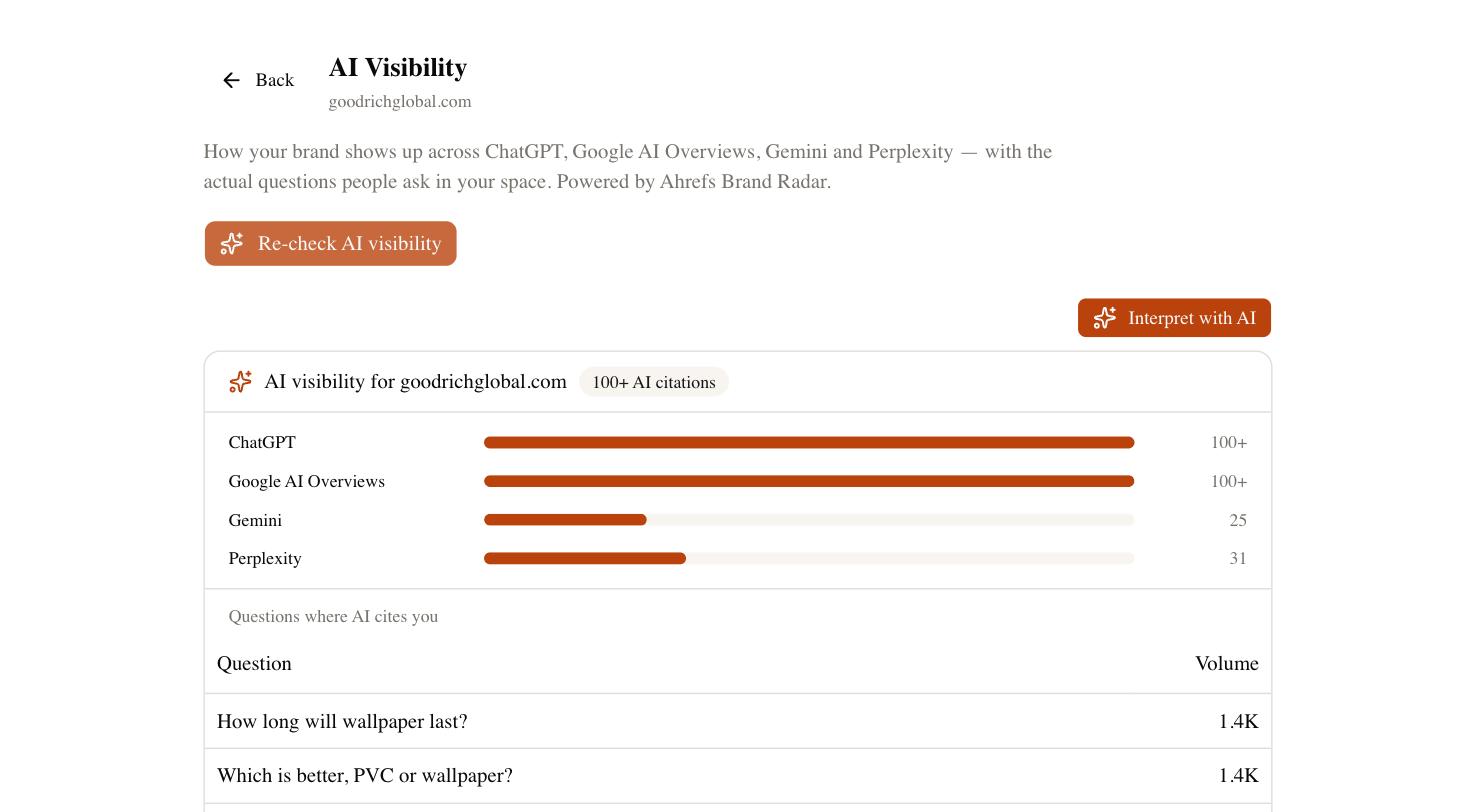
This is where SEO Rocket’s AI-visibility tracking, Brand Radar, fits. It checks whether — and where — your brand and pages get cited across Google AI Overviews, ChatGPT, and Perplexity for the queries you care about, so you can watch a specific question over time instead of refreshing a search and eyeballing it. That closes the loop: you rewrite a page to answer a question cleanly, then you can actually see whether the citation shows up, rather than assuming. Search is splitting across surfaces, and the same instinct that made you track rankings now applies to tracking mentions — you can’t improve what you can’t observe.
Where to start this week
Don’t rebuild your site. Pick five to ten commercially relevant queries where an Overview already appears and you already rank on page one — that intersection is your fastest path to a citation. Rewrite the opening of the matching section on each page so the direct answer leads, add the two or three follow-up questions a real searcher would ask next, and make sure any claim you make is specific and current. Then track those queries so you know if the change landed.
The whole thing is less mysterious than the hype suggests and more demanding than the shortcuts promise. There’s no trick that vaults an unremarkable page into an Overview, and there’s no reason a genuinely useful, well-structured page won’t get pulled in. Knowing how to appear in Google AI Overviews comes down to being the clearest, most trustworthy answer to a question worth asking — and then measuring whether the machines agree. Do the fundamentals, make your best answers easy to quote, and keep an eye on the surfaces where your buyers are actually searching now.