
Learning how to measure seo roi is mostly about being honest with the arithmetic. The formula itself is simple — return divided by cost — but SEO makes both numbers slippery, and the temptation to flatter the result is strong. If you want a number you can defend to a client or a finance team, you have to define revenue narrowly, count costs fully, and admit where the causation is fuzzy. This guide walks through the mechanics, a worked example, and the parts most reports quietly skip.
Do this well and you get something rare in marketing: a channel you can actually hold accountable. Do it loosely and you get a dashboard that looks great right up until someone asks a pointed question you cannot answer.
The formula, and why it is slippery
ROI is (revenue attributable to SEO minus cost of SEO) divided by cost of SEO, expressed as a percentage. A return of $30,000 on $10,000 of cost is a 200% ROI — you made two dollars for every dollar spent, on top of getting your dollar back. That part is not controversial.
The slippery bit is the word “attributable.” A visitor might find you through an organic search, leave, see a retargeting ad a week later, then convert after a friend’s recommendation. Which channel gets the credit? Last-click attribution hands it all to the final touch and undercounts SEO badly, because organic search is usually where discovery happens, not where the final click lands. Knowing this is the difference between a number that survives scrutiny and one that does not.
What actually counts as SEO revenue
Before you can divide anything, you need a defensible top line. The cleanest approach is to isolate organic conversions in your analytics — sessions that arrived through non-paid search — and tie them to real outcomes rather than proxy metrics. For an e-commerce site that means order value. For a lead-generation site it means qualified leads multiplied by your historical close rate and average deal size.
Two adjustments keep you honest. First, strip out branded search: someone typing your company name was probably coming anyway, so counting those conversions inflates SEO’s contribution. Second, use a sensible attribution window and a model that gives some credit to earlier touches, not just the last one. You do not need a perfect model. You need a consistent one you apply every month so the trend line means something.
A concrete example
Say you run a B2B software site. Over a quarter, non-branded organic search drove 400 demo requests. Your sales team historically closes 8% of demos, and your average first-year contract is worth $6,000. That is 400 × 0.08 × $6,000 = $192,000 in attributable revenue for the quarter.
Now the cost side. You paid a consultant $9,000, spent $12,000 on content production, and $3,000 on tools and one internal half-day a week you value at $6,000 of salaried time. Total cost: $30,000. ROI is ($192,000 − $30,000) ÷ $30,000, which is 540%. Even if you haircut the revenue by a third to account for attribution uncertainty, you are still comfortably positive — and that haircut is exactly the kind of conservatism that makes the number believable.
Why the haircut matters
A 540% figure with no caveats invites disbelief. The same figure presented as “somewhere between 350% and 540% depending on how we attribute assisted conversions” reads as competent. Underselling your certainty is a feature, not a weakness.
Costs people forget to include
Understated cost is the most common way SEO ROI gets quietly exaggerated. The line items below are the ones that go missing:
- Internal time. Hours your team spends briefing writers, reviewing drafts, and pulling reports are real costs even when nobody invoices for them.
- Content production. Writers, editors, images, and any subject-matter-expert review time — not just the freelancer’s headline rate.
- Tooling. Your rank tracker, crawler, and data subscriptions, prorated across the projects that use them.
- Technical and dev work. The engineering hours spent fixing site speed, redirects, or schema belong in the SEO column when SEO requested them.
Leaving these out does not make your program more profitable — it just makes the number less trustworthy the moment someone reconstructs it.
What does not matter as much as you think
Plenty of metrics feel like ROI without being it. Keyword rankings are a means, not an end — a page can climb from position eight to four and drive no additional revenue if the term has no commercial intent. Total organic traffic has the same problem: a spike from a viral informational post can look like a win while contributing nothing to the bottom line. Domain rating, backlinks acquired, and impressions are diagnostic signals, useful for explaining why revenue moved, but they are not the return itself.
The honest rule is that anything you cannot eventually connect to revenue or to a genuine cost saving is a supporting metric, not a headline one. Report it as context, never as the result.
Where SEO Rocket fits
The hard part of measurement is pulling the pieces together — organic conversions, rankings that actually convert, the traffic behind them, and a clean report a stakeholder can read. SEO Rocket keeps those in one place: real Ahrefs-grade data for the rankings and traffic that feed your revenue estimate, rank tracking so you can watch the commercial terms rather than vanity ones, and client dashboards that present the whole picture without a spreadsheet export.
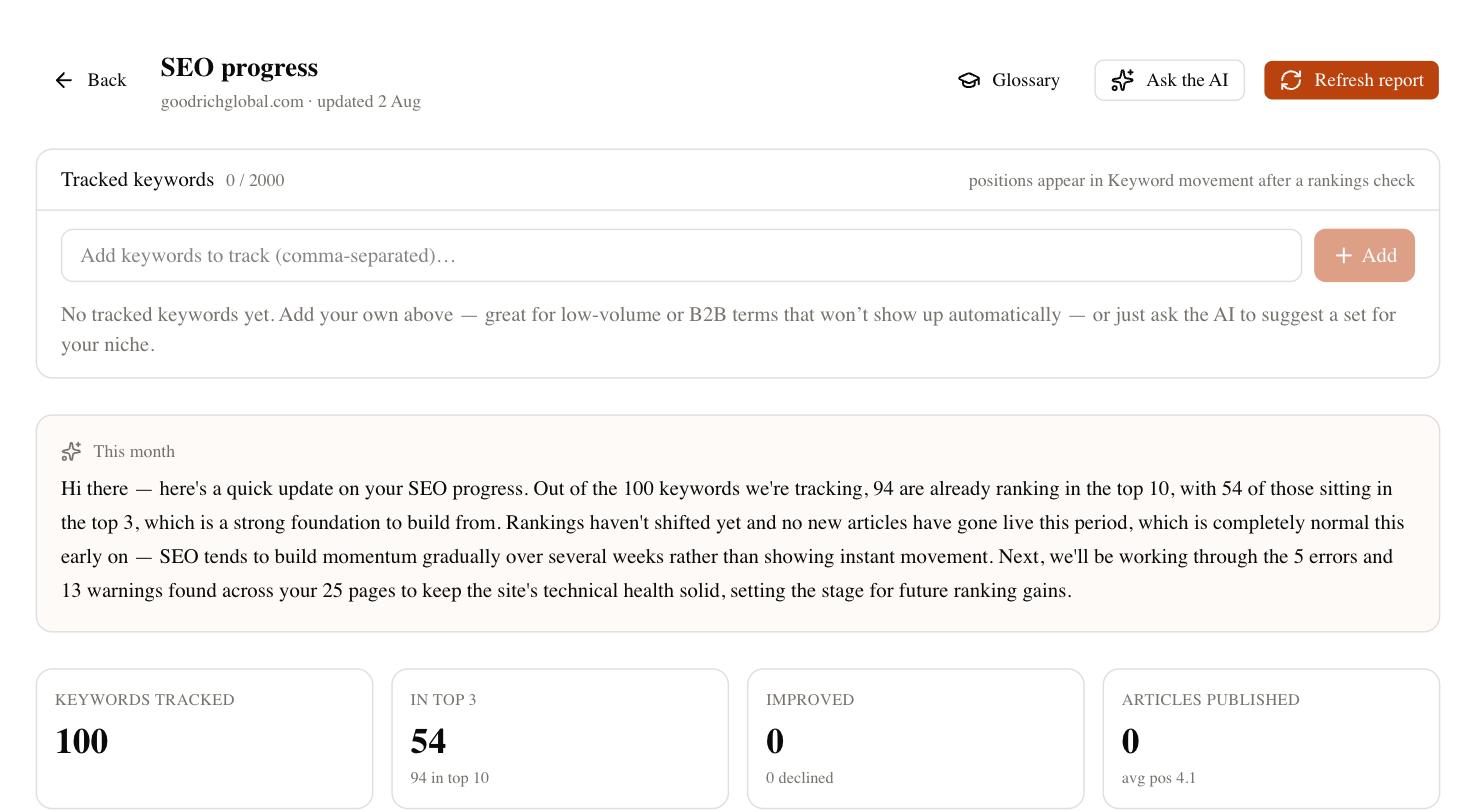
For consultants and agencies, that last part carries real weight. When learning how to measure seo roi for a client, half the battle is presenting it credibly, and a read-only white-label dashboard lets you hand over a live report instead of a static PDF that is stale the day you send it. The tool does not invent your revenue figures — you still supply close rate and deal size — but it removes the tab-juggling that makes monthly reporting a chore.
Reporting it without overclaiming
The final skill in how to measure seo roi is presentation. State your attribution model up front, show the revenue and cost sides separately so nothing looks hidden, and give a range rather than a single hero number. Compare against a realistic baseline — what organic did last quarter — instead of an imaginary zero, because some of that traffic would have arrived regardless.
Above all, give the program a fair timeframe before you judge it. SEO compounds over months, so a single-month ROI reading is noisy and often misleading — one big deal or one lost one can swing it wildly. Measure quarterly, report the trend rather than any single point, and be candid about the parts you cannot fully attribute. A defensible 300% beats an unbelievable 900% every time, and the credibility you build in how you report is what keeps the budget approved next year and the year after.