
If you have seen a new file passed around as the way to make your site “AI-ready,” this is llms txt explained without the marketing gloss. In short, llms.txt is a proposed plain-text file you place at the root of your domain that hands large language models a clean, curated map of your most important content — the same spot robots.txt lives, but aimed at AI systems instead of crawlers.
The idea is sensible and the file takes ten minutes to write. The harder question is whether anything reads it yet, and that is where most articles get quietly dishonest. So we will cover the concept, show you a real example, walk through publishing one, and then be straight about what it does and does not do for you today.
What llms.txt actually is
llms.txt is a single Markdown file served at /llms.txt — for example, https://yoursite.com/llms.txt. It was floated as an open proposal by the team behind Answer.AI, not by Google, OpenAI, or Anthropic, which matters when you weigh how much authority it carries. Think of it as a table of contents written for a machine: a short description of what your site is, followed by grouped links to the pages you most want an AI to understand and quote.
It is deliberately different from the files you already know. robots.txt tells crawlers where they may and may not go. An XML sitemap lists every URL for discovery. llms.txt does neither — it curates. Instead of dumping your whole site, you point a model at the handful of pages that best explain your product, your documentation, or your expertise, in a format that is trivially easy to parse.
What the file looks like
The format is intentionally minimal. It opens with an H1 carrying your site or brand name, an optional blockquote summarizing what you do, then one or more sections of bulleted links, each with a short note on what the page contains. A stripped-down example:
# Acme Analytics

> Acme is a self-serve product analytics platform for SaaS teams.

## Docs
- [Quickstart](https://acme.com/docs/quickstart): Install and send your first event
- [API reference](https://acme.com/docs/api): Full REST and webhook reference

## Guides
- [Funnel analysis](https://acme.com/guides/funnels): Build and read conversion funnels

## Optional
- [Changelog](https://acme.com/changelog): Recent releases
A companion convention, llms-full.txt, goes further and inlines the actual content of those pages as clean Markdown, so a model can ingest the full text in one request rather than following each link. Both are optional, and both are plain Markdown — no schema, no validation, no registration anywhere.
Why the idea exists
The mechanism behind llms.txt is genuinely reasonable. A modern web page is mostly noise to a language model: navigation, cookie banners, scripts, ads, and markup wrap a thin core of real content. Models also work within a limited context window, so every token spent parsing a bloated page is a token not spent understanding your actual message. A curated Markdown file removes that friction — clean text, clear structure, only the pages that matter.
For sites with sprawling documentation or a large knowledge base, that is a real problem worth solving. The proposal is a tidy answer to it: give the machine the good version directly instead of hoping it reconstructs meaning from your rendered HTML.
The honest part: what it does and doesn’t do
Here is where you deserve straight talk. As of now, none of the major AI providers has committed to reading llms.txt the way search engines commit to honoring robots.txt or sitemaps. There is no confirmation that ChatGPT, Claude, Gemini, or Google’s AI Overviews use it to train on or retrieve your pages, and prominent voices at Google have publicly downplayed it. The convention is proposed, not adopted — supported mostly by developer tooling and documentation platforms rather than the systems that actually answer queries.
That does not make it worthless. It is cheap to add, it will not hurt your rankings, and if adoption grows you are already positioned. But treat any claim that llms.txt “boosts your AI visibility” as a hypothesis, not a result. The file is a bet on where the ecosystem is heading, and reasonable people are placing small bets — not reorganizing their entire strategy around it.
It also helps to separate two audiences that get lumped together. There are the models that answer questions in real time by retrieving pages, and there are the training pipelines that shape a model months before you ever type a prompt. llms.txt could plausibly help the first group find your best content faster, but it does nothing to guarantee inclusion in the second. Keeping that distinction in mind stops you from expecting a curated file to rewrite what a model already believes about your brand.
How to write and publish yours
If you want one, building it is quick. The whole job is choosing the right pages and writing honest one-line descriptions.
- List the five to fifteen pages you would most want an AI to quote — core product pages, key docs, your best explainer content.
- Write the file: an H1 with your brand, a one-sentence blockquote summary, then sections of links with a short description after each.
- Keep descriptions factual and specific. “Build and read conversion funnels” beats “learn about our amazing features.”
- Save it as
llms.txtand serve it at your domain root so it resolves at/llms.txt. - Optionally generate
llms-full.txtwith the inlined Markdown content of those same pages.
Maintenance is the part people forget. A stale file pointing at moved or deleted pages is worse than none, so fold it into whatever process already updates your sitemap. If your content changes monthly, your llms.txt should too.
What actually moves AI visibility
Because llms.txt is speculative, the smarter play is to measure the thing that already decides whether AI systems mention you: are you being cited today, and for which prompts? That is a question of clean, crawlable content, real authority, structured data, and being referenced across the web — not a single file at your root. Language models surface brands they encounter repeatedly in trustworthy contexts, and no config file shortcuts that.
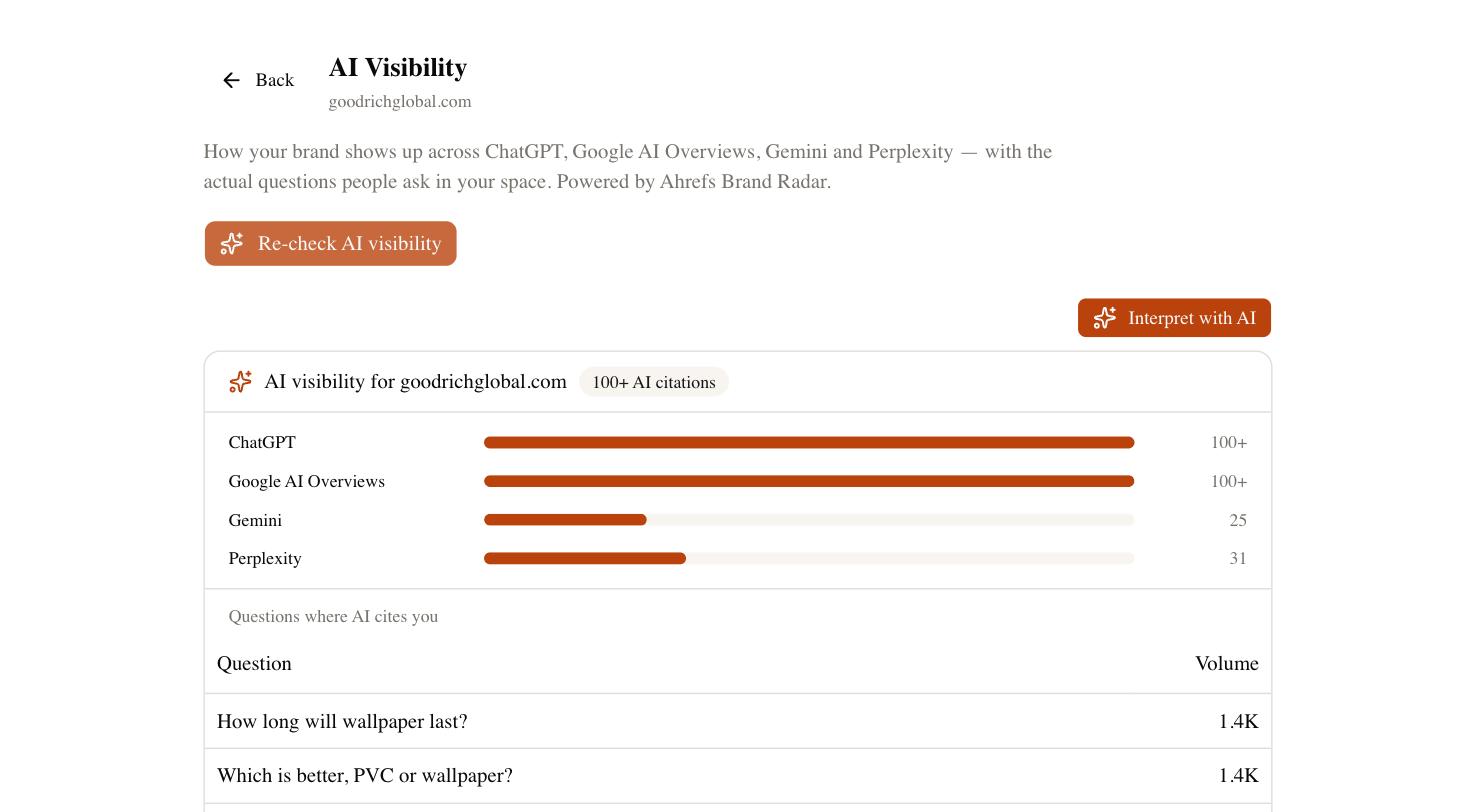
This is where SEO Rocket earns its place. Its AI Visibility feature, Brand Radar, tracks whether — and where — you are actually being cited across ChatGPT, Perplexity, and Google’s AI Overviews, so you optimize against evidence instead of a guess. You can add an llms.txt as a low-cost experiment, then watch Brand Radar to see if your presence in AI answers actually changes. That is the difference between doing the trendy thing and knowing whether it worked.
So should you bother?
Yes, but keep it in proportion. Adding an llms.txt is a ten-minute task with no downside and a small chance of future upside, which makes it easy to justify — just do not let it crowd out the work that reliably matters. Publish a clean, honest file, point it at your best pages, and keep it current alongside your sitemap.
Then spend your real effort where the returns are proven: content worth citing, technical health, and measuring your actual AI-answer presence rather than assuming a file changed it. That is llms txt explained as an operator would frame it — a reasonable small bet, not a silver bullet, and no substitute for being genuinely worth mentioning.