
Your share of voice in AI answers is the proportion of relevant AI-generated responses that mention or cite your brand, measured against the competitors who show up for the same questions. It borrows the idea from traditional share of voice — how loud you are in a market versus everyone else — and moves it onto the surfaces where buyers now ask questions directly: ChatGPT, Perplexity, Google’s AI Overviews, and the growing set of assistants that answer instead of listing links.
The reason it matters is simple. A rising slice of your audience gets an answer without ever seeing a page of blue links, and if the model doesn’t name you in that answer, you’re invisible to those people no matter how well you rank. Understanding your share of voice in AI answers tells you whether the models consider your brand part of the conversation — and, more usefully, which competitors they reach for instead.
What share of voice actually measures here
Classic share of voice measured ad spend or organic visibility against a market. The AI version keeps the spirit but changes the unit. Instead of counting rankings or impressions, you count mentions: for a defined set of prompts a real buyer might type, how often does an assistant bring up your brand, and how prominently, compared with rivals answering the same prompts?
Two details keep this honest. First, it is prompt-dependent — your voice for “best project management tool for agencies” can be strong while your voice for “cheapest CRM” is zero, so a single number across everything is close to meaningless. Second, AI answers are non-deterministic: ask the same question twice and you can get different brands, phrasing, and sources. That variability is not noise to be eliminated; it is the medium. You measure across many prompts and repeated runs to get a stable picture, the same way you’d never judge rankings off one refresh.
Why it matters — and where it doesn’t
It matters most when your buyers actually research through assistants, which skews toward considered purchases: software, professional services, comparisons, “which X should I pick” questions. In those categories, being named in the answer is the modern equivalent of appearing in a shortlist. Miss the shortlist and you don’t get the click, the demo, or the mention to a colleague.
It matters far less for navigational or transactional intent, where someone already knows your name, and for very local, low-consideration needs that assistants tend to hand back to a map or a direct link. Chasing AI share of voice for a business whose customers just type your brand and hit the site is effort spent in the wrong place. Be honest about which category you’re in before you invest — the point is to follow where your buyers actually ask, not to game a metric because it’s new.
How to structure the measurement
You can’t improve what you haven’t framed, and the framing is the hard part. A workable setup has four pieces.
- A prompt set. Build a list of the real questions your buyers ask — informational, comparison, and “recommend me a tool” phrasings. Pull them from sales calls, support tickets, and the queries you already rank for. A few dozen well-chosen prompts beat hundreds of vague ones.
- The surfaces. Decide which assistants count for you — typically ChatGPT, Perplexity, and Google AI Overviews. Different models cite differently, so track them separately rather than blending into one score.
- A scoring rule. At minimum, was your brand mentioned, yes or no. Better, weight for prominence: named as a top recommendation counts more than a passing aside, and being cited with a link counts more than an unlinked mention.
- Repetition. Because answers vary, run each prompt several times across a period and average. One snapshot is an anecdote; a fortnight of runs is a signal.
Your share of voice for a prompt set is then your weighted mentions divided by the total across you and the competitors you’re tracking. Do it monthly and the trend line — not any single reading — is what you act on.
A concrete example
Say you sell invoicing software for freelancers. You assemble twenty prompts: “best invoicing app for freelancers,” “how do I send a professional invoice,” “invoicing software with automatic tax,” and so on. You run each five times across ChatGPT, Perplexity, and AI Overviews over two weeks.
The picture that comes back is rarely flattering and always useful. Perhaps you’re named in most of the “how do I” educational prompts because your help content is thorough, but you barely appear in the “best app for freelancers” recommendation prompts, where two better-known rivals dominate. That split is the whole game. It tells you the models trust you to explain the task but don’t yet think of you as a top pick — a gap you close with comparison content, third-party reviews, and clearer positioning, not with more how-to articles you already win. Without the measurement you’d have guessed; with it you know exactly which prompts to work on and which competitor is eating the recommendation slot.
What actually moves your share of voice
This is where honesty saves you money, because a lot of AI-visibility advice is superstition. Models assemble answers from what they were trained on and, increasingly, from what they retrieve live at answer time. So the levers that work are the ones that make your brand a credible, frequently-referenced entity on the topic — the same fundamentals that were always good SEO, pointed at a new surface.
- Be genuinely citable. Clear, well-structured content that directly answers the question gives a model something clean to lift and attribute. Buried answers don’t get quoted.
- Earn third-party mentions. Being named across reviews, roundups, and reputable sites builds the association between your brand and the topic that models pick up on. Your own site saying you’re the best carries little weight; others saying it carries a lot.
- Cover the comparison and recommendation intents. If you only publish how-to content, you’ll win how-to prompts and lose the ones that drive purchases.
- Keep facts consistent. Contradictory descriptions of what you do across the web give models a muddier entity to reason about.
What does not reliably move it: keyword-stuffing for the assistant, thin “AI-optimized” pages, or any promised trick to force a citation. There’s no schema tag that makes a model love you. Treat anyone selling a guaranteed shortcut with the same skepticism you’d apply to guaranteed rankings.
Where SEO Rocket fits
Measuring all of this by hand — dozens of prompts, three surfaces, repeated runs, weighted scoring — is tedious and easy to do inconsistently. SEO Rocket’s AI Visibility view (Brand Radar) runs that measurement for you: it checks whether and where your brand is cited across ChatGPT, Google AI Overviews, and Perplexity, tracks it over time, and shows the competitors appearing in the same answers.
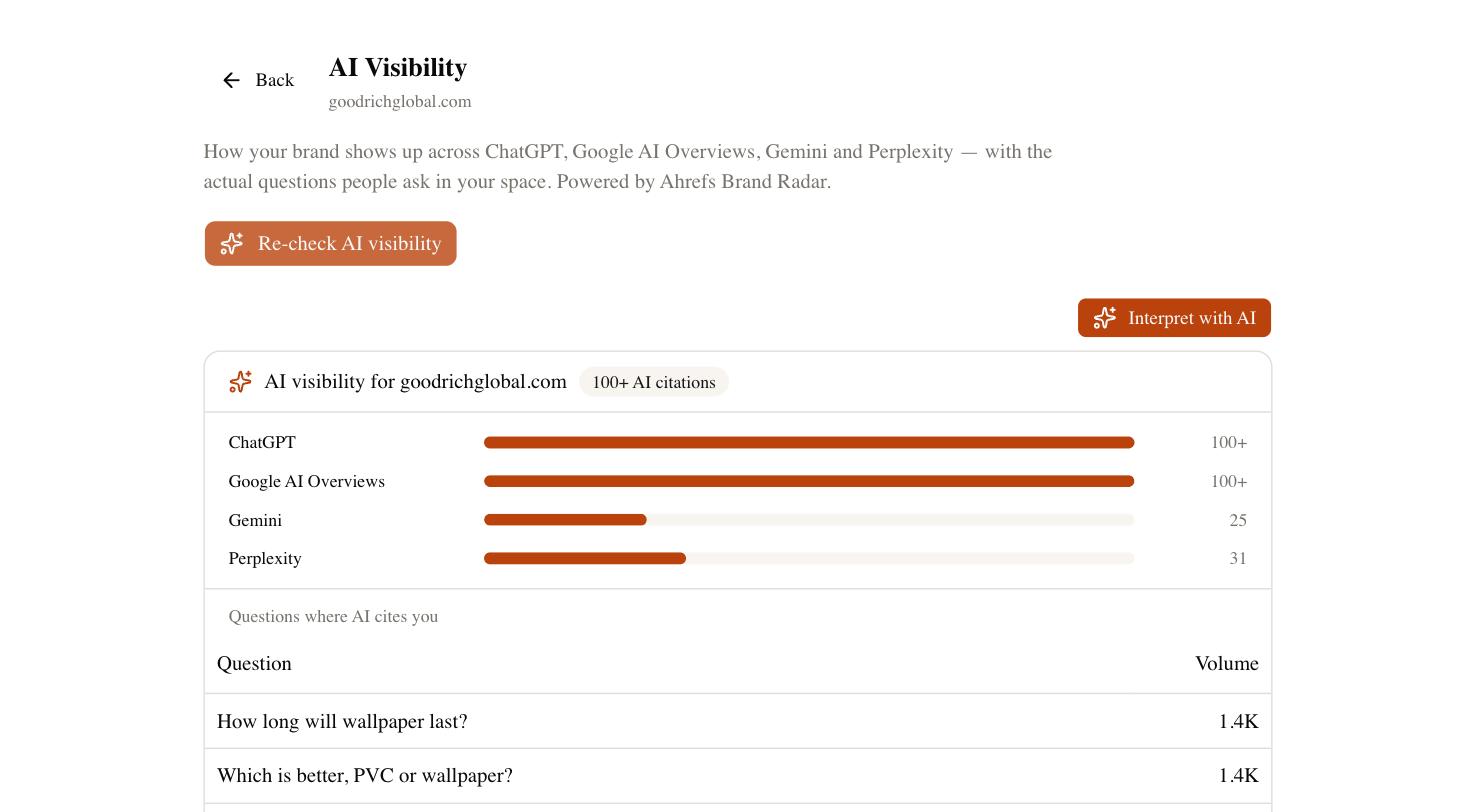
Because it sits alongside real keyword and competitor data plus AI content writing in one workflow, the loop closes in the same place: you spot a prompt set where a rival owns the recommendation, see the comparison content you’re missing, and draft it without switching tools. The value isn’t a vanity score — it’s turning a fuzzy question (“does ChatGPT ever mention us?”) into a tracked number with the next action attached. You’re optimizing for the search that’s actually happening rather than assuming your rankings carry over.
How to start this week
Don’t boil the ocean. Write down the ten questions a buyer most likely asks an assistant before choosing something like you, then run each a few times through ChatGPT, Perplexity, and AI Overviews and note who gets named. That hour gives you a baseline share of voice and, more importantly, the shortlist of competitors the models already prefer. From there, pick the two or three recommendation prompts where you’re absent and build the honest content that earns a place — then re-run in a month and watch the trend, not the daily wobble. Your share of voice in AI answers won’t move overnight, but the brands that measure it now will be the ones cited when far more of your buyers are asking.