Topical authority explained in one line: it is the signal that your site covers a subject deeply and consistently enough that search engines treat you as a credible source for it. The term gets thrown around constantly, so here is topical authority explained without the mysticism — what it really is, what actually builds it, what you can safely ignore, and a concrete example you can copy.
The short version is that authority is earned at the subject level, not the page level. A single great article about email deliverability will not make you the site to beat for email marketing. Fifteen connected articles that answer the real questions a marketer asks — from spam filters to warm-up schedules to bounce rates — start to.
What topical authority actually is
Topical authority is the accumulated trust a site earns for a specific subject area. Think of it less as a score you can look up and more as a pattern search engines infer from your content: do you cover the subject completely, do you cover it accurately, and do the pages hang together as a coherent body of work rather than a scattering of unrelated posts.
It is worth being clear that no search engine publishes a “topical authority” number, and the third-party metrics you have seen — domain rating, authority scores — are backlink-weighted estimates, not a direct read of subject expertise. They correlate with authority loosely. They do not measure the thing itself. What you are really optimizing for is coverage and coherence, and those you can control directly.
Why it matters — the mechanism, not the magic
The reason topical authority works is mundane, which is exactly why you should trust it. When your site answers a wide range of connected questions well, three things happen. You rank for the long-tail queries most competitors never bother to target. You give the algorithm more context about what your site is “about,” which helps your marquee pages compete for harder terms. And you keep more of the visitors who arrive, because the next answer they need is one click away instead of on a competitor’s site.
None of that requires a mystical trust signal. It is the predictable result of publishing comprehensive, well-linked content. The sites that dominate a niche rarely have one viral page — they have thirty pages that each rank modestly and, together, own the subject.
How topical authority is built
Three ingredients do most of the work, and they reinforce each other. Miss one and the other two underperform.
Breadth: cover the whole subject
Map every meaningful question a reader has about your topic and plan to answer them. If you sell project-management software, breadth means covering methodologies, templates, team rituals, common failures, and the adjacent tools people compare you to — not just “best project management software” ten different ways. Breadth is what tells a search engine you are a resource for the subject, not an opportunist chasing one keyword.
Depth: answer each question completely
Breadth without depth reads as thin, and thin content loses even when the site around it is strong. Each page should fully resolve the intent behind its query — enough that the reader does not need to open a second tab. Depth is where genuine expertise shows, and it is the hardest part to fake, which is precisely why it carries weight.
Structure: connect the pages
Coverage only compounds when the pages are linked into a clear hierarchy. A “pillar” page introduces the broad subject and links out to focused “cluster” pages, each of which links back and sideways to its siblings. This internal structure does two jobs at once: it guides readers through a logical journey, and it passes ranking signals between related pages so the whole cluster lifts together rather than one page carrying the rest.
A concrete example
Say you run a small accounting firm and want to own the subject “bookkeeping for freelancers.” A single 2,000-word guide will not get you there. A topical cluster will.
The pillar page is the broad guide: “Bookkeeping for Freelancers.” Around it you build cluster pages that each resolve one real question — how to separate business and personal finances, which expenses are deductible, how to set aside money for quarterly taxes, when to switch from a spreadsheet to software, how to handle late-paying clients, and what to hand your accountant at year end. Each cluster page links up to the pillar and across to the two or three siblings a reader would naturally need next.
Individually, none of those pages is a blockbuster. Collectively they cover the freelancer’s entire bookkeeping journey, and a search engine reading that cluster sees a site that clearly knows this subject. Six months in, the pillar starts competing for the competitive head term precisely because the cluster underneath it did the unglamorous work first.
What does not matter as much as you think
Being honest here saves you months. Publishing volume for its own sake does not build authority — ten pages of filler dilute a subject instead of deepening it. Exact-match keyword density does not matter; write for the human and the terms take care of themselves. Word count is not a target either — a 900-word page that fully answers the question beats a padded 2,500-word one, and search engines have gotten good at telling the difference.
Backlinks still help, but they are necessary rather than sufficient. Links to a shallow, disconnected site will not manufacture authority on their own; links pointing at a genuinely comprehensive cluster amplify work that already stands up. And do not expect same-week results — authority accrues over a full ranking cycle or two, and positions will jitter a few spots day to day while it settles. Judge the cluster over months, not mornings.
Where SEO Rocket fits
The slow part of all this is knowing which questions you have not answered yet. That is a gap-analysis problem, and it is exactly what SEO Rocket is built to make fast. Instead of manually reverse-engineering competitor sitemaps, you ask in plain language which keywords your competitors rank for that you do not, and it returns the missing subtopics from real, Ahrefs-grade data — the raw material for your next cluster pages.
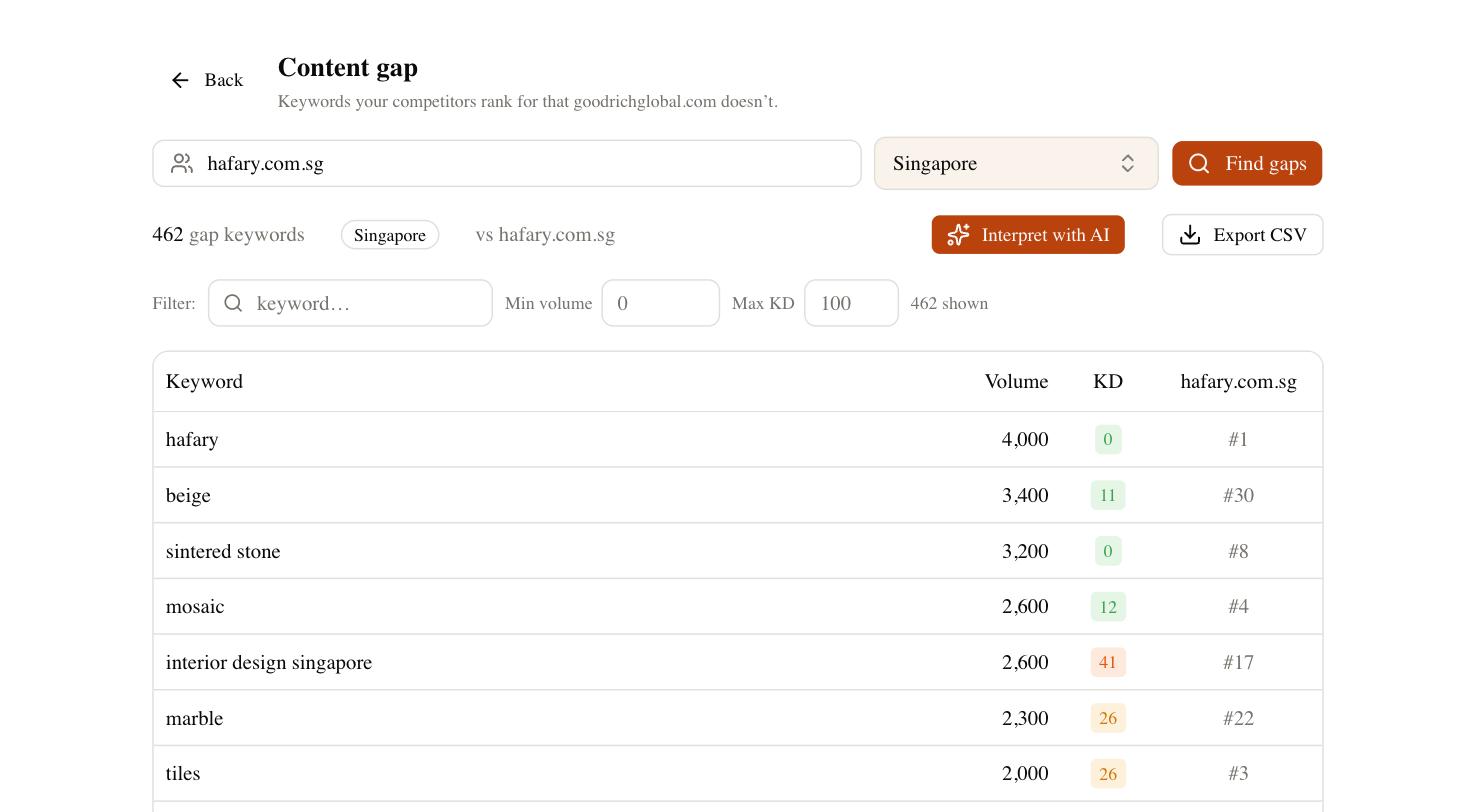
From there the same workflow closes the loop. You draft the cluster pages with AI writing that works from live keyword data rather than guesswork, track whether the new pages actually climb, and watch competitor gaps shrink as your coverage fills in. Because search is splitting, you can also see whether your growing authority is being cited in AI answers like ChatGPT and Google’s AI Overviews, not just classic search — the same subject depth that wins rankings tends to win those citations too. The point is not that a tool builds authority for you; it is that it removes the tedious mapping so you can spend your time on the depth that actually earns it.
How to start building topical authority this week
You do not need a quarter-long project to begin. Pick one subject you genuinely want to own — narrow enough that you could realistically cover it completely. List every question a customer asks you about it, then run a gap check to catch the ones your competitors already answer and you have missed. That combined list is your content plan.
Order it so the pillar page and the two or three highest-intent cluster pages come first, then publish steadily rather than in one dump. Link each new page up to the pillar and across to its natural siblings as you go, so the structure builds itself. Revisit the cluster every couple of months to add the questions that surface as you learn — a living cluster keeps compounding while a finished one slowly decays. Do that consistently on one subject before starting a second, and topical authority stops being a buzzword and becomes something you can watch accumulate.