
A topical map is a structured plan of every subtopic your website needs to cover to become the clear authority on a subject. If you just Googled what is a topical map, the short answer is this: it’s the blueprint that turns one broad idea — say, “email marketing” — into the full set of connected pages that, together, answer everything a reader or a search engine would expect a real expert on that topic to address.
It is not a keyword list, and it is not a content calendar. A keyword list is a pile of phrases. A topical map is a map: it shows how those phrases relate, which pages should exist, what each page is responsible for, and how they link together into a coherent whole. Think of it as the difference between a shopping list and a floor plan.
Why a topical map matters
Search engines don’t reward pages in isolation anymore. They try to understand whether your site, as a whole, demonstrates depth on a subject — whether you’ve covered the topic the way someone who genuinely knows it would. When your content only skims the popular, high-volume keywords, you look like a tourist. When you cover the obvious questions plus the awkward edge cases, the comparisons, the definitions, and the “how do I actually do this” details, you look like a resident.
That depth is what a topical map builds on purpose instead of by accident. It also stops the most common waste in content marketing: writing ten articles that all fight over the same three keywords while leaving the rest of the subject untouched. A good map spreads your effort across the whole territory, so each new page adds something the others don’t, and the internal links between them reinforce the theme rather than diluting it.
There’s a practical benefit too. When you plan the whole topic up front, you stop rewriting the same ground. Without a map, you’ll publish a post in March and a nearly identical one in September because you forgot the first existed — and now the two compete for the same rankings, splitting whatever authority they’d have had as one strong page. Mapping first makes that mistake almost impossible to make.
How to think about a topical map
The clearest mental model is a hub with spokes. At the center sits a broad “pillar” page covering the core subject at a high level. Around it sit “cluster” pages, each taking one narrow slice of that subject and going deep. The pillar links out to the clusters; the clusters link back to the pillar and, where it makes sense, to each other.
Picture a site about home coffee. The pillar might be a broad guide to brewing coffee at home. The clusters branch off it: how to use a French press, grind size explained, the difference between light and dark roast, how to descale an espresso machine, water temperature and why it matters. Each cluster is a complete answer to a specific question, and the pillar ties them into one authoritative library rather than a scattering of unrelated posts.
The reason this shape works is that it mirrors how people actually explore a subject. Someone rarely reads one page and leaves satisfied; they follow a thread. A visitor who lands on your grind-size article is the exact person who also wants to know about burr grinders and brew ratios. The hub-and-spoke structure meets that curiosity, keeps readers on your site longer, and tells search engines you’ve built a resource rather than a single lucky post.
What actually goes on the map
A useful topical map is organized into layers, so you can see at a glance which pages carry commercial weight and which exist to build trust and depth. You don’t need fancy software to sketch one — a spreadsheet or a whiteboard works — but naming the layers keeps the plan honest.
| Layer | What it does | Example page |
|---|---|---|
| Pillar | Broad overview that frames the whole topic and links to everything below | “The complete guide to home coffee brewing” |
| Cluster | Deep answer to one specific subtopic or question | “French press ratio: how much coffee per cup” |
| Supporting | Definitions, comparisons and edge cases that prove expertise | “Burr vs blade grinder: which to buy” |
| Commercial | Pages tied to a product, service or conversion | “Best entry-level espresso machines” |
The point of separating them isn’t bureaucracy. It’s that each layer has a job. Pillars capture broad demand and organize the site. Clusters win the specific, lower-competition searches that actually convert. Supporting pages give search engines the signals of genuine expertise. And commercial pages turn all that attention into revenue. When you map before you write, you can see whether your plan leans too hard on any one layer.
How to build one
You can build a first draft in an afternoon. The mechanics matter less than being systematic, so work in a fixed order rather than free-associating topics.
- Define the core subject in one plain sentence — the thing you want to be known for.
- List the major subtopics an expert would cover. Brainstorm first, then pressure-test the list against what people actually search for.
- Group related subtopics into clusters, and decide which broad theme each cluster rolls up into.
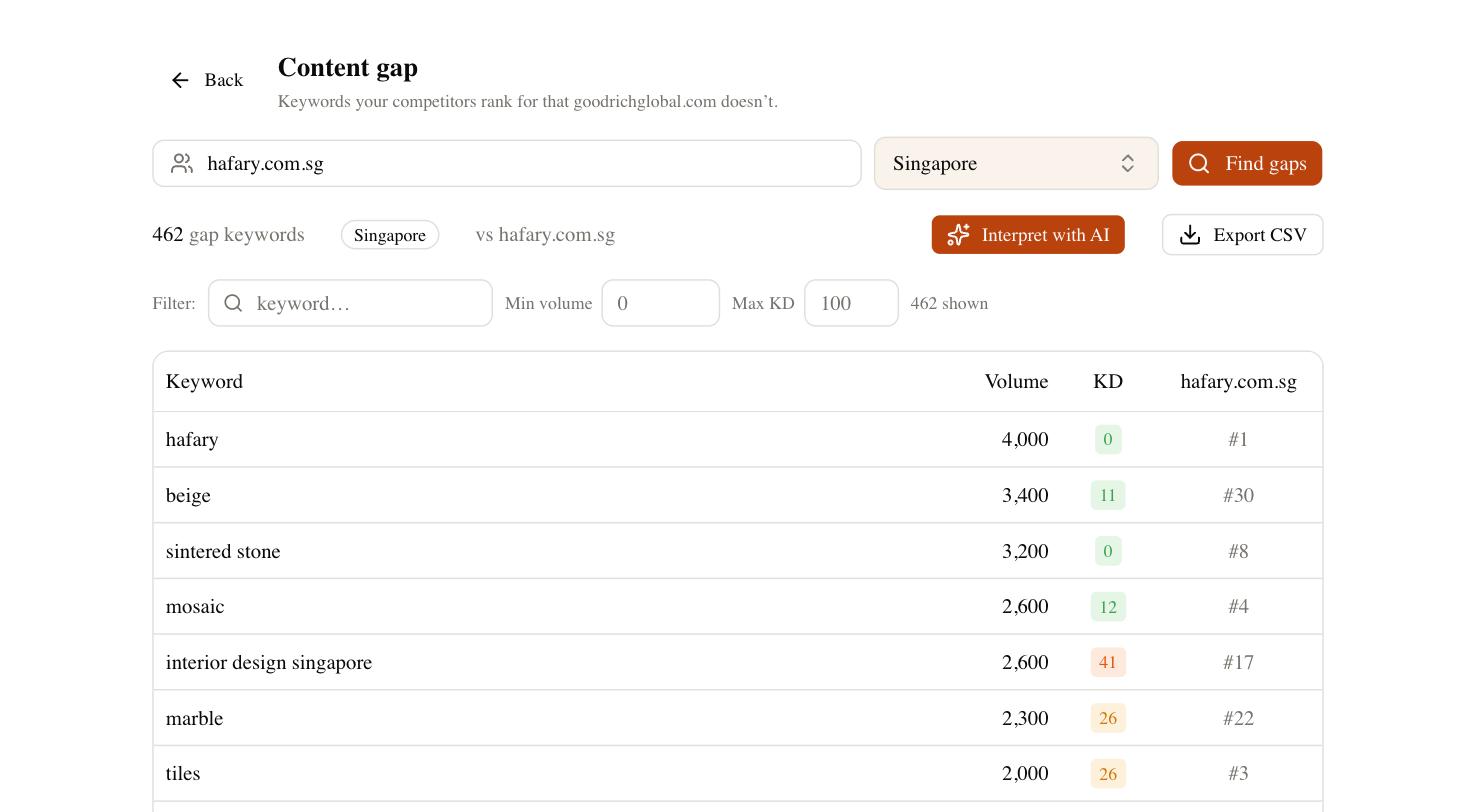
- Check what’s already ranking. Look at the pages competitors have that you don’t — the gaps are your fastest wins.
- Assign each planned page a job: which layer it belongs to, and which other pages it should link to.
Step four is where a real data tool earns its place. Guessing at subtopics gets you the obvious ones; the profitable gaps are usually the pages you’d never have thought of, sitting in a competitor’s library. A content-gap report surfaces exactly those — the keywords and topics your rivals rank for that you’re missing entirely.
From there, prioritize. Not every node on the map needs to be published at once, and it shouldn’t be. Start with the clusters closest to money and lowest in competition, publish them well, link them into the pillar, and only then work outward toward the wider supporting content. A map is a plan, not a deadline.
Common misconceptions
A few ideas trip people up often enough to be worth naming directly.
- “It’s just a keyword list.” No. Keywords are inputs. The map is the structure — how pages relate and link — that a flat list can never show.
- “More pages is always better.” Coverage matters, but a thin page on every subtopic hurts more than it helps. Depth beats a checklist of shallow posts every time.
- “Build the whole thing, then publish.” The map is a living document. Search intent shifts, competitors move, and you’ll add and retire nodes as you learn what actually ranks.
- “It replaces internal linking strategy.” The map informs your linking, but you still have to build the links deliberately — the plan on paper does nothing until the pages point at each other.
Where a topical map fits with the rest of your SEO
By now the answer to what is a topical map should feel concrete: it’s the planning layer that sits under everything else you do. Keyword research feeds it. Content writing executes it. Internal linking connects it. Rank tracking tells you which parts are working. On its own it ranks nothing — no plan does — but it’s the difference between publishing with intent and publishing whatever comes to mind that week.
It also changes how you measure progress. Without a map, success is a single page climbing a single search result, which is easy to celebrate and easy to lose. With one, success is the whole cluster gaining ground together — the pillar, its supporting pages, and the internal links between them all pulling in one direction. That shift, from chasing individual keywords to building coverage a subject at a time, is the real reason the concept has stuck around, and it’s why most durable content sites are built on a map even when they never call it that.
If you take one thing from this: before you write your next article, ask where it sits on the map, and what it’s responsible for that no other page covers. If you can’t answer that, you don’t need another article yet — you need the map. Sketch the territory first, find the gaps competitors have left open, and then write toward them one deliberate page at a time.