You probably just searched the term because someone dropped it in a strategy meeting or a tool put it in front of you. So what is content gap analysis? In one sentence: it is the process of finding the keywords and topics your competitors rank for that you don’t, so you can see exactly where your site is invisible to searchers who are ready to find you.
That’s the whole idea. You take two, three, or four rival sites, line up everything they earn traffic from, and subtract everything you already cover. What’s left is the gap — a list of searches happening every month that send visitors to them and none to you. It sounds obvious once you say it out loud, but most sites never do the exercise, which is precisely why it works so well when you do.
What is content gap analysis, in plain terms
Think of it as a Venn diagram. One circle is your site’s keyword footprint. The other circles belong to competitors. The overlap is territory you already share. The slice of their circles that never touches yours is the gap. Every keyword sitting in that slice represents a real question people are typing into Google, one where a competitor shows up and you simply don’t exist on the page.
The reason this framing matters is that it removes guesswork from content planning. Instead of brainstorming topics in a vacuum or copying whatever’s trending, you’re working from demonstrated demand — searches that already convert into traffic for sites like yours. When people ask what is content gap analysis and why it beats a blank-page brainstorm, that’s the answer: it starts from proof, not from a hunch.
Why content gaps matter
A gap is money you’re leaving on the table, and it compounds quietly. Say a competitor ranks on page one for a buying-intent phrase you’ve never targeted. Every month, a share of those searchers click through, some of them convert, and over a year that single keyword can be worth more than a whole quarter of scattered blog posts. Multiply that by dozens of missing keywords and the gap stops being an abstraction — it’s the difference between a site that grows and one that plateaus.
There’s a second, subtler reason. Search engines build a picture of what your site is authoritative about from the topics you cover well. When there are obvious holes in a subject you claim to serve, you look thin on that theme, and thin sites get outranked even on the keywords they do target. Closing gaps doesn’t just win the missing keywords; it strengthens your standing on the ones you already hold.
How to think about a content gap
Not every gap is worth filling, and this is where beginners go wrong. A keyword your competitor ranks for might be irrelevant to your business, wildly out of reach for a young site, or so low in volume it isn’t worth an afternoon. The skill isn’t finding gaps — a tool does that in seconds — it’s triaging them.
Three questions sort the list fast. First, is it relevant: would someone searching this actually become a customer, or are you chasing traffic that never buys? Second, is it winnable: can a page on your site realistically rank, given how strong the current results are? Third, is there enough demand to justify the work? A gap that clears all three is a priority. One that fails any of them goes to the bottom of the pile or off it entirely.
Reading the difficulty and authority scores
Most tools attach a domain-strength score to each competitor — Ahrefs calls it Domain Rating (DR), a 0-to-100 scale that estimates the power of a site’s backlink profile. It’s a rough proxy for how hard a domain is to outrank, and comparing it to your own is the quickest sanity check on whether a gap is winnable. Treat these bands as directional, not precise:
| DR band | Roughly what it signals |
|---|---|
| 0–20 | New or small site; beatable by most, even young domains |
| 21–40 | Established but modest authority; realistic target for a growing site |
| 41–60 | Strong domain; you’ll need solid content and some links to compete |
| 61–80 | Well-known authority; winnable on long-tail terms, hard on head terms |
| 81–100 | Major players; expect to fight on niche, specific queries only |
The practical move is to weigh a keyword’s difficulty against your own site’s strength. If a competitor five DR points above you ranks for a phrase, that’s a live target. If the only sites ranking are giants forty points clear of you, the gap is real but not yours to close this quarter — bank it for later and spend your effort where the math is friendlier.
How content gap analysis actually works
Under the hood, the process is mechanical, which is what makes it reliable. A tool crawls or pulls from a keyword index the full set of terms each competitor ranks for, cross-references it against your own ranking keywords, and returns the difference. Good tools let you set the rules: show me keywords where all three competitors rank but I don’t, or where any one of them ranks in the top ten and I’m nowhere.
The output is a list you can filter by search volume, difficulty, and intent, then sort into a content plan. In SEO Rocket you ask for it in plain language — name your site and a couple of rivals — and it runs the comparison on real, Ahrefs-grade data, then hands back the missing keywords with the volume and difficulty already attached.
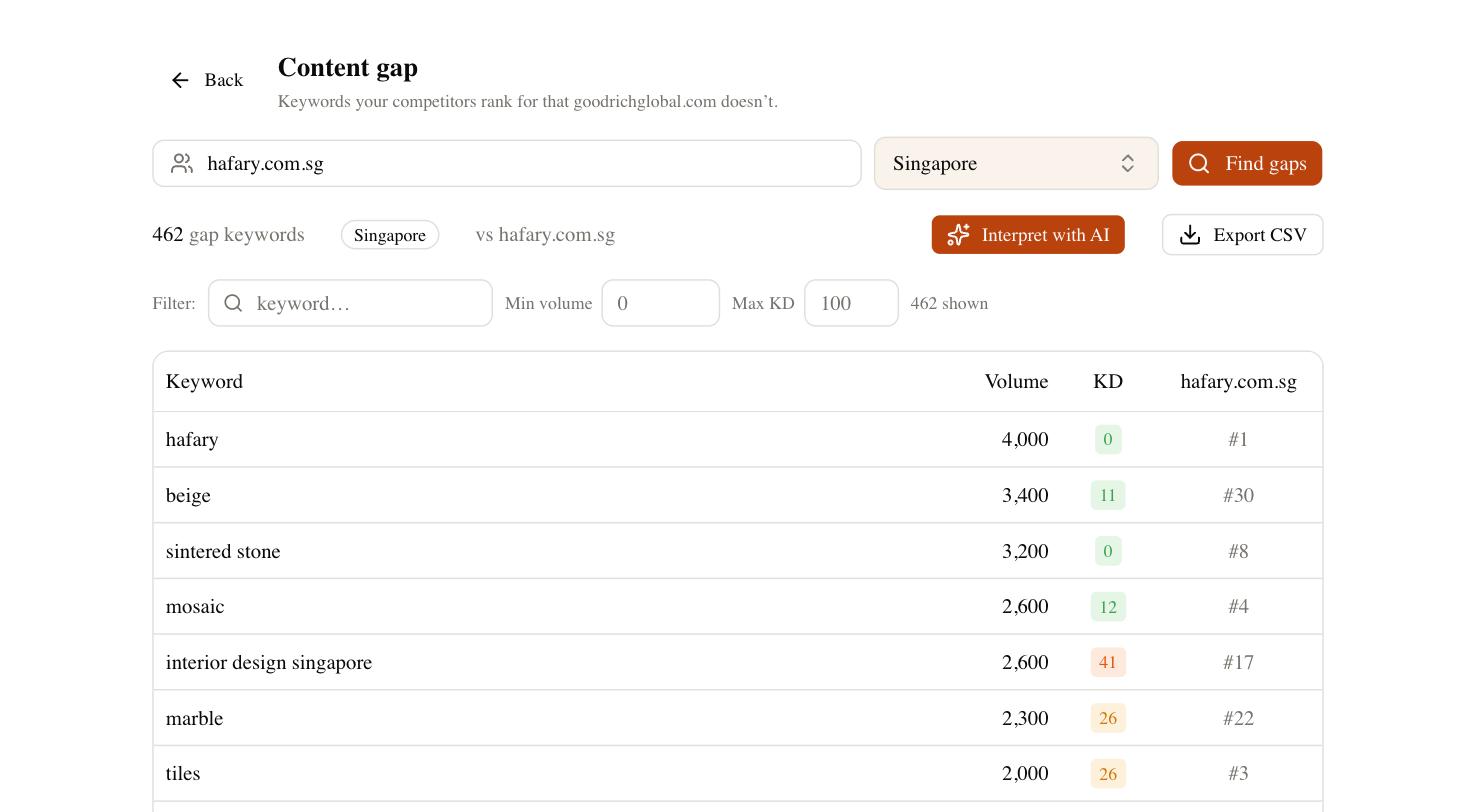
From there the workflow is straightforward: cluster the survivors by topic, decide which need a brand-new page and which can be folded into something you already publish, and order them by the relevance-winnability-demand test above. That ordered list is your roadmap for the next few months of content, built entirely from evidence rather than opinion.
Common misconceptions
The biggest one is treating the raw gap list as a to-do list. It isn’t. A fresh export can run to hundreds or thousands of keywords, most of them noise — branded terms for the competitor, off-topic queries, or phrases so competitive they’d take years. Publishing against an unfiltered list is how sites end up with piles of thin, unfocused posts that never rank.
- “More keywords means more traffic.” No — one page that fully answers a high-intent query beats ten that half-answer trivial ones. Prioritize depth on the gaps that matter.
- “A gap means I must write a new article.” Often the better fix is expanding or updating an existing page so it covers the missing sub-topic, which is faster and usually ranks sooner.
- “If a big brand ranks, I can too.” Their authority may be doing the heavy lifting. Check the DR spread before you commit; a winnable gap has beatable sites in the results.
- “It’s a one-time project.” Competitors publish constantly, so gaps reopen. A quarterly re-run keeps the plan current instead of letting it go stale.
How to run your first analysis
Start small and honest. Pick two or three competitors who genuinely compete for your customers — not the biggest names in the industry, but the sites that show up when you search your own money terms. Run the comparison, then ignore the total count and filter hard: keep only keywords that are relevant to what you sell, sit within reach of your domain strength, and carry enough volume to matter.
What survives that filter is usually a manageable shortlist, and that’s the point. Cluster it into a handful of topics, pick the two or three with the best mix of intent and winnability, and write those properly before touching anything else. A single well-executed page against a real gap will teach you more about your market than fifty speculative posts ever could.
Turning gaps into a plan
Content gap analysis isn’t a report you admire and file away — it’s the input to a decision. The finished output should answer one question: what should I publish next, and why. If your list does that, you’ve done it right; if it’s just a spreadsheet of keywords, you’ve stopped one step short.
Come back to it every quarter. Your rankings shift, competitors add pages, and last season’s unwinnable gap can become this season’s easy win once your own authority grows. Done regularly, this becomes the quiet engine behind steady growth: you’re no longer guessing what to write, you’re systematically closing the distance between your site and the ones already winning the searches you want.