What is keyword difficulty? It’s a score — usually 0 to 100 — that estimates how hard it would be to rank on the first page of Google for a given search term. You just typed a keyword into a research tool, saw a number next to it, and wanted to know whether that number is good news or bad news. This guide answers exactly that, without the jargon.
The short version: a higher keyword difficulty means more established, more authoritative pages already own the top results, so you’d need more of your own authority and better content to break in. A lower number means the front page looks beatable. But the score is a starting point, not a verdict — and treating it as gospel is where most people go wrong.
Where the difficulty number actually comes from
No tool can see Google’s ranking algorithm, so keyword difficulty is a model, not a measurement. Most tools build it primarily from the backlink strength of the pages currently ranking on page one. The logic is simple: if the top ten results all have thousands of referring domains pointing at them, out-linking that field is a serious project, and the score rises. If the top results are thin pages with almost no links, the score drops.
Different tools weigh other signals on top of links — the authority of the whole domain, on-page relevance, how well each page matches the search intent, and sometimes the presence of ads or featured snippets. This is why the same keyword can show a difficulty of, say, the low 30s in one tool and the mid-40s in another. Neither is wrong. They’re two models trained on different data, and both are estimating the same unknowable thing.
Why keyword difficulty matters
Difficulty matters because your time and content budget are finite. If you write ten articles this quarter and aim every one at a term dominated by national brands with huge link profiles, you may rank for none of them. Aim those same ten articles at terms where the front page is weak, and you could rank for most. Difficulty is how you tell those two situations apart before you spend the effort, not after.
It also sets expectations honestly. A term with a difficulty in the 60s isn’t off-limits, but it tells you the timeline is months of consistent work and link-building, not a single well-written post. Knowing that up front stops you from declaring a page a failure at week three when it was always a year-long play.
How to read the score
Because vendors calibrate their scales differently, treat any published band as a rough guide rather than a law. Still, the general shape holds across tools: the lower the number, the more realistic a target it is for a site that’s still building authority. Here’s a practical way to read a 0–100 scale.
| KD range | What it usually means | Who it suits |
|---|---|---|
| 0–14 | Weak front page; often thin or off-topic results | Brand-new sites and first content |
| 15–29 | Beatable with genuinely good, well-matched content | Small sites building momentum |
| 30–49 | Competitive; you’ll need some authority and a few links | Established sites with a track record |
| 50–69 | Hard; strong domains dominate, expect a long timeline | Sites with real authority and a link plan |
| 70–100 | Very hard; national brands and heavily-linked pages | Large, high-authority sites only |
Read the score relative to your own site, not in the abstract. A difficulty of 40 is a comfortable target for an authoritative domain and a stretch goal for a three-month-old blog. The number never changes, but what it means for you depends entirely on the authority you’re bringing to the fight.
Look past the number at the actual results
The single most useful habit in keyword research is to stop trusting the score alone and open the search results yourself. The difficulty model can only summarize what it measures; your eyes catch what it misses. Scan the top ten and ask a few honest questions.
- Who’s actually ranking? A page of forum threads and old blog posts is far more beatable than a page of major publications, even if both show the same difficulty.
- Do the results match the intent? If people searching that term want a product page but Google is showing guides, a well-aimed page can win despite a scary number.
- How good is the weakest page-one result? You don’t have to beat the best page. You have to be better than the worst one currently ranking — that’s your real bar.
That last point is the one seasoned SEOs lean on. Difficulty scores describe the average strength of the field, but rankings are a competition against specific pages. Find the weakest page on page one, decide honestly whether you can out-write and out-link it, and you have a far better read on your odds than any single score gives you.
Common misconceptions
Keyword difficulty gets misused in a handful of predictable ways. Clearing these up will save you from bad calls.
Low difficulty does not mean low value
A term can be easy to rank for and still be worth targeting — often the easiest keywords are specific, long-tail phrases where the searcher knows exactly what they want and is close to acting. Chasing only high-volume, high-difficulty terms while ignoring easy ones is how new sites stall.
Difficulty and search volume are different things
A keyword can be low difficulty and low volume, or high difficulty and high volume, in any combination. Difficulty tells you how hard it is to rank; volume tells you how many people search it. You need to weigh both, plus how commercially relevant the term is to you. A moderate-difficulty keyword that describes exactly what you sell often beats an easy one nobody who buys from you would ever type.
A single score is not a guarantee
Two tools disagreeing on the same keyword isn’t a bug — it’s a reminder that these are estimates. Use difficulty to prioritize and to sanity-check ambition, never as a promise. Google’s results shift, competitors publish, and your own authority grows. The score is a snapshot of a moving target.
How to use difficulty in real research
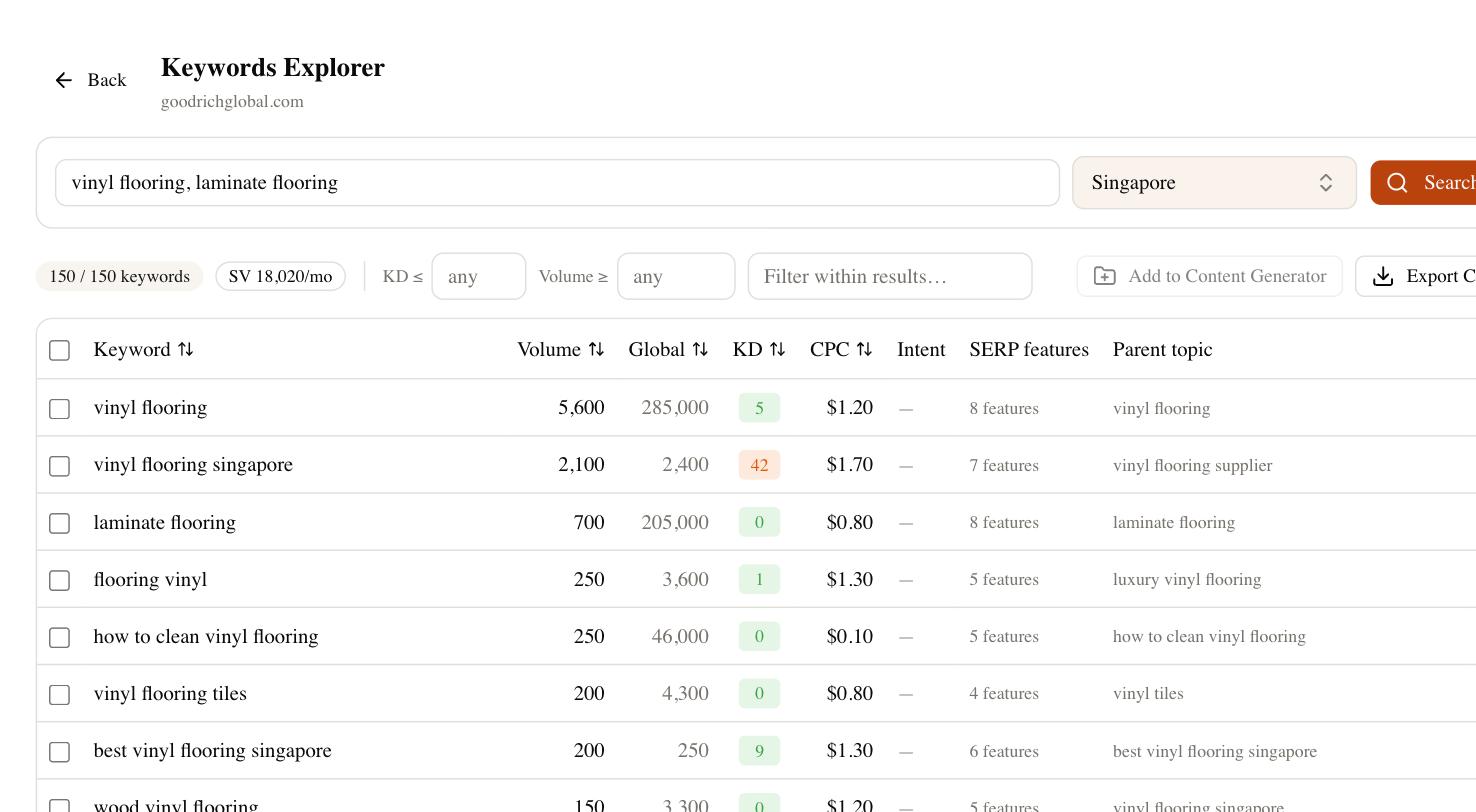
In practice, difficulty earns its keep as a filter. Pull a big list of keyword ideas, then sort by difficulty to surface the terms your site can realistically win right now, and set the intimidating ones aside for later, when you’ve built the authority to chase them. That single sort turns a wall of possibilities into a short, workable list.
From there, layer in the other signals. A good workflow looks at difficulty, volume, and how closely the term matches what you actually offer, then eyeballs the live results before committing. Modern tools speed this up considerably — in SEO Rocket you can ask for keyword ideas in plain language and get volume and difficulty side by side, then read the ranking pages without hopping between tabs, so the judgment call takes minutes instead of an afternoon.
Start where you can win. Target the achievable terms first, bank the traffic and the links they earn, and use that growing authority to move up the difficulty scale over time. That’s the whole game: not avoiding hard keywords forever, but earning the right to compete for them. Understanding what keyword difficulty is measuring — and what it quietly isn’t — is what lets you spend your effort where it actually pays off.