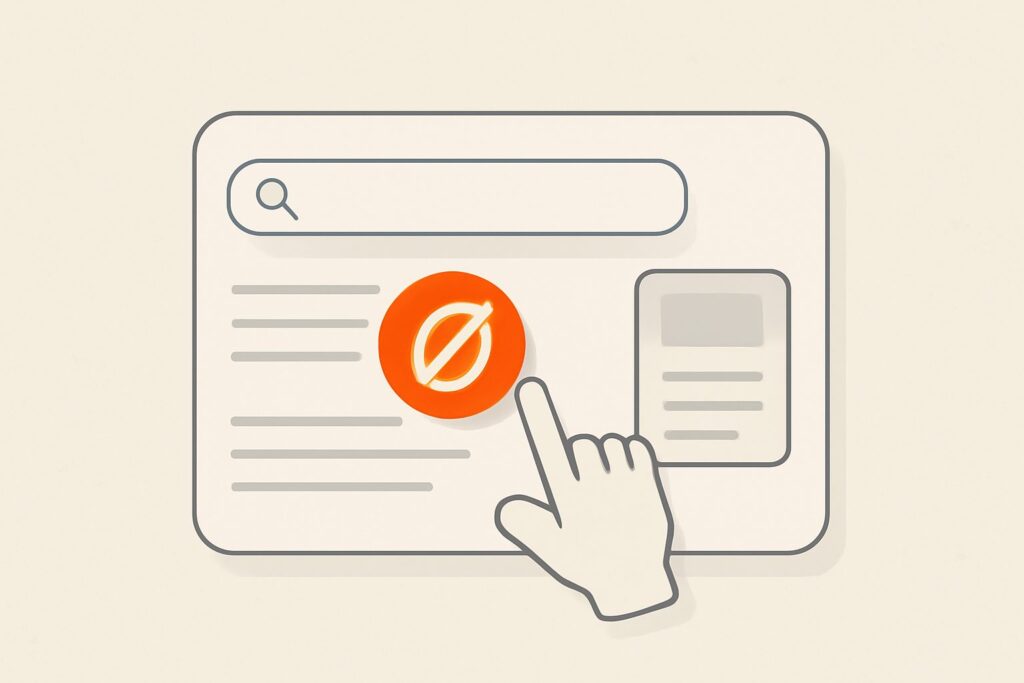
A zero-click search is any search where the person gets their answer on the results page and never clicks through to a website. Zero click searches explained in one sentence: Google increasingly answers the question itself — with a featured snippet, a knowledge panel, a weather box, a calculation, or an AI Overview — so the searcher is satisfied without visiting anyone. That is not a glitch to fix. It is how a large and growing share of search now works, and the sites that adapt to it are quietly winning the visibility that used to come only from a click.
The instinct is to treat every zero-click result as a stolen visit. That framing will cost you. Once you understand zero click searches explained at the mechanism level, you can tell the difference between a query that was never going to convert anyway and one where you should fight for the click — and you can start extracting real value from the searches that end on Google.
What actually counts as a zero-click search
Not all of them are the same, and lumping them together leads to bad decisions. A zero-click search is broadly any query resolved on the SERP itself, but the causes vary. Some are answered by a data widget Google owns outright — a currency conversion, a sports score, a time zone, a definition. You were never getting that click, and you never had it to lose.
Others are answered by pulling a snippet directly from a ranking page. The searcher reads your two sentences at the top of the page, nods, and leaves. Here the click was possible, and it went missing because Google surfaced just enough of your content to close the loop. A third and newer category is the AI Overview, where a generated summary blends several sources into one answer. Telling these apart matters, because your response to each is different.
Why Google keeps expanding them
The reason is simple and it is not going to reverse: answering faster keeps people searching. Every time Google resolves a question in place, the experience feels quicker, which trains searchers to come back. Voice assistants and mobile screens push in the same direction — there is barely room for ten blue links on a phone, and no room at all when someone asks a speaker out loud.
So the honest baseline is this: a meaningful slice of search intent is now satisfied without a website visit, and that slice grows with every feature Google ships. Fighting the trend is futile. The useful move is to figure out which of your queries are affected and whether you can still capture value from them.
A concrete example
Say you run a small accounting firm and you rank well for “how long to keep tax records.” That query has clear informational intent, and Google loves to answer it with a featured snippet — probably a short list of retention periods. If your page provides the cleanest version of that list, Google may lift it into the snippet. The searcher reads “keep most records three years, some seven” and closes the tab. No click.
Here is the part people miss. That searcher just saw your firm’s name at the very top of the results, positioned as the authority Google trusts to answer the question. That is a branding impression you did not pay for. Meanwhile, the same page can still earn the click from people who want the caveats — the exceptions, the state rules, the “what if I’m audited” follow-up. You lose the shallow click and keep the valuable one. For a topic like this, that is a good trade.
Now flip it. If you sell a product and someone searches “best accounting software for freelancers,” a zero-click answer that recommends three competitors is a real loss. Same feature, opposite consequence. The example shows why you have to judge zero-click impact query by query, not as a blanket threat.
How to apply this to your own site
The practical work comes down to a repeatable loop. You are not trying to eliminate zero-click results; you are sorting them into “fine,” “capture the brand value,” and “must win the click.”
- Segment your queries by intent. Purely factual, one-answer questions are natural zero-click territory — accept it. Comparison, commercial, and multi-step queries still want a click, so those are where you push.
- Check which of your rankings already lose the click. Look at pages with high impressions but a low click-through rate. That gap is often a snippet or an AI Overview answering for you. Some of those are fine; some are worth reclaiming.
- Decide snippet strategy per page. For brand and informational queries, format to win the snippet — a tight definition, a clean list, a direct answer near the top. The impression and authority are worth more than the lost shallow click.
- Protect commercial queries. Where the click carries the money, make the page answer the surface question but hold the deciding detail — pricing nuance, a comparison, the recommendation — just past the fold so the searcher has a reason to come in.
None of this requires guesswork if you can see the data behind it. The whole loop depends on knowing your impressions, your click-through rate, and which SERP features sit on each keyword.
What matters and what does not
Be honest about the stakes so you spend effort in the right place. What genuinely matters: winning the featured snippet on queries where the impression builds authority or captures a brand mention, and defending the click on anything with commercial intent. Those two moves cover most of the real upside.
What does not matter, despite the anxiety around it: chasing clicks on queries that were always going to be answered by a widget. You will never win the click on “what time is it in Tokyo,” and you should not waste a page trying. Equally overblown is the fear that zero-click means SEO is dead. It does not. It means the reward for ranking is shifting from raw traffic toward visibility, brand presence, and being the source an AI answer cites. Rankings still jitter a few positions day to day, third-party estimates are still estimates, and the fundamentals — useful content, clear structure, earned links — still decide who Google trusts enough to quote.
Where SEO Rocket fits
Acting on any of this requires seeing it first, and that is the gap the tooling closes. SEO Rocket runs on real, Ahrefs-grade data, so you can pull the keywords where you rank, the SERP features attached to each one, and the pages where high impressions are not turning into clicks — the exact signal that a zero-click feature is answering for you.
The part traditional tools miss is the AI-answer side. Because search is splitting across ChatGPT, Perplexity, and Google’s AI Overviews, a page can be quoted in an answer while never getting a visit, and its Brand Radar feature tracks whether and where you are being cited across those surfaces. You ask in plain language, it runs the lookup, and it can draft the snippet-ready content to go with it. That turns “zero-click” from a vague worry into a list of specific pages you can either accept, optimize for the brand impression, or rework to win back the click.
The takeaway
Zero-click searches are not the end of organic value — they are a change in what that value looks like. Some queries were never clicks to begin with, some now pay you in brand impressions and citations instead of visits, and a smaller, more valuable set still rewards the page that earns the click. Sort your queries into those buckets, win the snippets that build authority, defend the ones that drive revenue, and measure the AI surfaces where the new visibility actually lives. Do that and a trend that scares most site owners becomes an edge over the ones still counting only clicks.