
SEO for B2B is not the same job as ranking a recipe blog or an e-commerce store, and treating it that way is why most B2B sites stall. The searches that matter are low-volume, high-intent, and spread across a buying committee that takes months to decide — so SEO for B2B is less about traffic totals and more about owning the handful of queries that a serious buyer types right before they book a demo.
If you sell a $30,000 contract, a keyword with 90 monthly searches can be worth more than one with 90,000. That single fact changes almost every decision — which keywords you chase, what you write, and how you measure whether any of it worked.
How B2B buyers actually search
A B2B purchase rarely starts with someone ready to buy. It starts with a problem owner Googling a symptom — “why is our sales pipeline stalling,” “how to reduce SaaS onboarding churn” — long before they know your category exists. Weeks later the same person, now building a shortlist, searches very differently: “best [category] software,” “[competitor] alternatives,” “[product] pricing.” By the final stretch there are three or four people involved, and each has their own searches. The champion reads comparison pages; the finance lead searches for ROI and pricing; the security reviewer looks for compliance and SOC 2 documentation.
That journey means one page can never do the job. You need content mapped to each stage, and you need to accept that the bottom-of-funnel pages — the boring “vs” and “pricing” and “for [industry]” pages — are the ones that actually generate revenue, even though they’ll never win a traffic award. It also means your search intent will skew commercial far earlier than a consumer site’s would, because even a first-time searcher researching a business problem is, by definition, a qualified prospect for someone. Read every keyword through that lens.
The money keywords in B2B
The highest-value B2B keywords cluster into a few predictable patterns. They look small in a volume report and convert far above anything top-of-funnel. Here’s how the intent tiers break down, with the kind of examples you’d actually target for a project-management or CRM-style product.
| Keyword pattern | Example | Intent | Priority |
|---|---|---|---|
| Category + “software” | project management software | Commercial — building a shortlist | High |
| “Best” + category | best CRM for agencies | Commercial — comparing options | High |
| Competitor + “alternatives” | Asana alternatives | Commercial — actively switching | Very high |
| Product A “vs” Product B | Monday vs Asana | Commercial — final shortlist | Very high |
| Category + “for [industry]” | CRM for law firms | Commercial — niche fit | High |
| Problem or “how to” | how to track team capacity | Informational — early research | Medium |
| Category + “pricing” / “cost” | PM software pricing | Transactional — budgeting | Medium-high |
Notice that “alternatives” and “vs” queries sit at the top. Someone searching “Asana alternatives” has already decided to spend money — they’re just choosing where. Ranking there puts you in front of a buyer at the exact moment of switching, which is why these low-volume pages routinely outperform a viral blog post that pulls ten times the traffic.
The highest-leverage moves
Start at the bottom of the funnel and work up. Most B2B teams do the opposite — they publish thought-leadership pieces for years and wonder why nothing converts. Build your comparison, alternatives, and “for [industry]” pages first, because they’re closest to the sale and usually the least competitive. A well-built “[competitor] alternatives” page can rank within a couple of months and start booking demos almost immediately.
Second, build topic depth, not scattered posts. B2B buyers judge expertise, and so does Google. One authoritative pillar on your core category, supported by a dozen genuinely useful sub-pages, beats fifty thin articles. Third, get your product and pricing pages indexable and clear — buyers search for these directly, and hiding pricing behind a “contact sales” wall often just hands the click to a competitor who published theirs.
Finally, invest in the assets that earn links naturally: original data, benchmarks, calculators, and templates. In B2B, a single referenced statistic or free template can pull backlinks for years, and links remain necessary — though never sufficient on their own — to compete for the commercial terms that matter.
Common mistakes B2B teams make
The most expensive mistake is chasing volume. A director sees “10,000 searches a month” and greenlights content around a keyword no actual buyer of a six-figure platform would ever type. Traffic goes up, pipeline doesn’t move, and SEO gets blamed. Judge keywords by who searches them, not how many.
The second mistake is writing for peers instead of buyers. B2B content drifts into jargon and industry inside-baseball because the author is thinking about their LinkedIn feed, not the finance lead who needs a straight answer on cost. The third is neglecting AI search entirely. A growing share of B2B research now happens inside ChatGPT, Perplexity, and Google’s AI Overviews, where a page that ranks first on classic Google can still go completely uncited. If you’re not checking whether AI tools mention you, you’re blind to a channel your buyers already use.
How SEO Rocket fits a B2B workflow
SEO Rocket is built for exactly this kind of low-volume, high-intent work. You ask in plain language — “show me the alternatives and comparison keywords for my category” — and it runs the research on Ahrefs-grade data, so you can find the small, valuable queries a volume-first tool buries. The competitor gap feature is especially useful in B2B: point it at two or three rivals and it surfaces the exact commercial terms they rank for and you don’t, which is usually your fastest route to pipeline.
From there the same tool drafts the comparison and “for [industry]” pages, tracks your positions on the terms that actually close deals, and — through Brand Radar — shows whether ChatGPT and Perplexity are citing you when a buyer asks them for recommendations. For consultants and agencies serving B2B clients, the client dashboard hands over a clean, read-only report without exporting a thing.
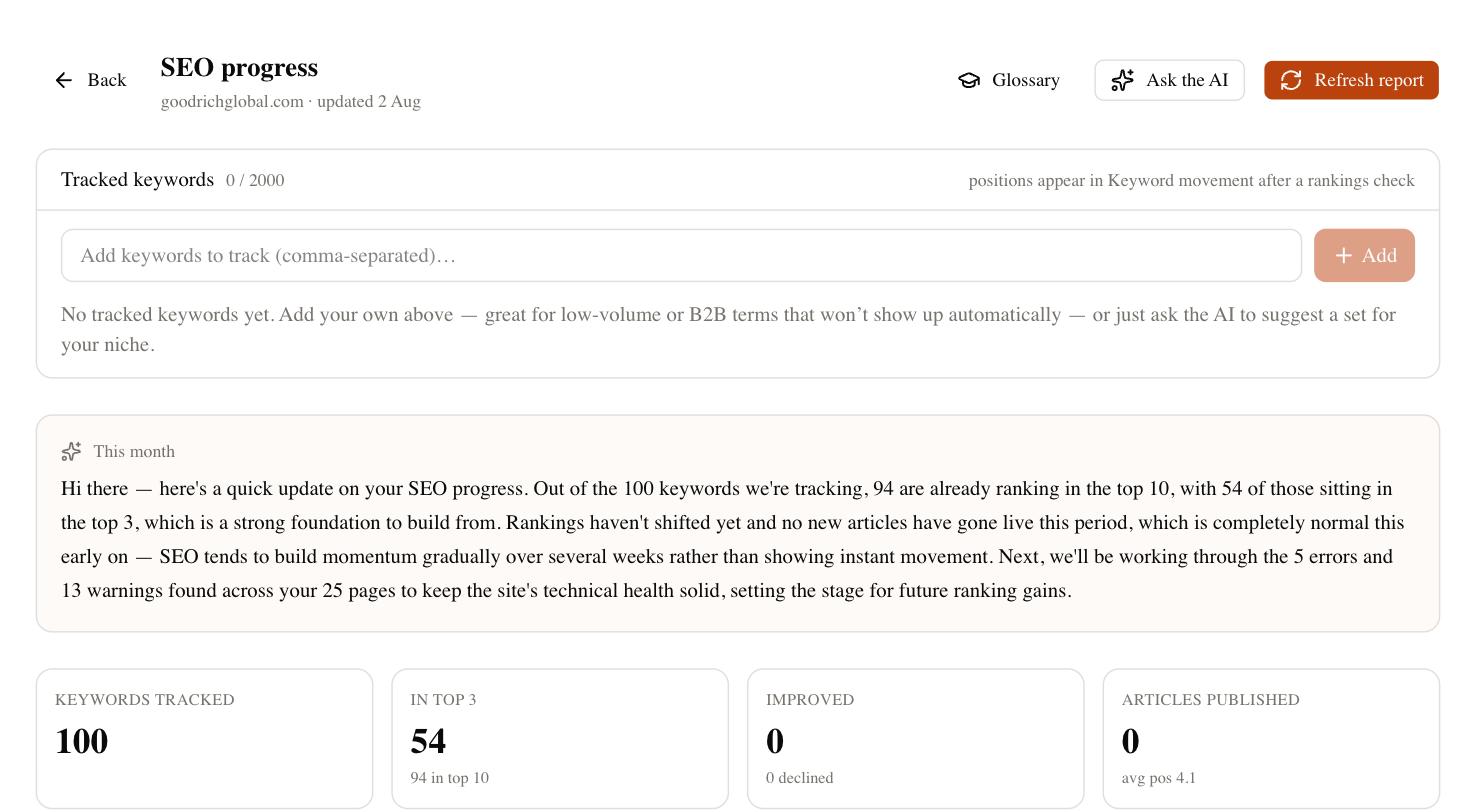
None of this is magic. Positions still jitter a few spots day to day, links still take time to earn, and thin pages still lose no matter how clever the keyword. But having research, writing, rank tracking, and AI-visibility in one place removes the tool-sprawl that slows most B2B teams down.
Your B2B SEO priority checklist
If you do nothing else this quarter, work this list in order. It’s sequenced by proximity to revenue, not by ease.
- Map your buying committee’s searches — champion, finance, security, end user — and note which stage each hits.
- Publish your bottom-funnel pages first: “[competitor] alternatives,” “vs” comparisons, and “[category] for [industry].”
- Make pricing and product pages clear, indexable, and honest — don’t hide the number buyers are searching for.
- Run a competitor gap analysis and claim the commercial keywords your rivals already own.
- Build one deep pillar per core category instead of scattering thin posts.
- Create one link-worthy asset — original data, a benchmark, or a template — per quarter.
- Track your AI-search visibility, not just classic rankings.
The teams that win at SEO for B2B aren’t the ones publishing the most. They’re the ones who identified the twenty searches a real buyer makes before signing, owned every one of them, and ignored the vanity metrics along the way. Start with the search your best customer made last week, and build outward from there.