If you just Googled the phrase and landed here, here is the short answer: what is AI SEO comes down to using artificial intelligence to do search engine optimization faster, and optimizing your site so AI systems recommend it back. It matters because the term now covers two related jobs at once, and people usually mean only one of them when they say it.
The first job is using AI as a tool — to research keywords, draft content, audit a site, and spot competitor gaps in a fraction of the time it used to take. The second is newer and less obvious: making sure your pages get surfaced by AI-driven search itself, like ChatGPT, Perplexity, and Google’s AI Overviews. Both fall under the same umbrella, and this guide walks through each so you can tell which one a given article, tool, or salesperson is actually talking about.
A one-line definition, then the nuance
Strip away the jargon and it comes down to a simple idea. Traditional SEO is the practice of earning visibility in search results through relevant content, technical health, and links. AI SEO keeps that goal but changes two things about it: the methods you use to get there now lean on machine learning, and the surfaces you are trying to appear in now include AI-generated answers, not just the classic list of ten blue links.
That second shift is the part most definitions skip. For twenty years, “ranking” meant a position in a search results page. Today a chunk of your audience never sees that page — they ask a chatbot a question and read a synthesized answer that may cite three sources and ignore the other nine million. If your site is not one of those cited sources, you are invisible to that reader no matter how well you rank in the traditional sense.
Why AI SEO matters now
Search behavior is splitting. Some of your buyers still type a query into Google and scan the results the way they always have. A growing number open ChatGPT or Perplexity, describe what they need in a full sentence, and act on the answer without clicking anything at all. Those are two different funnels, and a page can win one while losing the other.
This is why AI SEO is not a rebrand of the old playbook. The fundamentals still hold — useful content, clean technical structure, and credible links remain the foundation — but the definition of “showing up” has widened. You are now competing for a spot in a paragraph an AI writes on the fly, and the signals that earn that spot overlap with, but are not identical to, the ones that earn a top ranking. Ignoring the shift does not make it go away; it just means a competitor gets cited in the answer your customer reads.
The two halves of AI SEO
Because the term gets used loosely, it helps to separate its two meanings and treat them as distinct skills.
Using AI to do SEO
This is the half most people think of first. AI speeds up the grind: generating keyword clusters, drafting and refining articles, summarizing a technical audit, and flagging the pages a competitor ranks for that you do not. Done well, it compresses a week of manual research into an afternoon. Done badly, it floods the web with generic filler that search engines have gotten very good at ignoring. The tool does not replace judgment — it removes the busywork around it.
Optimizing for AI search
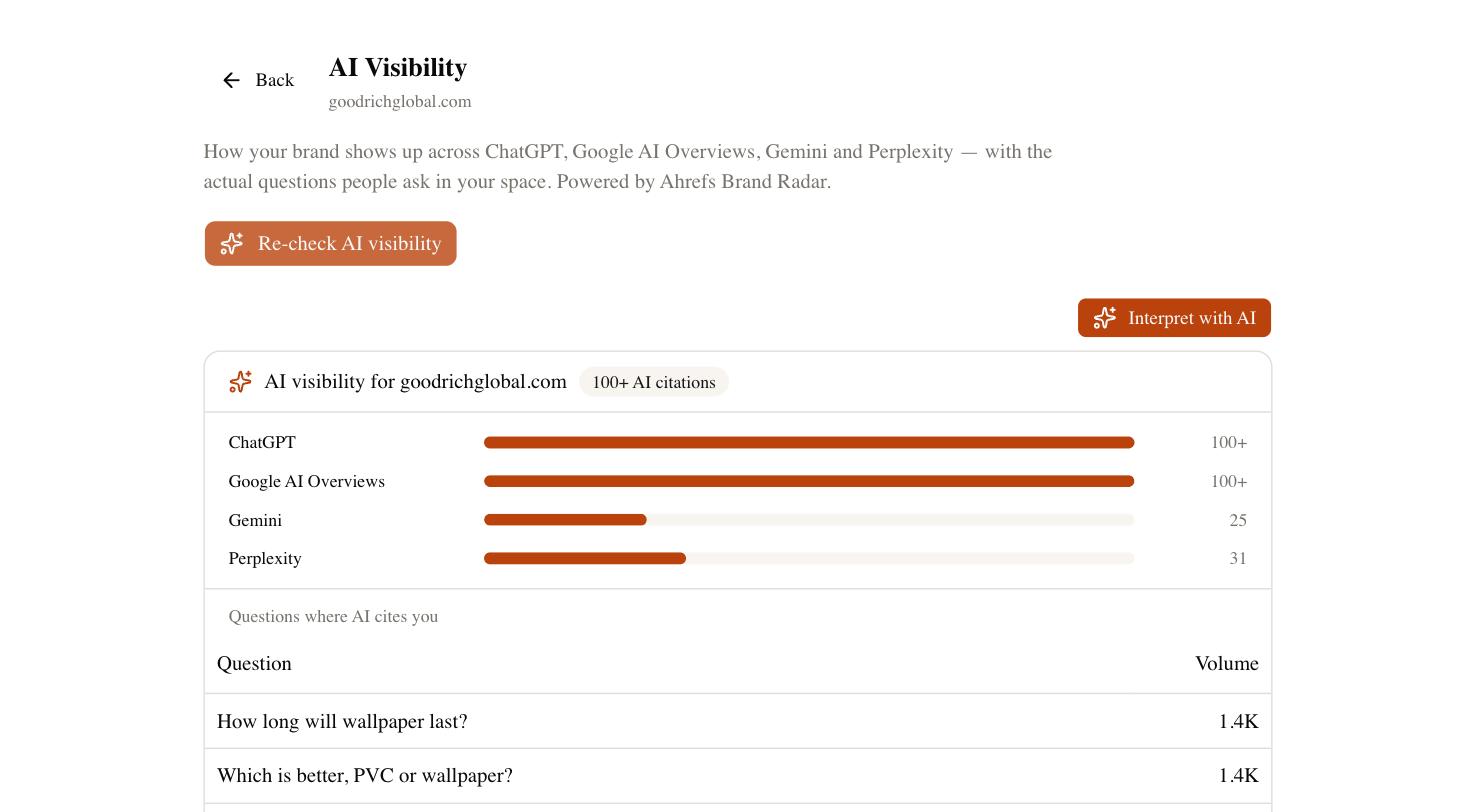
The second half is about being the answer, not just the tool. When someone asks an AI assistant a question in your niche, does your brand get named? This work — sometimes called generative engine optimization or answer-engine optimization — focuses on clear, factual, well-structured content that AI systems can quote confidently, plus the kind of brand mentions and authority signals that make you a source worth citing. It is measured differently too: instead of a rank position, you track whether and where you are cited across AI surfaces.
How to think about it
The most useful mental model is to treat AI as an accelerator sitting on top of unchanged fundamentals, not a shortcut around them. Search engines and AI assistants are both trying to do the same thing they have always done: identify genuinely helpful, trustworthy content and put it in front of the right person. AI changes how quickly you can produce and analyze that content, and it adds new places for it to appear — but it does not reward thin, unhelpful pages just because a machine wrote them. If anything, the flood of AI-generated mediocrity has raised the bar for what stands out.
So the practical stance is boring on purpose: use AI to move faster on the work that was always worth doing, and hold the output to the same standard you would hold a good human writer. A well-researched article that an AI helped you draft in two hours is fine. A vague one it hallucinated in ninety seconds is not, and readers and search engines will both tell the difference.
A quick map of the metrics you’ll meet
Learning AI SEO means running into a handful of scores. They are useful shorthand, but every one of them is a third-party estimate, not a number handed down by Google. Treat them as directional. Domain Rating, for example, is a 0–100 strength score based on a site’s backlink profile, and it is easier to read once you know roughly what each band signals.
| DR range | Rough interpretation |
|---|---|
| 0–20 | New or small site; a little link building moves the needle fast |
| 21–40 | Established but still growing; competitive for mid-difficulty terms |
| 41–60 | Strong authority in a niche; can rank for harder keywords with good content |
| 61–100 | Major, well-linked domain; hard to displace on competitive queries |
The point of a table like this is not precision — two tools will report different DR numbers for the same site — but calibration. It tells you whether you are punching above or below your weight for a given keyword, which is exactly the kind of judgment call AI tooling is meant to inform rather than replace.
Common misconceptions
A few myths follow the term around, and clearing them up saves a lot of wasted effort.
- “AI SEO means letting AI write everything.” It does not. Unedited AI output tends to be generic and occasionally wrong, and publishing it at scale is a reliable way to get ignored. AI drafts; you direct, fact-check, and add the specifics only you know.
- “It replaces traditional SEO.” It extends it. Technical health, useful content, and links still decide most of your visibility. AI adds speed and a new set of surfaces on top of that foundation.
- “There’s a trick to rank in AI answers.” There is no gimmick. The same things that make content trustworthy to a reader — clarity, accuracy, structure, real authority — are what make an AI comfortable citing it. Shortcuts age badly.
- “You need to pick between old SEO and AI search.” You do not. Most of the work overlaps, and the sites doing well in AI answers are usually the ones already doing the fundamentals properly.
Where to start
If you are new to this, resist the urge to buy five tools and automate everything on day one. Start by understanding your current position: what you already rank for, where the obvious content gaps are, and whether your brand shows up at all when an AI assistant is asked about your niche. That last check surprises most people, because a site can rank respectably in Google and still never get mentioned in an AI answer.
From there, the workflow is the same one good SEOs have always used, just faster. Pick keywords you have a realistic shot at given your authority, produce genuinely useful content around them, keep the technical side clean, and earn the links and mentions that build credibility. Use AI to compress the research and drafting, and use an AI-visibility check to see whether the newer surfaces are picking you up. That combination is really all AI SEO means in practice — the old craft, done quicker, aimed at a search landscape that now has more than one front door.
The honest bottom line: none of this is magic, and anyone promising overnight results with AI is selling something. What AI genuinely changes is your speed and your reach. It lets a small team do the research, writing, and monitoring that used to need several people and several tools — and it points that work at both the search everyone knows and the AI-driven one that is quietly taking a share of it.