
If you just searched what are answer engines, here is the one-sentence version: they are search tools that reply with a single written answer instead of a page of blue links. The longer answer to what are answer engines — and why the term suddenly matters for anyone with a website — takes a few more paragraphs, so stick with us.
You have almost certainly used one already. When you ask ChatGPT a question, get an AI Overview at the top of Google, or type a query into Perplexity, you are using an answer engine. It reads the web for you, decides what is relevant, and hands back a finished response. No scrolling, no ten links, no deciding which result to trust — the tool has already made that call.
A plain definition of answer engines
An answer engine is any system that takes your question in normal language and returns a direct answer, usually written as a short paragraph or two, often with a few cited sources underneath. The key word is answer. A traditional search engine gives you a list of documents and leaves the reading to you. An answer engine does the reading and the summarizing itself, then gives you the conclusion.
Under the hood, most of them work in two steps. First they retrieve relevant material — from a live web index, from sources they were trained on, or both. Then a large language model stitches that material into a coherent reply. That second step is what makes the output feel like a knowledgeable person talking, rather than a filing cabinet you have to dig through yourself.
You will also hear a handful of near-synonyms thrown around: generative search, AI search, conversational search, and “answer engine optimization.” They all point at the same shift. The machine is now doing the summarizing, and the job of being found has quietly moved from ranking in a list to being included in a reply.
Answer engines vs. traditional search engines
The clearest way to grasp the difference is to see the two side by side. Same question, very different experience.
| Search engine | Answer engine | |
|---|---|---|
| What you get back | A ranked list of links | A written answer |
| Who does the reading | You | The tool |
| How you phrase things | Short keywords | Full questions or requests |
| Follow-ups | A brand-new search | A back-and-forth conversation |
| Everyday examples | Classic Google, Bing | ChatGPT, Perplexity, Google AI Overviews |
Note that the line between the two is blurring. Google now shows AI Overviews above its normal results, so a single page can be a search engine and an answer engine at once. That overlap is exactly why the vocabulary is shifting, and why you are seeing the phrase everywhere right now.
Why answer engines matter now
For most of the last two decades, being found online meant ranking in a list. You wanted to be one of the ten links, ideally near the top. Answer engines change the shape of that goal. When the tool writes the answer, there may be no list to rank in — just a paragraph that either mentions your business or does not.
That has a real consequence. A page can rank first in classic search and still be completely absent from the AI answer covering the same topic. Your customers are quietly splitting into two groups: the ones still clicking through a results page, and the ones who read the AI reply and never scroll further. If you only measure the first group, you are blind to a growing slice of how people actually find things.
It matters most for questions where the buyer wants a recommendation rather than a document — “which supplier should I use,” “what is the best option for a small team,” “who does this near me.” Those are exactly the queries that end in a sale, and they are also the ones answer engines love to handle in a single reply. If the tool names three providers and you are not one of them, you are not losing a ranking; you are losing the introduction entirely.
How to think about answer engines
Do not picture an answer engine as a smarter Google. Picture it as a well-read assistant who has already skimmed the web and formed an opinion. When someone asks that assistant to recommend a tool, a supplier, or an approach, it names whatever it considers credible and relevant — and it does not owe you a slot just because you rank.
So the useful question stops being “where do I rank” and becomes “does the assistant know who I am, and does it bring me up when it matters.” Getting mentioned depends on the same fundamentals that have always signaled trust: clear, genuinely helpful content, being referenced across reputable sites, and covering your topic thoroughly enough that a model retrieving sources keeps running into your name. There is no secret switch, and anyone selling you one is guessing.
Common misconceptions
Because the term is new, a lot of confident-sounding but wrong ideas are floating around. A few worth clearing up:
- “Answer engines are just chatbots.” Chat is the interface, not the point. What makes it an answer engine is that it pulls from real information to answer a genuine question, not that it happens to talk.
- “This replaces SEO.” It does not replace search work; it widens it. The habits that earn traditional rankings — helpful content, credibility, clear structure — are the same ones that get you cited in answers. The scoreboard changed more than the game.
- “If I rank on Google, I’m covered.” Ranking and being cited are related but separate. Being on page one helps, but the model still chooses what to include, and plenty of top-ranked pages never make the summary.
- “Answer engines are always right.” They are not. They can misread a source, blend two facts together, or state something outdated with total confidence. Treat their output as a well-informed draft, not a verdict.
What this means for your website
The practical takeaway is that you now have two audiences: people and the models that summarize the web for people. Serving both is less complicated than it sounds, because they reward the same things. Write pages that answer real questions plainly. Be specific about who you are and what you do. Earn mentions on sites the models already trust. Structure content so a machine can parse it as easily as a reader can.
What is genuinely new is the need to check the second audience. You cannot improve what you cannot see, and until recently there was no clean way to know whether ChatGPT or Perplexity ever brings up your brand. That visibility gap is the real shift behind the whole “what are answer engines” conversation.
How to see if answer engines mention you
You can start by hand: open a few answer engines and ask the questions your customers would ask — “best tool for X,” “who does Y in my city” — and note whether you appear and how you are described. Do it across ChatGPT, Perplexity, and Google’s AI Overviews, since each pulls from different sources and each can give you a different picture.
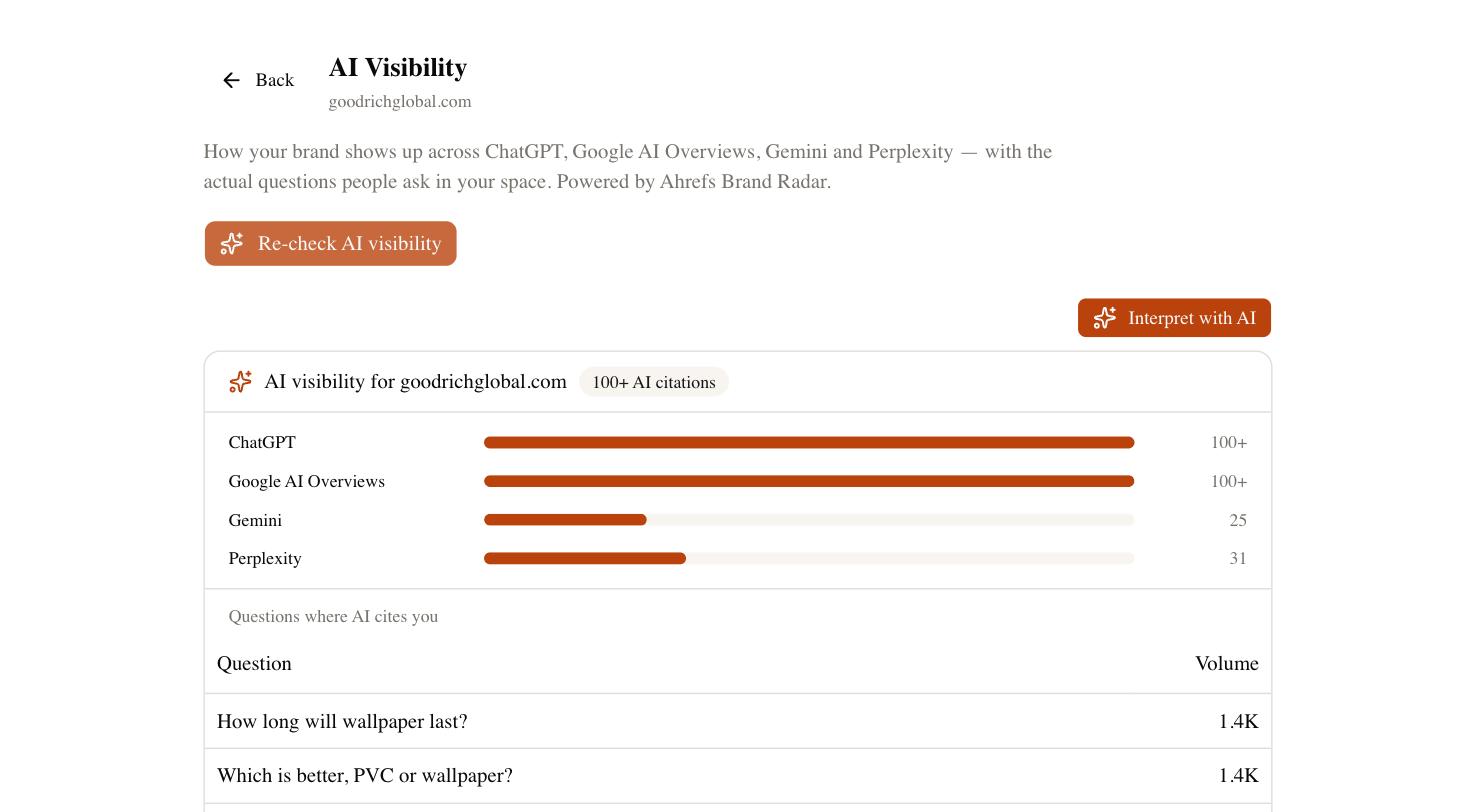
Doing that manually gets old fast, which is why SEO Rocket includes an AI-visibility view — Brand Radar — that tracks whether and where you are cited across those surfaces, alongside the classic keyword, rank-tracking, and competitor-gap data you would expect from a serious SEO tool. The point is not to chase every AI mention. It is to stop guessing. Once you can see how answer engines describe your business, deciding what to fix next becomes a normal SEO task again — just aimed at the search that is actually happening, not the one that happened five years ago.