Ask ten people about the future of SEO with AI and you’ll get ten confident predictions, most of them wrong in opposite directions. One camp says organic search is over, replaced by a chatbot that answers everything. The other insists nothing has changed and you should keep doing exactly what worked in 2019. Both are selling you something.
The honest read on the future of SEO with AI sits in the boring middle: the mechanics of how people find information are shifting in specific, trackable ways, and most of the fundamentals that made a page rank still make it get cited. Your job is to tell the difference. This guide is the grounded version — what’s actually moving, what’s staying put, and what to do about it this quarter.
The “SEO is dead” claim, argued properly
People have declared SEO dead after every major Google update for two decades, so the phrase should trigger skepticism on its own. But this time the argument has a real kernel, and it deserves a fair hearing rather than a reflexive dismissal.
Here’s the nuance. A share of the queries that used to send you traffic are now answered directly — in an AI Overview, in a ChatGPT reply, in a Perplexity summary — without the user ever clicking. That’s genuinely different from a featured snippet, because the answer is synthesized from several sources and the click is often unnecessary. For thin, purely informational pages that existed only to capture a definition or a quick how-to, that traffic is under real pressure.
What’s not dying is the underlying need: businesses still have to be the source those answers are built from. The channel is fragmenting, not vanishing. “SEO is dead” is lazy; “some informational traffic is being intermediated, so being the cited source matters more than being the tenth blue link” is the accurate, less tweetable version.
How AI answers actually choose their sources
To plan for this you need a rough model of the machine, and the good news is that it rhymes with search you already understand. AI answer engines don’t hallucinate your industry out of thin air — most retrieve real pages, rank them, and summarize the strongest few. The retrieval layer still leans heavily on the same signals classic search uses: relevance to the query, topical authority, and trust.
That means the page an AI engine pulls from is usually a page that already ranks well. Being genuinely useful, well-structured, and cited by others isn’t a separate “AI SEO” discipline — it’s the same work, judged by an additional reader. Where it diverges is in format. Answer engines favor content that states a clear claim and supports it, uses plain headings that match how people phrase questions, and doesn’t bury the point under 600 words of throat-clearing. Clarity is now a ranking-adjacent trait, not just a nicety.
What tends to get cited
- Pages that answer a specific question directly, near the top, in plain language.
- Content with clear structure — descriptive headings, short paragraphs, tables where they fit.
- Sources with real topical depth across a subject, not one shallow post.
- Original information — data you gathered, a firsthand test, a genuine point of view — that a summary can’t get anywhere else.
What still works exactly as before
Strip away the novelty and a large part of the playbook is unchanged, which is the part most “everything is different now” takes conveniently skip. Keyword and intent research still tells you what people want and in what words. Technical health still decides whether your pages can be crawled and understood. Backlinks and brand mentions still function as third-party trust, and AI systems read that trust the same way search engines do.
Content quality, if anything, matters more. When an engine is choosing three sources to synthesize instead of ranking ten links, the bar to be one of those three is higher, and thin content fails faster. The durable advice — earn genuine authority, cover a topic properly, be the most useful page a person could land on — didn’t expire. It got a stricter grader.
The one new thing you have to measure
Traditional SEO tools answer “where do I rank?” They can’t answer the question that now sits right beside it: when someone asks ChatGPT, Perplexity, or Google’s AI Overviews about your category, does your brand get mentioned — and are your pages the ones being cited? A page can rank first on Google and still be completely invisible in the AI answer for the same query. That gap is the genuinely new surface, and you can’t fix what you can’t see.
This is where SEO Rocket’s AI Visibility feature, Brand Radar, fits. It tracks whether and where your brand shows up across ChatGPT, Google AI Overviews, Gemini, and Perplexity, so you can watch your share of those answers the way you’ve always watched keyword positions. It measures actual citations, not just loose name-drops — so a zero means real work to do, and a rising count means the AI-search layer is starting to trust you.
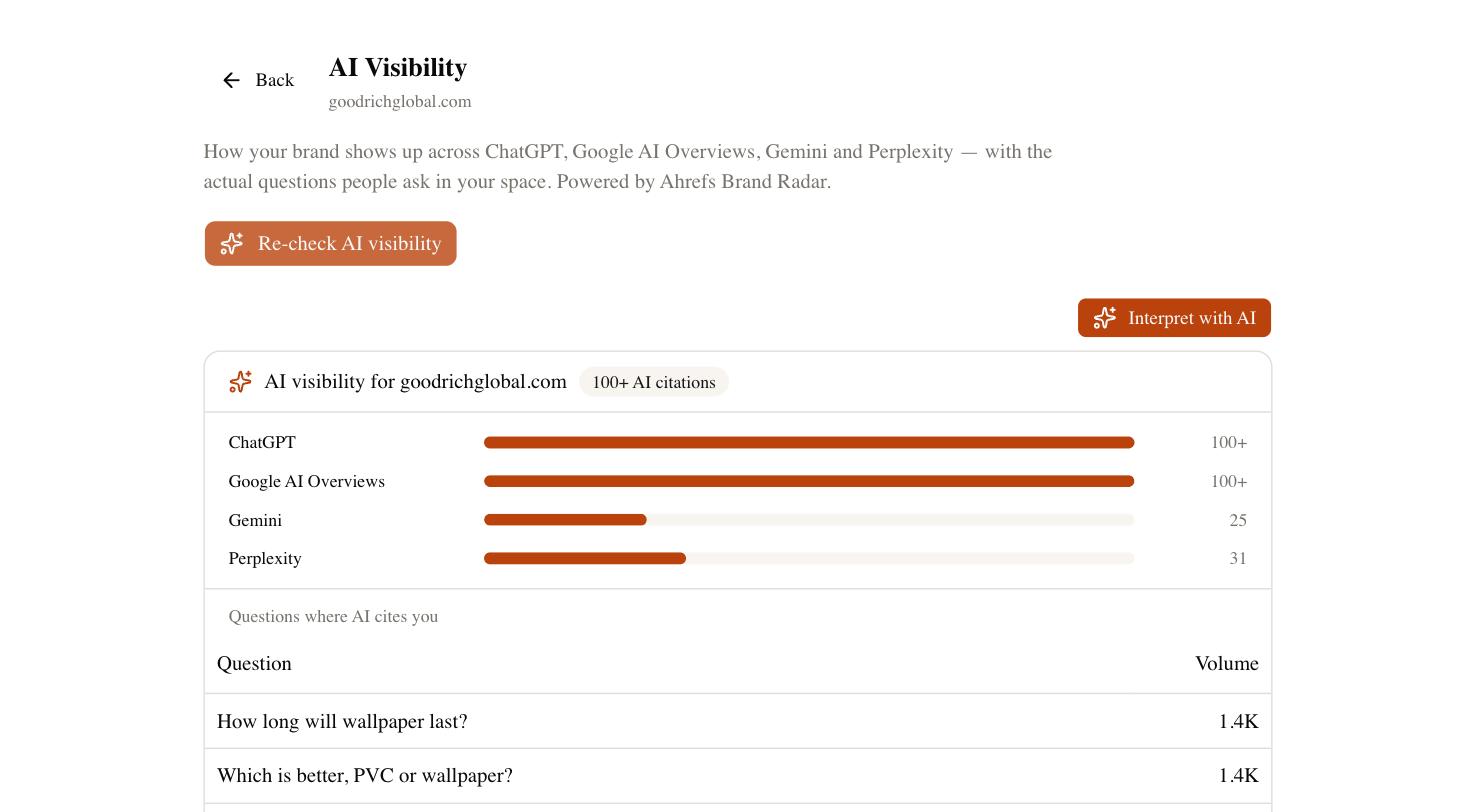
Set a baseline early, even if it’s low. A new brand often starts near zero on these surfaces, and that’s fine — the point is to measure the gap honestly and then close it, not to pretend you’re already everywhere.
Concrete moves to make this quarter
Futurism is easy; changing your Tuesday is the hard part. Here’s the short, unglamorous list that actually moves the needle, in the order I’d do it.
- Audit your money pages for clarity. For your top commercial and informational pages, make sure each answers its core question plainly in the first screen. Front-load the answer, then elaborate.
- Match headings to real questions. Use the phrasing people actually type and speak. This helps both classic search and answer-engine retrieval, at no cost.
- Add something a summary can’t replace. Original data, a firsthand test, a strong opinion, an example nobody else has. Synthesizable-but-generic content is the most exposed.
- Measure AI visibility, then track it monthly. Baseline where you’re cited today, pick a few priority topics, and watch the trend the same way you watch rankings.
- Keep doing the fundamentals. Technical health, internal links, earning real mentions. None of it stopped mattering.
Notice what’s not on the list: no gimmicks, no “prompt your way to page one,” no rewriting your whole site for a robot. The work that earns AI citations is mostly the work that earned rankings, done with a little more discipline about clarity and originality.
Where this is actually heading
Predicting exact timelines is a fool’s errand, so I won’t hand you a fake percentage or a made-up adoption curve. What’s reasonable to expect is directional: more queries answered inline, more of your visibility happening inside someone else’s interface, and a slow rise in how much being the cited source matters relative to owning a raw ranking position. Some categories will feel this fast; a plumber in one city will feel it far more slowly than a software review site.
The strategic takeaway is calm, not dramatic. You don’t need to burn the playbook — you need to add one instrument to it and tighten your standards on the rest. The businesses that win the next few years won’t be the ones chasing every AI headline; they’ll be the ones who kept publishing genuinely useful, well-structured, trustworthy pages, and who bothered to measure whether the machines were quoting them. That’s the whole strategy for the future of SEO with AI: do the durable work, watch the new surface, and don’t let anyone panic you into either extreme.