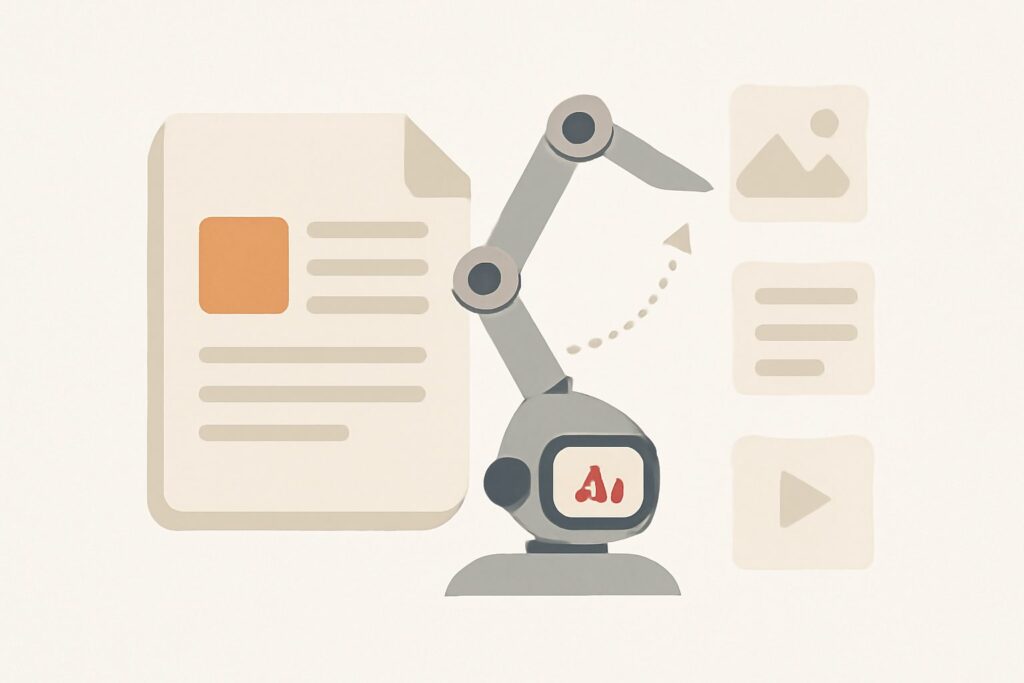
Most teams use content repurposing AI the way a photocopier uses toner: feed in a blog post, spray out a LinkedIn caption, an X thread, and a newsletter blurb, all saying the same thing in a slightly worse voice. That’s not repurposing — it’s dilution at scale. The pillar article was written for someone actively searching a query; the derivatives get pushed at people who weren’t asking anything. When the reach numbers disappoint, everyone blames the tool. The tool was fine. The mental model was broken. Real repurposing isn’t reformatting one message into ten channels — it’s mining one deep asset for ten different intents, each of which some real audience is already trying to satisfy.
Why most repurposing feels like a waste of time
The lazy version fails for a mechanical reason: format and intent are not the same axis, and copy-paste repurposing only changes format. A 2,000-word guide answers a “help me understand this end to end” intent. Chopping it into a thread doesn’t change that the thread is still trying to teach a concept to people who are scrolling for entertainment or a quick take. The container changed; the job the reader hired the content to do didn’t. So the derivative underperforms, and the “AI repurposing is overhyped” takes pile up. The fix is to repurpose along intent, then let format follow.
The atomic-asset model: one source of truth, many derivatives
Here’s the framework I run in production. Treat every substantial thing you make — a webinar, a data study, a founder interview, a definitive guide — as a source-of-truth asset, not a finished deliverable. Its job is to be dense: full of claims, numbers, stories, objections, and quotable lines. Then break it into atoms — a single stat, a single before/after, a single counterintuitive claim, a single step. Each atom can be recomposed into a derivative aimed at a specific intent and channel. The source stays canonical; the atoms travel.
This matters because it changes what “good source content” looks like. If you know a piece will be atomized, you deliberately load it with more standalone-quotable moments, more discrete data points, more named steps. One rich asset yields fifteen genuine atoms. A thin one yields three and forces you to pad the rest — which is exactly how AI repurposing produces mediocrity at volume.
Repurpose across intent, not across format
Map each atom to the intent it can serve, then pick the format that intent lives in. A pricing objection your founder answered on a sales call is a bottom-funnel intent — it belongs in an FAQ block, a comparison page, or a retargeting email, not a top-funnel Reel. A surprising benchmark from a data study is a link-earning intent — it belongs in a standalone stat page and a pitch to journalists. The same source, cut along intent lines, produces derivatives that each land because each one meets a searcher or scroller where they already are.
- Informational atoms → cluster posts, FAQ entries, AI-Overview-friendly Q&A blocks
- Commercial atoms → comparison pages, objection-handling sections, sales-enablement one-pagers
- Emotional/story atoms → short video, LinkedIn narrative posts, podcast cold-opens
- Data atoms → standalone statistics pages, infographics, outreach hooks for backlinks
A worked example: one webinar, seven assets
Say you run a 45-minute webinar on technical SEO audits. The transcript is your source of truth. Atomize it: (1) the three most common crawl-budget mistakes, (2) a live before/after of a fixed redirect chain, (3) a blunt answer to “does page speed still matter,” (4) a stat you cited on index bloat, (5) a story about a site that recovered after a core update, (6) your step-by-step audit order, (7) an objection about AI-generated content quality.
Now recompose. Atom 1 becomes a cluster post targeting “crawl budget optimization.” Atom 3 becomes an FAQ block engineered for AI Overviews. Atom 4 becomes a stat page built to earn links. Atom 5 becomes a LinkedIn story post. Atom 6 becomes a lead-magnet checklist gated behind an email. Atom 7 becomes an objection-handling paragraph on your product page. Seven assets, seven intents, one recording — and not one of them is a lossy copy of the others. That’s the difference the technique is supposed to buy you, and rarely does when it’s pointed at “turn this into a thread.”
The formats that reliably compound
Not every derivative earns its keep. After running this at portfolio scale, a handful pay off consistently: long-form video into a structured guide (the transcript is 80% of the draft); a pillar page into an interlinked cluster (each subhead is a searchable query in its own right); recorded sales and support calls into an FAQ library (real questions in real language beat invented ones); a single data study into multiple angle-specific posts; and a definitive guide into a segmented email sequence. What these share: the derivative serves a different search or subscriber intent than the source, so it competes for its own attention rather than cannibalizing the parent.
Duplicate content is not your real risk — cannibalization is
The most common objection to content repurposing AI is “won’t Google penalize duplicate content?” There is no duplicate-content penalty in the way people imagine. Google filters near-duplicates by picking one canonical version to show; it does not demote your whole site for it. The failure mode that actually costs you traffic is keyword cannibalization — publishing three derivatives that all target the same query, so they split link equity and click signals and none of them ranks. The atomic model prevents this by construction: if each atom serves a distinct intent, each derivative targets a distinct query, and they reinforce rather than compete. A quick way to catch overlap before it hurts is a content-gap and rank check across your own URLs — SEO Rocket’s competitor and content-gap analysis will surface when two of your pages are chasing the same keyword instead of complementary ones.
Put hard validation gates on every derivative
The real danger of AI-assisted repurposing is being mediocre at scale — shipping fifteen derivatives that each pass “technically written” but fail “worth reading.” Volume without a quality floor just publishes your thin content faster. So gate the output. Every derivative should clear a minimum substance bar, hit title and meta limits, contain at least one atom the source uniquely provides, and read in your actual brand voice rather than generic model default. This is exactly why SEO Rocket’s AI writer runs validation gates — minimum word count, title and meta constraints, section-count checks, and an automatic repair loop that catches thin or broken output before it reaches a draft. The gate isn’t compliance theater; thin content loses rankings even when it’s technically on-topic, and repurposing multiplies whatever quality level you started at.
Repurpose for AI visibility, not just for humans
Repurposing now has a second audience: the models behind AI Overviews, ChatGPT, and Perplexity that assemble answers from passages they can lift cleanly. These systems reward content structured as explicit question-and-answer pairs, self-contained claims, and clearly labeled data — which is precisely what atomization produces. A guide reformatted into discrete Q&A blocks is far more citable than the same information buried in flowing prose. When you repurpose, deliberately cut a version optimized for extraction: a short question as a heading, a direct answer in the first sentence, supporting detail after. Then track whether it’s actually getting cited — SEO Rocket’s AI-visibility tracking shows when your pages start surfacing in AI answers, which is fast becoming its own traffic channel separate from blue links.
A weekly workflow you can actually run
Sustainable repurposing is a cadence, not a heroic sprint. A workable weekly loop:
- Monday: pick one source-of-truth asset from the last 90 days and atomize it into 8–12 discrete atoms.
- Tuesday: map each atom to an intent and target query; kill any atom that overlaps an existing ranking page.
- Wednesday–Thursday: draft the two or three highest-leverage derivatives through your AI writer, then edit and fact-check by hand.
- Friday: publish, interlink to the parent, and log the target keywords for rank and AI-visibility tracking.
Two or three good derivatives a week compounds into a hundred-plus interlinked assets a year — the kind of density that a playbook proven across 1,000,000+ ranking pages is actually built on. The constraint is never AI throughput; it’s editorial judgment, which is exactly the part you should keep human.
Honest caveats: where content repurposing AI still fails
Three failure modes are worth naming plainly. First, garbage in, garbage out — repurposing a shallow source just distributes shallowness; fix the source before you scale it. Second, voice drift — models regress to a bland average across many derivatives, so a real editor still has to pull each one back to your voice. Third, the extraction trap — over-optimizing for AI-citable snippets can produce clipped, listicle-flat content that a human bounces off; you’re writing for two audiences and can’t fully sacrifice either. Content repurposing AI removes the mechanical cost of producing variants. It does not remove the need for a point of view, and it never will.
Frequently asked questions
Does repurposing content hurt SEO with duplicate-content penalties?
No. There is no duplicate-content penalty; Google simply canonicalizes near-duplicates and shows one version. The real risk is keyword cannibalization — multiple pages targeting the same query. Repurpose along distinct intents so each derivative ranks for its own keyword.
How many pieces can one asset realistically become?
A dense source-of-truth asset — a webinar, data study, or definitive guide — typically yields 8–15 genuine derivatives across different intents. Thin sources yield three or four before you’re padding, which is where quality collapses.
Can content repurposing AI replace my writers?
No, and treating it that way is the fastest route to mediocre-at-scale output. It removes the mechanical cost of producing format variants. Judgment — choosing intents, editing voice, fact-checking claims — stays human. Use it to give good writers more leverage, not to remove them.
The bottom line
Content repurposing AI is only as good as the model you point it at — not the language model, the mental model. Copy-paste reformatting dilutes one message across ten channels and disappoints on all of them. Atomizing one dense source of truth and recomposing each atom into a derivative built for a distinct intent turns a single asset into ten that each earn their own attention. Load your source assets with quotable atoms, cut along intent lines, gate every derivative against a real quality floor, and structure a share of them for AI extraction. Do that weekly and one recording becomes a compounding library — the durable kind that keeps ranking after the novelty of the tooling wears off.