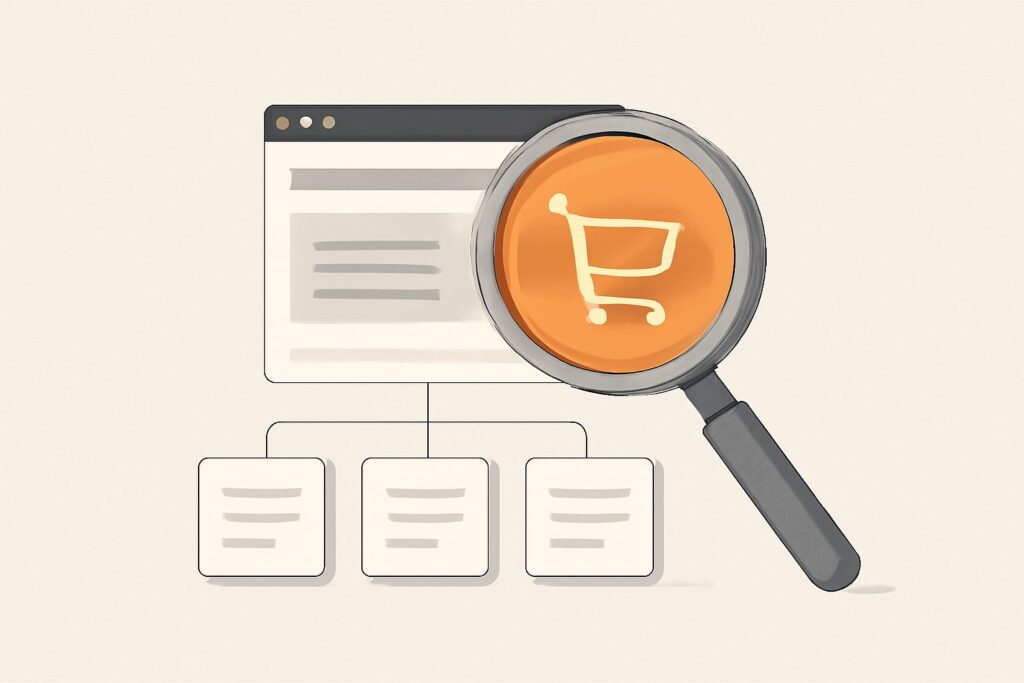
Most advice on ecommerce site architecture treats it as an interior-design problem — make the menu tidy, group things logically, ship it. That framing misses the entire point. Architecture isn’t about how a human navigates your store; it’s about how much of your catalog Google can find, how link equity flows to the pages that actually make money, and whether ten thousand near-duplicate URLs quietly poison your crawl budget before a single product ever ranks. Get the structure wrong and no amount of on-page optimization saves you. Get it right and mediocre product copy still ranks, because the machine can finally read your store the way you intended.
Architecture Is a Crawl-and-Equity Problem, Not a Menu Problem
Every store has two audiences reading its structure: shoppers, who use search and filters and rarely think about the URL tree, and crawlers, which experience your site as a graph of links to follow and pages to index. Good ecommerce site architecture serves both, but the SEO stakes live entirely in the second audience. Googlebot has a finite budget for how many URLs it will fetch from your domain in a given window. On a 50-product boutique that budget is irrelevant. On a 40,000-SKU catalog with faceted filters, it’s the single biggest lever you have — waste it on filter permutations and paginated junk, and your genuinely important category pages get crawled late, indexed slowly, and refreshed rarely.
The second stake is internal PageRank. Your homepage holds the most authority on the domain, and every internal link passes a share of it downstream. A shallow, deliberate structure concentrates that equity on the pages you want to rank. A sprawling, accidental one dilutes it across thousands of low-value URLs. Architecture is how you decide, on purpose, where your authority pools.
The Flat Hierarchy: Keep Money Pages Within Three Clicks
The durable principle in online store structure is depth control: every page that matters should sit within roughly three clicks of the homepage. This isn’t a mystical Google rule — it’s a proxy for two real things. Pages linked closer to the homepage receive more internal link equity, and pages reachable in fewer hops get crawled more often. A product buried six clicks deep behind a chain of subcategories and pagination is telling Google, structurally, that you don’t care about it much.
The canonical hierarchy that achieves this is Home → Category → Subcategory → Product, with the homepage linking to top categories, categories linking to subcategories and their best products, and every product linking back up via breadcrumbs. On a large catalog you flatten aggressively: fewer subcategory layers, category pages that surface more products directly, and internal links that create shortcuts rather than forcing a strict tree walk. Flat beats deep almost every time in ecommerce information architecture.
Category Pages Are Your Real Ranking Assets
Here’s the counterintuitive part most store owners miss: your category and collection pages, not your product pages, do most of the ranking for commercial head terms. Someone searching “running shoes” or “standing desk” has research-and-browse intent — they want a selection, not one SKU. That query is won by a category page. The individual product page wins the narrow, high-converting long tail: the specific model number, the exact variant, “brand X model Y 27-inch.”
This has a hard architectural consequence. Category pages need to be treated as content assets, not just grids of thumbnails — a genuine intro that describes the selection, sensible internal links to related categories, and enough unique framing that Google sees a page worth ranking rather than a template. Map your keyword targets to the right tier: broad head terms to categories, specific and model-level terms to products, and research queries (“how to choose a standing desk”) to buying guides that link down into both. Mapping real search demand to the correct page tier is exactly what SEO Rocket’s keyword research does on live Ahrefs data — segmenting product, category, and buying-guide terms so you build the page each query actually rewards.
Faceted Navigation: The Silent Catalog Killer
Faceted navigation — the color, size, price, and brand filters down the side of a category page — is the number-one failure mode in ecommerce site architecture, and it fails silently. Every filter combination a shopper can select typically generates a crawlable URL: ?color=blue&size=large&sort=price. Multiply a handful of facets across a category and you produce thousands, sometimes millions, of near-identical URLs from a single page of products. Google crawls them, finds them thin and duplicative, and burns your crawl budget doing it — often while your real category pages go under-crawled.
You don’t fix this by “adding keywords.” You fix it by deciding, per facet, which URLs deserve to be an indexable page and which are just a shopper convenience. The standard toolkit:
- Canonical tags pointing filtered variants back to the clean category URL, so equity consolidates and duplicates don’t compete.
- robots.txt disallow or URL-parameter handling for sort-order and pagination parameters that never need indexing.
- Selective indexing of high-demand facet combinations that have real search volume — “waterproof hiking boots” as a landing page is worth indexing; “boots sorted by price, page 4” is not.
- noindex, follow on filter pages you want crawled for discovery but kept out of the index.
The decision rule is simple: index a facet only if people search for it and it maps to a genuinely distinct, valuable set of products. Everything else gets canonicalized or blocked.
URL Structure: Flat, Readable, and Stable
Ecommerce URLs should be short, human-readable, and — critically — stable. A clean pattern like /category/product-name beats a parameter-stuffed /p?id=48213&cat=9 on both readability and click-through. The genuinely debated question is whether to nest the category path inside product URLs. Nesting (/mens/shoes/trail-runner) reads well but creates a real problem: products that belong in multiple categories either get duplicate URLs or force you to pick one canonical path, and re-categorizing a product breaks its URL.
The pragmatic answer for most stores is a flat product URL (/products/trail-runner) with breadcrumbs and internal links carrying the hierarchy signal instead. It sidesteps the multi-category duplication trap entirely. Whatever you choose, never change URLs casually — every URL change needs a 301 redirect, and a migration that drops redirects is one of the fastest ways to trigger a 40–70% traffic collapse overnight.
Internal Linking: Breadcrumbs, Related Products, and Silos
Internal linking is the circulatory system of store hierarchy SEO — it’s how equity and crawl priority actually move through the graph. Three patterns do the heavy lifting. Breadcrumbs give every product a crawlable path back up to its category and add structured-data context Google uses in results. Related and complementary product links create lateral connections that help crawlers discover deep inventory and keep shoppers moving. And topical siloing — clustering a category, its subcategories, its products, and its supporting buying guides into a tightly interlinked group — concentrates relevance signals around each theme.
The failure mode to hunt for is orphaned products: SKUs with no internal links pointing at them, reachable only through search or a sitemap. Orphans get crawled rarely and rank almost never. A real crawler-based audit is the only reliable way to find them — SEO Rocket’s site audit uses an actual crawler that surfaces orphan pages, duplicate variants, redirect chains, and broken internal links, which are the exact structural faults that quietly cap an ecommerce site’s ceiling.
Handling Variants and Near-Duplicate Product Pages
Product variants — the same shirt in eight colors — are a duplicate-content trap dressed as a UX decision. If each color spins up its own indexable URL with 90% identical copy, you’ve created eight thin, competing pages where you wanted one strong one. The default fix is to keep variants on a single canonical product page with in-page selectors, so all the equity and reviews consolidate. The exception is when individual variants have real, distinct search demand (a specific color-way people actually search by name) — then a separate, differentiated page can earn its keep. Decide by demand, not by default, and canonicalize the rest.
Pagination and Deep Catalog Crawling
Category pages with hundreds of products get paginated, and pagination is where a lot of deep inventory goes to die. Google retired support for rel="next"/"prev" years ago, so the current best practice is straightforward: give each paginated page a self-referencing canonical (not one pointing back to page 1, which would deindex pages 2+ and hide the products only listed there), keep the pagination links as real crawlable anchors, and make sure deep products are also reachable through other paths so they don’t depend on a crawler walking twenty pages. Infinite-scroll and “load more” patterns that only fire on JavaScript interaction are especially dangerous — if there’s no crawlable link, those products are effectively invisible.
XML Sitemaps and Out-of-Stock Handling on Large Catalogs
On a big catalog, a clean XML sitemap is a crawl-efficiency tool, not a nice-to-have. Segment it — products, categories, content — so you can diagnose indexing per section in Search Console, keep only canonical, indexable, 200-status URLs in it, and let it reflect reality as inventory changes. Out-of-stock and discontinued products need a deliberate policy: temporarily out-of-stock items should stay live (keep the URL, the reviews, and the ranking, and mark availability in schema), while permanently discontinued products should 301-redirect to the closest equivalent or the parent category rather than 404 into a dead end and dump their accumulated equity. Letting popular product URLs die without redirects is throwing away ranked assets.
Structured Data That Matches Your Architecture
Once the structure is sound, schema makes it legible to search engines. Product pages should carry Product markup with nested Offer (price, availability, currency) and, where you have genuine first-party reviews on your own products, AggregateRating — those self-collected reviews remain eligible for star snippets. Be accurate here rather than optimistic: Google restricts review rich results for certain third-party widget setups, so don’t assume stars will show just because you added markup. Add BreadcrumbList schema to reinforce the hierarchy you built, and keep availability and price in sync with the real store state, because mismatched schema is a rich-result liability, not a shortcut.
Auditing and Building the Structure With SEO Rocket
Ecommerce site architecture problems are hard to see from inside your own admin panel — the tree looks fine until a crawler shows you the 12,000 filter URLs Google is actually spending its budget on. That’s the whole case for tooling. SEO Rocket runs the ecommerce architecture workflow as one loop: keyword research on real Ahrefs data to map terms to the right page tier, competitor and content-gap analysis to find the categories and buying guides rivals rank for that you’re missing, a real-crawler site audit that flags duplicate variants, orphan products, thin pages, and redirect chains, rank tracking for your product and category terms, and a validation-gated AI writer for the unique category and product descriptions that thin-content-at-scale otherwise makes impossible. It’s an SEO layer that sits on top of whatever store platform you run — roughly $50/month with a free tier — not a replacement for it. The founder’s playbook behind it is one proven across 1,000,000+ ranking pages, including flooring-ecommerce catalogs where these exact structural rules were the difference between indexed and ignored.
Frequently Asked Questions
How many clicks deep should ecommerce products be?
Aim for important products to sit within roughly three clicks of the homepage. It’s a proxy, not a law — closer pages get more internal link equity and get crawled more often. On very large catalogs you achieve this by flattening the hierarchy and adding internal-link shortcuts, not by forcing a rigid tree that pushes deep inventory five or six clicks down.
Should product URLs include the category path?
Usually no. Nested URLs like /mens/shoes/trail-runner read nicely but break when a product belongs to multiple categories or gets re-categorized, creating duplicate URLs or forcing awkward canonical choices. A flat product URL with breadcrumbs and internal links carrying the hierarchy signal is the more robust default for most stores.
How do I stop faceted navigation from hurting SEO?
Decide per filter which URLs deserve indexing. Canonicalize filtered variants back to the clean category URL, block sort and pagination parameters in robots.txt or parameter handling, and selectively index only the high-demand facet combinations that people actually search for. The goal is to stop Google from wasting crawl budget on thousands of near-duplicate filter URLs.