Enterprise marketing leaders rarely lack opinions about SEO — what they lack is verified numbers. Every figure in this article is pulled from a named, publicly available study (Ahrefs, Searchmetrics, HubSpot, Semrush, Borrell Associates, uSERP, and Aira), cited inline with the year it was published, so you can trace each one back to its source instead of taking a marketer’s word for it. That matters more at enterprise scale than anywhere else: a single percentage-point swing in an in-house-vs-agency split or a retainer benchmark can translate into six or seven figures of budget when it’s applied across a portfolio of brands, regions, or product lines.
How Much Enterprise Brands Spend on SEO
Enterprise SEO spend is not a rounding error in the marketing budget. Borrell Associates estimated that brands and agencies in the United States would spend $79.27 billion on SEO services in 2020 alone (Borrell Associates, 2020) — a figure that covers everything from in-house salaries to agency retainers and enterprise tooling. Spending intent has stayed strong since: a 2022 survey by Searchmetrics found that 53% of businesses planned to increase their SEO spending that year, and almost 40% of respondents said they already allocate more than 40% of their total marketing budget to organic search (Searchmetrics, 2022).
That commitment shows up again in more recent data. HubSpot’s 2023 marketing survey found that 88% of marketers already investing in SEO planned to maintain or increase that budget in 2023 (HubSpot, 2023) — a strong signal that, unlike paid channels, enterprise SEO budgets tend to ratchet up rather than get cut when marketing spend is reviewed.
Link building alone — just one line item inside a broader enterprise SEO budget — represents meaningful spend on its own. A 2022 survey by uSERP found that almost half of SEO professionals spend $5,000–$10,000 every month on link building (uSERP, 2022), and Ahrefs’ 2024 survey of the profession found that 78.2% of SEOs charge monthly retainers for some or all of their services (Ahrefs, 2024) — the dominant commercial model enterprise buyers encounter whether they staff SEO in-house, through an agency, or with freelance support.
Enterprise SEO ROI: What the Budget Is Actually Buying
None of that spend matters if it isn’t converting into pipeline. Enterprise leaders evaluating SEO investment against other channels can lean on the same Semrush 2023 survey referenced above: 46% of marketers named SEO a leading driver of content marketing success, putting it on par with — and by some measures ahead of — paid promotion and social distribution as a growth lever (Semrush, 2023). Combined with the budget-allocation data from Searchmetrics showing nearly 40% of total marketing spend going to organic in some organizations (Searchmetrics, 2022), the picture that emerges is of SEO graduating from a defensive, “must-do” line item into one of the primary channels enterprise marketing leaders are held accountable for.
In-House vs Agency: Who Actually Runs Enterprise SEO
Most larger organizations keep SEO close rather than fully outsourcing it. Searchmetrics’ 2022 survey found that over 70% of marketers employ internal SEO staff, compared with 38.7% who use external consultants or agencies (Searchmetrics, 2022). Those numbers overlap because a large share of enterprise teams run a hybrid model — keeping strategy and stakeholder management in-house while outsourcing specialist execution such as technical audits, content production, or link building to an agency.
This hybrid pattern is consistent with how enterprise SEO buyers typically procure services: rather than choosing purely in-house or purely agency, most large organizations blend a core internal team with retainer-based external specialists, which is reflected in the 78.2% monthly-retainer figure cited above (Ahrefs, 2024).
Enterprise SEO Team Size and Salaries
Compensation data is one of the clearest available proxies for how seriously enterprise organizations resource SEO. Ahrefs’ 2024 salary survey put the median annual SEO salary at $58,288, up from $49,211 the year before (Ahrefs, 2023 and 2024) — an increase that signals rising demand for in-house expertise at exactly the moment AI search is reshaping the discipline.
Pay varies significantly by employment type. Self-employed SEOs earned the most on average, at $60,232, while in-house specialists — the group most representative of enterprise hiring — averaged $56,789, and agency-side SEOs earned the least, at a median of $44,169 (Ahrefs, 2024). Seniority compounds those numbers further: Ahrefs found that SEO Directors average 13 years of experience and Heads of SEO average 10 years (Ahrefs, 2024), reflecting how enterprise organizations tend to promote leadership from deep technical-SEO backgrounds rather than hire generalist marketing managers into the role.
Where Enterprise SEO Budgets Are Moving
Once an enterprise SEO budget exists, it isn’t spent uniformly across activities. Semrush’s 2023 survey of marketers found that 46% credit SEO as a major driver of content marketing success, while 47% cite audience research as the single biggest factor behind that success (Semrush, 2023) — evidence that enterprise budgets increasingly fund research and content operations, not just crawling and technical tooling.
AI is now its own budget line. HubSpot’s 2023 survey found that 84% of bloggers and content marketers said AI and automation had already changed their SEO strategy that year (HubSpot, 2023). Opinion on the net effect, however, was split almost down the middle: 44% of marketers expected AI to have a positive impact on SEO strategy, 51% expected no real impact, and only 5% expected a negative one (HubSpot, 2023) — a reminder that “AI is changing everything” and “AI budgets are growing” are not the same claim, and enterprise leaders should treat them separately when building next year’s plan.
Which Tools Enterprise SEOs Actually Use
Enterprise tool stacks tend to consolidate around a small number of platforms rather than spreading budget thin. A widely cited Aira survey of digital marketers found that 70% use Ahrefs as a tool for link building, 51% use Semrush, and 34% would choose Domain Authority (Moz) if forced to pick a single metric to judge link quality (Aira, 2021). Even though that survey predates the current AI-search shift, the underlying pattern — a dominant one or two platforms plus a long tail of specialist tools — still matches what enterprise procurement teams report when consolidating vendor lists today.
Enterprise SEO Statistics at a Glance
| Metric | Figure | Source (Year) |
|---|---|---|
| US SEO services spend | $79.27 billion | Borrell Associates (2020) |
| Businesses planning to increase SEO spend | 53% | Searchmetrics (2022) |
| Marketers keeping SEO budget flat or higher in 2023 | 88% | HubSpot (2023) |
| Marketers employing in-house SEO staff | 70%+ | Searchmetrics (2022) |
| Marketers using external SEO consultants/agencies | 38.7% | Searchmetrics (2022) |
| Median annual SEO salary, 2024 | $58,288 | Ahrefs (2024) |
| Median in-house SEO salary | $56,789 | Ahrefs (2024) |
| Median agency-side SEO salary | $44,169 | Ahrefs (2024) |
| SEOs charging monthly retainers | 78.2% | Ahrefs (2024) |
| SEO pros spending $5,000–$10,000/month on link building | ~50% | uSERP (2022) |
A note on the data: these figures come from separate, independently run studies with different sample sizes, survey years, and respondent pools — an Ahrefs practitioner survey is not measuring the same population as a Searchmetrics enterprise-marketer survey, and a link-building spend figure from uSERP isn’t measuring the same thing as an overall SEO-services spend estimate from Borrell Associates. None of these studies were run specifically on a Fortune 500 or enterprise-only sample, so the figures are best read as industry-wide benchmarks that enterprise organizations sit within, not enterprise-exclusive numbers. Treat each figure as a directional signal about the industry rather than a single unified data set, and weight more recent studies over older ones where they conflict.
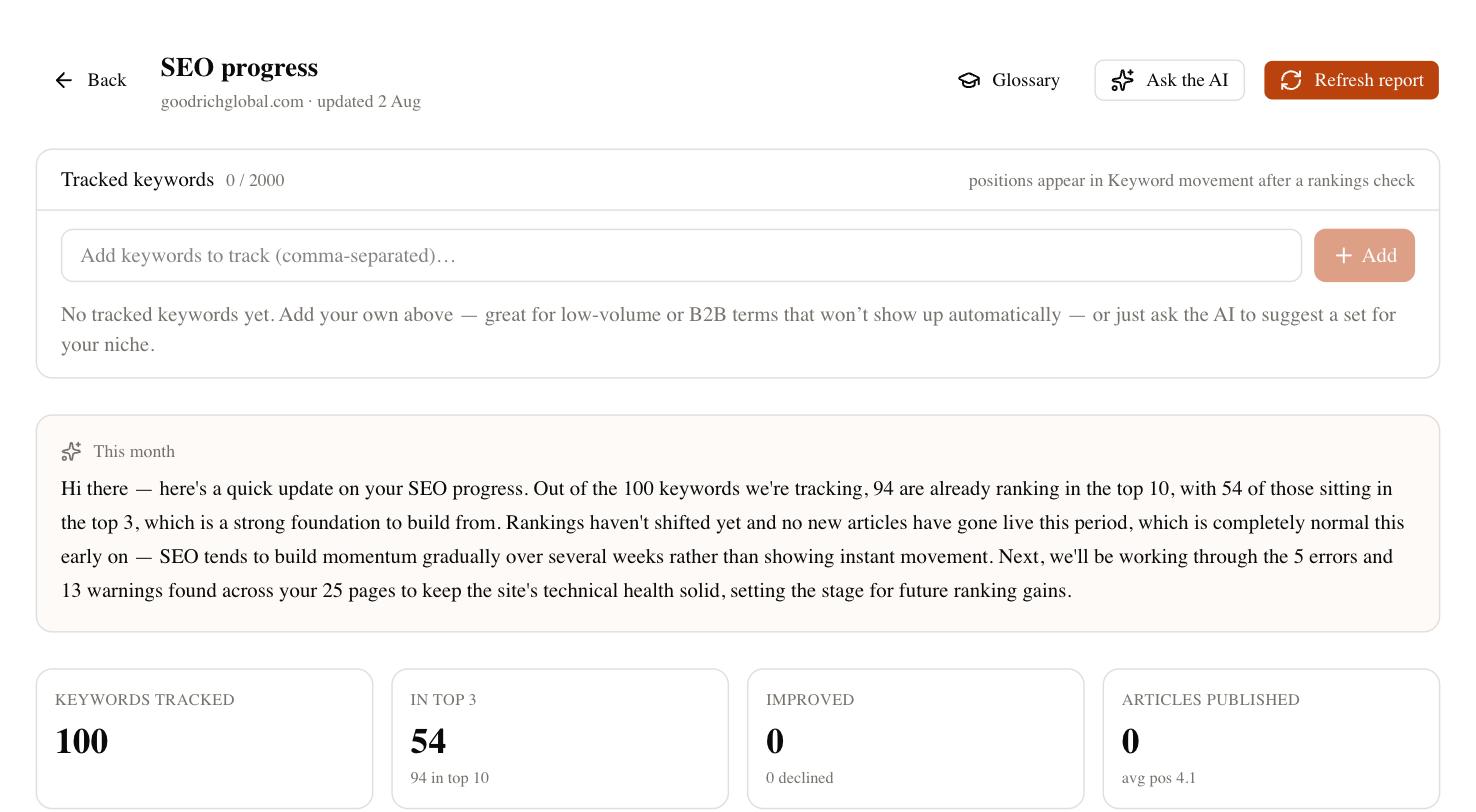
Industry averages are a useful backdrop, but they can’t tell you whether your own site’s organic traffic, rankings, or budget efficiency are actually improving. SEO Rocket lets you track your own rankings and organic performance on real data rather than relying on industry averages, with a free plan to start and paid plans from $49/month: app.seorocket.ai.