Most advice on internal linking strategy stops at “link related pages together,” which is true, useless, and the reason so many sites have a thousand internal links that do nothing. An internal link is not a decoration or a courtesy to the reader — it is the single most controllable ranking lever you own. Unlike backlinks, which you have to earn, and unlike Google’s algorithm, which you can’t touch, internal links are entirely in your hands. Get them right and you route authority, crawl budget, and context exactly where you want them. Get them wrong and you strand your best pages five clicks deep where neither Google nor a human will ever reach them.
What Internal Links Actually Do
An internal link does three distinct jobs at once, and confusing them is why most link plans underperform. First, discovery: Googlebot finds new URLs by following links, so a page nothing points to may never get crawled at all. Second, equity flow: every link passes a share of a page’s ranking power (the concept people still call PageRank) to its target. Third, context: the anchor text and the surrounding copy tell Google what the linked page is about and how it fits your site’s topic map. A good internal linking strategy optimizes all three deliberately instead of letting your CMS template decide by accident.
Link Equity Is a Flow, Not a Stamp
Here is the mechanism most guides skip. Ranking power isn’t a badge a page either has or doesn’t — it’s a quantity that gets divided among every link on a page and passed along. A page with authority to give splits that authority across its outbound internal links. Ten links on a page each carry roughly a tenth of what’s available to pass; a hundred links each carry a hundredth. This is why a page with 200 navigation, footer, and sidebar links dilutes the value reaching any single one of them to near nothing.
The practical takeaway: links inside your main content are worth far more than links buried in a mega-menu or a footer, both because they carry more concentrated equity and because Google weights contextual, editorial links higher than boilerplate ones. If your money page’s only internal links come from the global footer, you’ve technically linked to it and functionally ignored it.
The Click-Depth Rule That Beats Most Tactics
Click depth — how many clicks a page sits from your homepage — correlates with rankings more reliably than almost any other internal signal. Your homepage typically holds the most authority (it earns the most external links), and that authority decays with every hop away from it. A page one click from home inherits a strong share; a page five clicks deep inherits a rounding error.
The working rule: your important pages should be reachable within three clicks of the homepage, and ideally two. If a high-value product or guide is buried four or five levels down, you don’t need a new page — you need a link from something shallow and authoritative pointing straight at it. Flattening your architecture is often the highest-ROI hour you can spend on internal links seo, and it costs nothing but a few well-placed anchors.
Hub-and-Spoke: The Topic Cluster Model
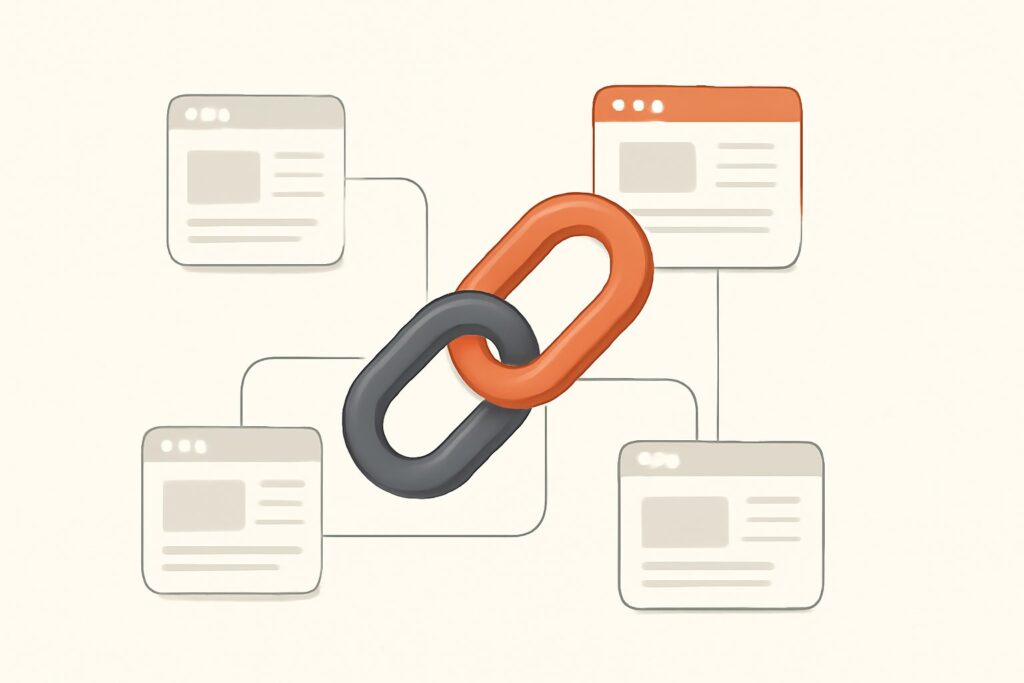
The most durable internal linking structure is the hub-and-spoke, also called the topic cluster or pillar model. You build one broad pillar page covering a subject at a high level, then a set of cluster pages each covering one sub-topic in depth. Every cluster page links up to the pillar, the pillar links down to each cluster, and clusters link across to each other where genuinely relevant.
This does two things. It concentrates topical authority — Google sees a tightly interlinked group of pages all reinforcing one subject, which signals genuine expertise rather than scattered one-off posts. And it gives every page in the cluster a clear path to equity: the pillar collects links from the whole cluster and from external sources, then redistributes that strength back down. Site interlinking done this way turns a pile of loosely related articles into a structured argument for why you deserve to rank on the topic.
Anchor Text: Descriptive, Not Robotic
Anchor text is the label you hand Google for the destination page, so “click here” and “read more” waste the single clearest context signal you have. Use descriptive anchors that reflect what the target page is actually about — for a page on keyword difficulty, link with the phrase “keyword difficulty,” not a naked URL or a generic prompt.
But don’t over-optimize. Exact-match anchors pointing to the same page from dozens of internal links look manufactured, and while internal anchor manipulation is far less risky than doing it with backlinks, unnatural patterns still read as engineered. Vary your anchors naturally: the exact keyword sometimes, a close variation other times, a longer descriptive phrase elsewhere. Write the anchor a careful editor would write, not the one a rank-chasing script would generate. That variation is exactly what a healthy internal linking strategy produces on its own when a human writes the copy.
Orphan Pages: The Silent Ranking Leak
An orphan page is a URL with zero internal links pointing to it. It exists, it might be in your sitemap, but nothing on your site connects to it — which means Google struggles to discover it, assigns it almost no equity, and often decides it isn’t important enough to rank. Orphans accumulate quietly: an old campaign page, a product that got moved, an article published before you had a category to file it under.
Finding them is the hard part, because by definition you can’t reach them by clicking. You have to compare the full list of URLs a crawler can reach by following links against your complete URL inventory (from the sitemap, your CMS, or analytics); anything in the second list but not the first is orphaned. This is precisely the kind of structural leak a real-crawler site audit surfaces — SEO Rocket’s audit crawls your site the way Googlebot does and flags orphan pages, broken internal links, and pages sitting too many clicks deep, so you can fix the plumbing instead of guessing at it.
Where to Add Links: Follow the Authority
Don’t add internal links at random. The highest-leverage move is to link from your strongest pages to the pages you want to lift. Identify which of your URLs earn the most external links or organic traffic — those are your authority reservoirs — then add contextual links from them to the targets that need help. A single link from a page that already ranks well and gets crawled constantly is worth more than twenty links from thin, deep pages nobody visits.
The reverse also matters: when you publish something new, immediately link to it from a few established, relevant pages so it inherits equity and gets discovered fast, rather than waiting months for Google to stumble onto it through your sitemap alone.
Common Mistakes That Quietly Cost You
- Nofollow “sculpting.” Adding rel=”nofollow” to internal links to hoard equity hasn’t worked since Google changed how nofollow flows equity — the value is simply lost, not redirected. Don’t nofollow your own internal links.
- JavaScript-only links. Links that only render or fire via onclick JavaScript may not be reliably crawled. Use real
<a href>anchors so every internal link is guaranteed to be followed. - Footer and menu link dumps. Stuffing every page into the global navigation dilutes equity across hundreds of links and buries your priorities. Reserve site-wide links for genuinely site-wide destinations.
- Redirect and broken chains. Internal links pointing to 301s, 404s, or long redirect hops waste crawl budget and leak equity at each hop. Link straight to the final live URL.
- One-directional clusters. Linking down from a pillar but never back up, or never across between siblings, leaves half the equity flow on the table.
A Repeatable Internal Linking Process
Here’s the sequence that holds up across sites of any size:
- Map your topics into clusters. Group existing and planned pages under pillar subjects so every page has a clear home and clear siblings.
- Audit structure with a real crawler. Pull click depth, orphan pages, and broken internal links — you can’t fix a map you can’t see.
- Flatten the deep pages. Get every priority URL within three clicks of home by adding shallow, contextual links to it.
- Route authority deliberately. Link from your highest-traffic, most-linked pages to the targets you’re trying to rank.
- Fix anchors and dead links. Replace generic anchors with descriptive ones and repoint any link hitting a redirect or error.
- Re-crawl and track. Rankings jitter, so watch the trend over weeks, not a single snapshot.
SEO Rocket runs the diagnostic half of this as one workflow — the real-crawler audit exposes click depth, orphans, and broken links, competitor gap analysis on real Ahrefs data shows which topics your rivals interlink that you don’t, and rank tracking confirms whether the changes moved anything — for roughly $50/month with a free tier. It won’t write your anchors for you, but it tells you exactly where the plumbing is leaking. This is the same playbook, proven across 1,000,000+ ranking pages, applied to the one lever you fully control.
Internal Linking Best Practices at a Glance
If you remember nothing else, remember these internal linking best practices: keep priority pages within three clicks of home; link from strong pages to weak ones, not the reverse; use descriptive, varied anchors; build tight hub-and-spoke clusters instead of scattered posts; kill orphans; and point every link at a live, final URL. None of this requires a budget or a backlink — just the discipline to treat your own site as a network you route on purpose.
Frequently Asked Questions
How many internal links should a page have?
There’s no hard number, but be intentional. In-content, a few to a couple dozen relevant links is normal for a long article; the concern isn’t a strict cap so much as dilution — the more links a page has, the less equity each one passes. Prioritize relevance over quantity, and don’t pad a page with links just to hit a count.
Do internal links help SEO as much as backlinks?
They do different jobs. Backlinks bring authority into your site from outside; internal links distribute that authority once it’s there and control discovery and context. You can’t rank a competitive page on internal links alone, but poor internal linking will waste the backlinks you do earn by stranding equity where it isn’t needed.
What’s the difference between internal and external links?
Internal links point from one page on your domain to another page on the same domain — you control them completely. External links point to or from other domains. Your internal linking strategy is the part of link building you can execute unilaterally, today, without anyone else’s cooperation.
How do I find orphan pages on my site?
Compare every URL a crawler reaches by following links against your full URL list from the sitemap, CMS, or analytics. Any URL in the full list but not the crawl is orphaned. A crawler-based site audit automates this and flags them, along with pages buried too deep to inherit meaningful equity.