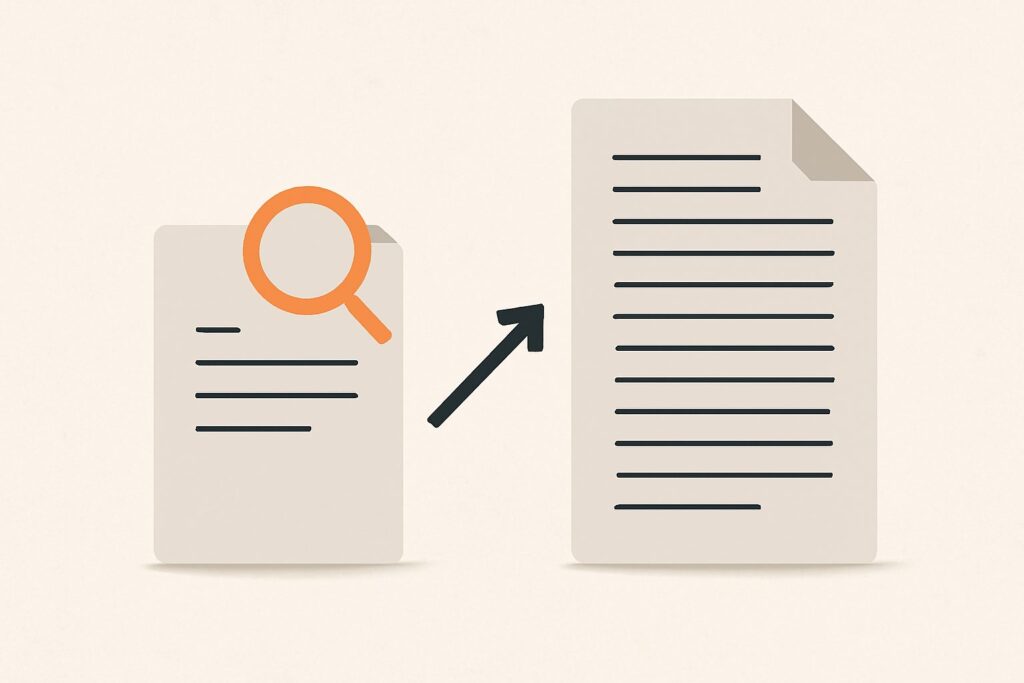
The long-form vs short-form debate is usually settled by citing a study that shows longer pages rank higher, then padding every article to 2,000 words. That’s the wrong lesson from the right data. Word count is not a ranking factor — Google has said so plainly, and the correlation everyone quotes is a proxy for something else entirely: topical completeness and intent match. Long pages tend to rank because thorough coverage tends to be long, not because length itself earns position. Confuse the proxy for the cause and you’ll bloat quick-answer queries into essays that bury the answer, and starve research queries that needed depth. The real skill in long-form vs short-form is reading what the query demands and matching the format to it.
Word Count Is a Symptom, Not a Cause
Start by killing the myth cleanly. Correlation studies that plot average word count against ranking position keep resurfacing, and they keep getting misread. A page that fully answers “how to run a technical SEO audit” is naturally long because the task has fifteen steps. A page that fully answers “what time does the Super Bowl start” is naturally short because the answer is a time. Both can rank number one. The length wasn’t the lever — the completeness relative to intent was. When you add 1,200 words of throat-clearing to the second query, you don’t rank better; you rank worse, because you’ve made the searcher hunt for a fact they wanted in two seconds.
This is the whole game with long-form vs short-form: length is downstream of intent. Decide the intent first, and the appropriate length reveals itself. Decide the length first, and you’ll manufacture filler or amputate substance to hit an arbitrary target.
Read the SERP Before You Decide
The search results page is a live vote on what Google thinks satisfies a query, and it’s the single best free signal you have. Before writing a word, run the target keyword and read the top ten with these questions: Are the ranking pages 400-word answers or 3,000-word guides? Is there a featured snippet pulling a concise definition, or a “things to know” carousel implying breadth? Does the intent look informational, transactional, or navigational? The SERP has already run the experiment — your job is to read the result, then beat the weakest page-one competitor at whatever length that intent rewards.
If the top results are all short and punchy and you publish a 2,500-word monster, you’ve misread the room. If they’re all comprehensive guides and you ship 500 words, you can’t compete on completeness no matter how well-written it is. SEO Rocket’s competitor gap analysis makes this concrete: it pulls what’s actually ranking for your target so you can see the real length and coverage bar instead of guessing from a blog post’s opinion.
A Decision Framework by Intent
Here’s the framework I use to settle long-form vs short-form on every brief. Classify the query into one of four buckets, then let the bucket set the format:
- Quick-answer / definitional (“what is canonicalization,” “meta description length”) — short-form wins. 300–800 words, answer in the first sentence, structured for the featured snippet. Adding depth here dilutes the snippet-worthiness.
- Transactional / commercial (“buy standing desk,” “best CRM for agencies”) — usually medium and conversion-led. The searcher wants to compare and act, not read an essay. 800–1,500 words with comparison tables, specs, and clear CTAs beats a rambling guide.
- Research / how-to / “complete guide” (“how to migrate a site to HTTPS,” “content strategy framework”) — long-form wins because the intent is genuinely to understand a whole subject. 1,500–3,000+ words, but only if every section earns its place.
- Pillar / topic-hub — deliberately long-form as a hub that links to short-form spokes. Length here is a structural choice, not a padding exercise.
The bucket is the decision rule. Length falls out of it. You never start from “we need a 2,000-word post” — you start from “this is a research query, so it needs depth,” and the depth dictates the count.
When Short-Form Genuinely Wins
Short-form isn’t the consolation prize; for a large class of queries it’s the correct answer and the only one that ranks. Definitional queries, quick facts, tool-like utilities, and time-sensitive news all reward brevity because the searcher’s job-to-be-done is completed fast. Featured snippets — the position-zero box — overwhelmingly pull tight, well-structured passages, and you win them by being concise and answering directly, not by burying the answer under 1,800 words of preamble.
Short-form also compounds a strategic advantage most people miss: it scales. You can cover fifty long-tail definitional queries with fifty crisp 500-word pages far faster than fifty 2,500-word guides, and each one can catch a snippet. In a topic cluster, these short spokes feed authority to your long pillar through internal links. Short-form isn’t thin content — thin content is short-form that answers nothing. A 500-word page that fully resolves its query is complete, not thin.
When Long-Form Genuinely Wins
Long-form earns its length when the query is a whole subject rather than a single fact. Complete guides, multi-step processes, comparison deep-dives, and pillar pages all reward depth because the searcher has many sub-questions bundled into one search — the “people also ask” space. A strong long-form page answers the headline query and the eight follow-ups the reader would otherwise open new tabs for. That completeness is what actually drives the ranking correlation people misattribute to word count.
Long-form also does non-ranking work: it earns links (people cite the definitive resource, not the thin one), it captures more long-tail variations within one URL, and it feeds AI answer engines that pull from comprehensive, well-structured sources. But the moment a long page includes a section that exists only to add words, it stops helping and starts hurting — which brings us to the real failure mode.
The Bloat Trap: How Long-Form Backfires
The most common way long-form fails is padding. Writers chase a word-count target and add a “history of the topic” section nobody searched for, three restated paragraphs, and a 200-word conclusion that says “in conclusion.” Google’s helpful-content signals are designed to catch exactly this: content that’s written to fill space rather than to satisfy a person. Padding raises your word count and lowers your quality per word, and quality per word is what actually correlates with holding a ranking through core updates.
The discipline is ruthless relevance: every section must answer a real sub-question a searcher has. If you can’t name the sub-question a paragraph serves, cut it. A tight 1,400-word guide that answers the query completely beats a bloated 2,800-word one every time, because dwell time, scroll depth, and the odds a reader gets their answer all improve when there’s no filler to wade through.
Information Gain Beats Length Every Time
Here’s the variable that actually decides rankings in a competitive niche, and it has nothing to do with length: information gain. Google’s systems increasingly reward pages that add something the existing top results don’t — a sharper framework, a concrete mechanism, original data, a non-obvious caveat, a worked example. Publishing the eleventh 2,000-word restatement of the same ten points gains you nothing, however long it is. A 900-word page with one genuinely new framework can outrank it.
So the honest hierarchy is: intent match first, information gain second, length a distant third and only as a consequence of the first two. When you brief a piece, the question isn’t “how long should this be” — it’s “what does this add that page one doesn’t, and what length does delivering that require.” Answer those two and the word count is already decided.
A Worked Example: One Keyword, Two Formats
Take a realistic scenario. You’re targeting “email marketing” as a broad head term and “best email subject line length” as a specific one. The instinct under the old myth is to write two long guides. The framework says otherwise.
“Best email subject line length” is a definitional quick-answer query. The SERP shows short pages and a featured snippet quoting a character range. You write a focused 600-word page: the answer in sentence one (a concrete range), the reasoning, a short data-backed table, done. It’s structured to win the snippet. “Email marketing,” by contrast, is a research/pillar query — the SERP is wall-to-wall comprehensive guides. Here you write the long-form pillar, 2,500+ words, that links out to the subject-line page and a dozen other short spokes. Same topic, opposite formats, both correct — because the intent, not a house style, decided the length. Get this backwards (a long subject-line essay, a thin pillar) and both underperform.
Scaling Both Without Losing Quality
The practical problem isn’t choosing a format for one page — it’s producing dozens of correctly-formatted pages without the quality drifting. This is where a quality floor matters more than a word-count target. SEO Rocket’s AI article writer runs validation gates on every draft: a minimum substance floor, enforced title and meta limits, a required section count, and an automatic repair loop that catches thin or malformed drafts before a human sees them. The point isn’t to hit a number — it’s to guarantee a baseline so the human editor spends time on judgment (is this the right length for this intent, does it add information gain) rather than fixing structural basics. The editorial layer stays non-negotiable; the tool just clears the floor first.
Paired with competitor gap analysis to set the length bar per keyword and rank tracking to watch which formats actually hold position, you get a feedback loop: publish to the intent-matched length, measure, and adjust. That workflow — proven across a playbook of 1,000,000+ ranking pages — is what separates a content operation from a word-count factory.
Measure Format Performance, Then Adjust
Length decisions aren’t permanent. Track each page’s rankings, impressions, and average position in Search Console, and watch for the tells: a short page stuck below a wall of long guides probably under-serves the intent and needs expansion; a long page with high impressions but poor dwell and no snippet probably buried a quick answer and needs trimming. Rankings jitter daily, so judge on trends over weeks, not spot checks. The goal is a portfolio where each URL sits at the length its query rewards — short where short wins, long where depth is the moat — rather than a uniform house length applied to everything.
Frequently Asked Questions
Is long-form content always better for SEO?
No. Long-form wins for research, how-to, and pillar queries where the searcher has many bundled sub-questions. For definitional, quick-answer, and many transactional queries, short-form ranks better because it satisfies the intent fast and wins featured snippets. Length should match intent, not a house rule.
Does word count affect Google rankings?
Not directly — Google has confirmed word count is not a ranking factor. The correlation between length and rankings exists because thorough, intent-satisfying content tends to be longer, not because length itself is rewarded. Padding a page to hit a target hurts more than it helps.
How do I decide how long an article should be?
Read the SERP for your target keyword. If the top results are short and there’s a featured snippet, go short and direct. If they’re comprehensive guides, match that depth. Then ask what your page adds that page one doesn’t — the information gain and intent decide the length, not the reverse.