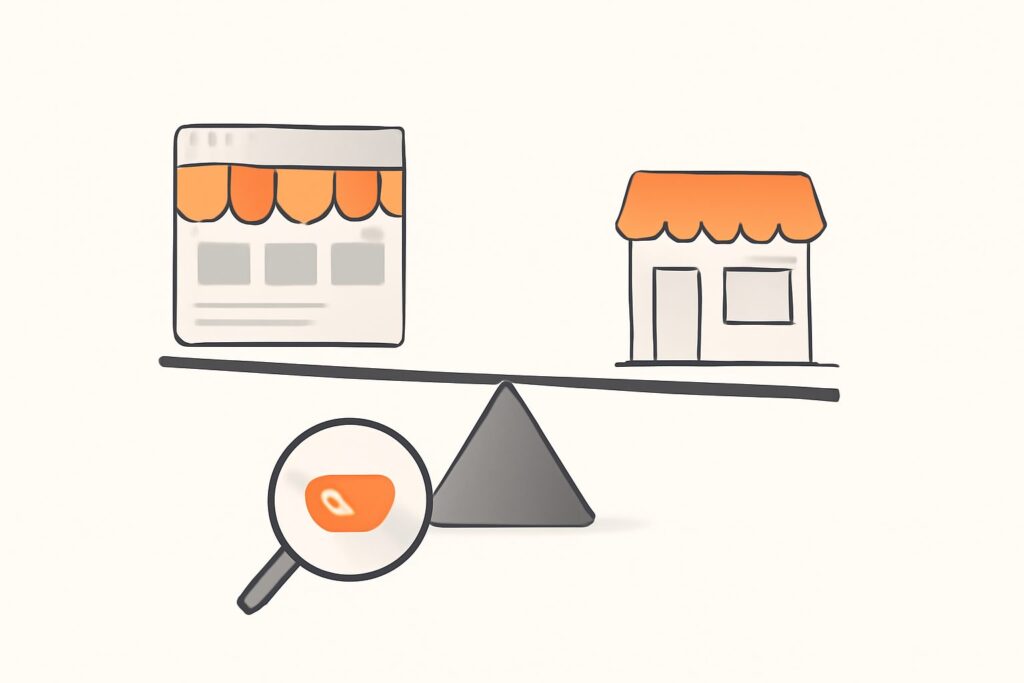
The marketplace vs own store question is usually pitched as reach versus control, and that framing quietly hides the part that decides your long-term outcome: who owns the ranking asset you’re building. Every product listing you publish is a bet, and on a marketplace the house holds the deed. You can absolutely sell more, faster, on Amazon or Etsy — but the search equity your listings generate belongs to the platform, not to you. Reframe the decision around asset ownership and it stops being a reach argument and becomes a question about what you’re actually accumulating: a rented audience, or a domain that compounds.
Two Completely Different Ranking Systems
The first mistake in the marketplace vs own store debate is treating “SEO” as one skill that transfers. It doesn’t. Your own store competes in Google’s organic index, where relevance, links, crawlability, and content quality decide position. A marketplace listing competes inside that platform’s internal search — Amazon’s A9/A10 algorithm, Etsy’s relevance-plus-listing-quality ranking, eBay’s Best Match. These are separate systems with separate inputs. Optimizing an Amazon title for conversion velocity and keyword coverage in the backend fields has almost nothing in common with earning a backlink or fixing a faceted-navigation crawl trap on Shopify.
So you’re not choosing one SEO channel over another. You’re choosing which ranking game to play — and whether the skills and equity you build are portable when you leave.
Borrowed Authority: The Fast Start Nobody Owns
A marketplace hands you domain authority you could never build alone. Amazon.com and Etsy.com are among the most trusted, most crawled domains on the web, and a brand-new listing inherits that trust instantly. A product you upload today can appear in front of buyers this afternoon, both inside the marketplace and sometimes in Google, because the platform’s domain does the heavy lifting.
The catch is in the word “borrowed.” None of that authority accrues to you. When a customer finds your product through Amazon search, Amazon owns the query, the click, the customer relationship, and the ranking signal. Your standalone store starts from zero authority — slower, harder, occasionally demoralizing in month two — but every link, every ranking page, and every returning visitor deposits equity into a domain you control. That’s the core of the trade: instant borrowed reach versus slow owned compounding.
The Domain Equity You Only Build on Your Own Store
SEO is one of the few marketing channels that produces a durable asset. A page that ranks on page one keeps sending traffic for months or years at near-zero marginal cost. But that asset only exists if it lives on a domain you own. On a marketplace, you’re improving the platform’s asset — your reviews, your ranking listings, your conversion history all strengthen Amazon’s search, not a property you can sell, migrate, or defend.
This is the strategic heart of the own store vs Amazon decision. A standalone store lets you build category pages targeting broad head terms, buying guides that capture research intent, and product pages optimized for long-tail and model-number queries — a content architecture that funnels searchers from “best waterproof laminate flooring” down to a specific SKU. None of that structure is possible on a marketplace, where you get a listing template and nothing else.
Marketplace Dependency Is a Concentration Risk
The quiet danger of going marketplace-first is marketplace dependency — building your entire revenue base on a channel whose rules, fees, and algorithm you don’t control. Platforms change ranking factors without notice, raise referral and fulfillment fees, launch private-label products that compete directly with top sellers, and suspend accounts over policy disputes with slow appeals. When 90% of your revenue flows through one marketplace, a single algorithm change or suspension is an existential event, not a bad month.
Selling on marketplaces for SEO purposes carries a second hidden cost: you’re training buyers to search on the platform, not for your brand. Every sale reinforces the marketplace as the place to find products like yours, which makes eventually pulling those customers to your own store progressively harder. Dependency compounds in the wrong direction.
How Marketplace Search Actually Ranks You
To weigh the trade-off honestly, you have to respect that marketplace ranking is real and specific — it just isn’t web SEO. Amazon’s system, evolved from A9 into what sellers call A10, is fundamentally a conversion-and-relevance engine. It rewards listings that turn impressions into sales:
- Sales velocity and conversion rate — the dominant signal; a listing that converts clicks into orders climbs.
- Keyword relevance — placement in the title, bullets, and hidden backend search-term fields, matched against the buyer’s query.
- Reviews and rating volume — social proof that lifts both ranking and conversion.
- Price competitiveness and stock availability — out-of-stock or overpriced listings get suppressed.
- Fulfillment method — Prime-eligible (FBA) listings often get a visibility edge.
Notice what’s absent: backlinks, domain authority, and most of what governs Google. A marketplace listing lives or dies on conversion inside a closed system. That makes marketplace optimization a genuine discipline — but a non-transferable one.
How Google Ranks Your Own Store
On your own domain, you’re playing the open-web game, and it has its own well-documented ecommerce failure modes. Faceted navigation can spawn thousands of near-duplicate URLs that shred your crawl budget. Variant pages (same shirt, six colors) create near-duplicate content that dilutes ranking signals. Thin, manufacturer-copied product descriptions get treated as low-value at scale. Out-of-stock and discontinued products leak equity and frustrate crawlers if handled carelessly.
The upside is that you can fix every one of these and turn technical hygiene into a moat competitors on a template can’t match — canonical tags on variants, controlled indexation of filtered URLs, unique descriptions, and clean redirect handling for retired SKUs. Correct Product, Offer, and AggregateRating schema can earn rich results in Google. One accuracy note worth respecting: Google’s review-snippet policy allows self-serve first-party reviews on your own products to be eligible for star markup, but restricts third-party review widgets — so mark up genuine reviews, and don’t expect stars from a bolted-on badge.
A Worked Example: The Same Product, Two Paths
Picture a small brand selling handmade ceramic mugs. On Etsy, they list twenty variations, inherit Etsy’s authority, and start getting sales in week one from buyers already browsing “handmade mug.” Etsy’s internal search rewards their listing quality and conversion rate. Revenue is real and fast — but every buyer is an Etsy customer, and the brand owns none of the search equity.
On their own Shopify store, month one is quiet. By month four, a buying guide — “how to choose a handmade coffee mug” — starts ranking, feeding a category page, which feeds product pages targeting long-tail terms like “large speckled ceramic mug.” The traffic is smaller at first but it’s theirs, it compounds, and the email list it builds is a customer relationship no platform can revoke. The honest read for most brands: this isn’t marketplace vs own store as an either/or, it’s a sequencing decision — use the marketplace for cash flow and validation while you build the owned asset that eventually carries the business.
When Each Channel Actually Wins
The even-handed answer depends on your stage and goals:
- Marketplace wins when you need fast validation, have no audience yet, sell commodity or impulse products where buyers search on Amazon by default, or lack the resources to build technical SEO. Borrowed authority is a legitimate accelerant.
- Your own store wins when you’re building a brand, want durable organic traffic, need margin (marketplace fees can take 15%+ per sale), or plan to sell the business one day — because you can only sell an asset you own.
- Both, sequenced is the pragmatic default: marketplace for early cash flow, own store as the long-term equity play, with a deliberate plan to migrate customer relationships to the domain you control.
De-Risking Marketplace Dependency
If you start on a marketplace, treat it as a customer-acquisition channel, not the destination. Put your brand and store URL on packaging and inserts (within platform rules). Build an email or SMS list from the moment a customer engages off-platform. Register a domain early and stand up even a thin store so the owned asset starts accumulating age and authority in parallel. The goal is never to be in a position where one algorithm update or account review can end the business — diversification is the entire defense against marketplace dependency.
Building the Owned SEO Asset with SEO Rocket
The reason most brands never escape the marketplace is that standalone-store SEO feels opaque, so they default to the channel that gives instant feedback. That’s the gap SEO Rocket is built to close. It runs keyword research on real Ahrefs data segmented into product, category, and buying-guide terms, so you can see the head terms your category pages should own and the long-tail queries your product pages can win — the exact structure a marketplace listing can’t build.
Its real-crawler site audit surfaces the specific ecommerce failure modes above — duplicate variant URLs, thin product pages, broken links, redirect chains — before they cost you crawl budget, and its competitor gap analysis shows what rivals rank for that you don’t. The validation-gated AI writer produces unique product descriptions and buying guides at scale, which is a real answer to thin-content-at-scale rather than a shortcut to it. It’s worth being clear about what it is: an SEO layer at roughly $50/mo with a free tier, not a store platform — you still choose Shopify or WooCommerce; SEO Rocket makes the owned asset actually rank. The underlying playbook is one proven across 1,000,000+ ranking pages, including flooring ecommerce, so the ecommerce mechanics aren’t theoretical.
Frequently Asked Questions
Does selling on a marketplace help my own website’s SEO?
Not directly. A marketplace listing builds the platform’s search equity, not your domain’s. Marketplace links to your site are typically nofollowed or blocked, so they pass little ranking value. The indirect benefits are brand searches and validation — real, but they don’t move your own store’s organic rankings on their own.
Is Amazon SEO the same as Google SEO?
No. Amazon’s A9/A10 is a conversion-and-relevance engine driven by sales velocity, keyword placement, reviews, price, and stock inside a closed system. Google ranks on relevance, links, content quality, and crawlability across the open web. The skills and the equity you build are largely non-transferable between them.
Should a new store start on a marketplace or its own domain?
For most, both in sequence: use the marketplace for fast validation and cash flow while building the owned store as the durable asset. Start the domain early so it accumulates authority in parallel, and work deliberately to move customer relationships onto property you control.
The Bottom Line
The marketplace vs own store choice isn’t reach versus control — it’s rented equity versus owned equity. Marketplaces lend you authority and speed but keep the asset; your own store makes you earn authority slowly and then hands you an asset that compounds and can be sold. The strongest position for most brands is to use both honestly: take the marketplace’s fast start, but treat every sale as a step toward the owned domain that eventually carries the business. Build the asset you keep.