A private blog network looks like a shortcut because it is one — and shortcuts in SEO tend to work right up until the moment they catastrophically don’t. People searching “what is a PBN” usually want to know whether they can buy their way onto page one without the slow grind of earning links. The honest answer is that you can, for a while, and then Google reprocesses the network and the rankings you rented disappear in a single update. Understanding exactly how a PBN works is the fastest way to see why it’s a bad bet.
What Is a PBN, Actually
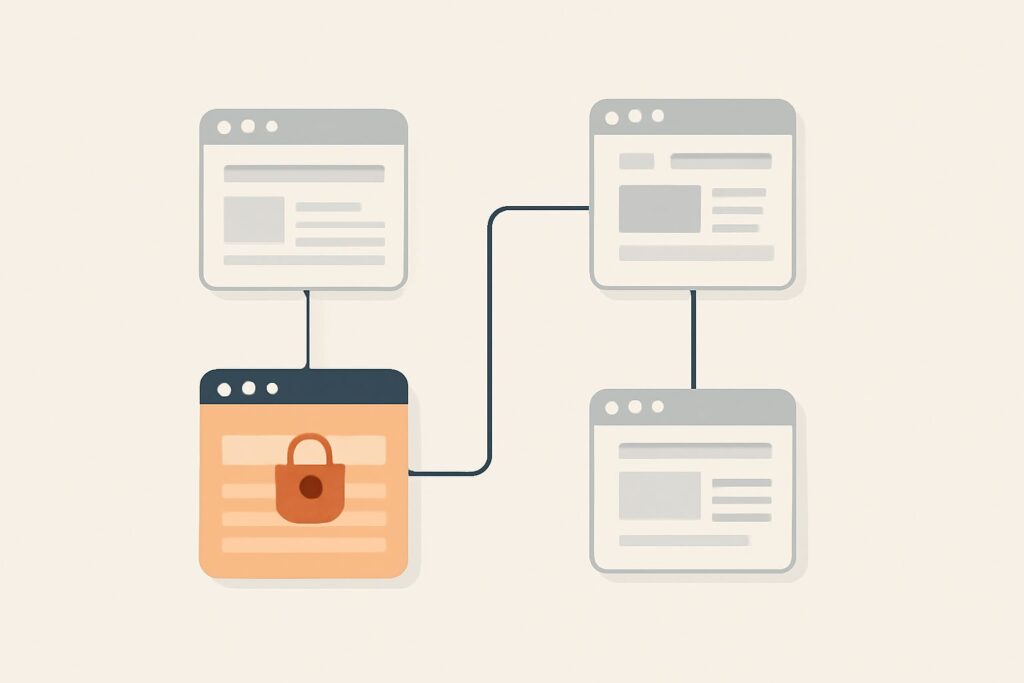
A private blog network is a collection of websites — often dozens or hundreds — that one operator controls, built for the sole purpose of passing link equity to a “money site” they want to rank. The trick is that the network is supposed to look private, meaning the sites appear unrelated to each other and to the site they’re boosting. Each blog publishes a few articles, links out to the target, and pretends to be an independent voice in the niche.
The raw material is usually expired domains. Operators buy domains that once belonged to real businesses, nonprofits, or news sites — domains that still carry backlinks and authority metrics from their former life. They rebuild a thin version of the old site, or a plausible-looking new one, and inherit the leftover “link juice.” That inherited authority is the entire product. When people ask what a PBN is, this is it: recycled domain authority, resold as backlinks.
How PBN Backlinks Are Supposed to Work
The mechanism relies on Google treating each linking domain as an independent editorial endorsement. In theory, twenty different websites linking to your page with your target anchor text signals that twenty independent publishers found you worth citing. Rankings for competitive terms are still heavily influenced by links, so a burst of authoritative-looking pbn backlinks can genuinely move a page up within weeks.
Operators go to real lengths to hide the footprint that would give the network away. They spread sites across different hosting providers and IP ranges, register domains with privacy protection, vary the WordPress themes and plugins, use different registrars, and stagger publishing schedules so nothing looks coordinated. Some rent PBN links to clients at $30 to $200 per placement per month; others build private networks purely for their own portfolio. Either way, the cost of maintaining the illusion is exactly what makes PBNs fragile.
Why Google Treats PBNs as a Link Scheme
Google’s guidelines are explicit: links intended to manipulate rankings are a link scheme, and “using automated programs or services to create links to your site” plus any network built to pass equity qualifies. PBNs aren’t a grey area to Google. They’re a named violation, and the company has spent more than a decade building detection for exactly this pattern.
The footprints operators try to hide are the same signals Google’s systems are tuned to find. Overlapping hosting, recurring registration patterns, unusual link graphs where a cluster of low-traffic sites all point at the same commercial targets, thin content that exists only to host outbound links, and domains whose topic suddenly changed after an ownership transfer — each is a detectable fingerprint. Google has also run manual deindexing campaigns against networks, most famously wiping out large public PBN services and every site they linked to in one sweep. When a network gets caught, it’s rarely one site that falls. It’s the whole network and often the money sites relying on it.
Are PBNs Worth It? The Real Cost of Getting Caught
So are PBNs worth it? Run the actual numbers, not the fantasy. On the upside you get a temporary ranking lift that lasts until the next detection cycle — could be months, could be weeks. On the downside sits a stack of losses most people don’t price in:
- Deindexing of the network — the domains you paid to build or rent lose all value the moment they’re flagged, taking your spend with them.
- A manual action on your money site — an “unnatural links” penalty can erase the majority of your organic traffic within days.
- Recovery drag — cleaning up means disavowing links and filing a reconsideration request, a process that routinely takes two to four months even when Google approves it the first time.
- Permanent gaps — while you’re penalized, competitors take the rankings you vacated, and some of that ground never comes back.
The deeper problem is that you never owned the asset. PBN rankings are rented against a debt that comes due whenever Google decides to reprocess the network. You’re building your business on land the landlord can repossess without notice, and the eviction is silent — no email, just traffic falling off a cliff.
The Grey-Hat Middle Everyone Rationalizes
Plenty of operators tell themselves their network is different — the content is decent, the sites get real traffic, the footprint is clean. Occasionally a well-run private network survives longer than the cheap ones. But “longer” is not “durable.” The economics only work if Google never catches up, and Google’s spam systems have improved materially with every core update since 2022. Betting your primary revenue channel on the assumption that detection stops improving is not a strategy. It’s a countdown.
What Actually Builds Durable Authority
The links that survive updates are the ones you’d be proud to show a Google engineer: earned citations from sites that genuinely found your content worth referencing. That’s slower, but it compounds instead of evaporating. The work breaks into two honest halves — publishing pages good enough to attract links, and running real outreach to earn them.
This is where SEO Rocket replaces the PBN workflow with a legitimate one. Its competitor and backlink analysis maps the links your rivals actually earned across up to five competitors, with anchor-text breakdowns and named outreach targets, so you’re prospecting real sites you can pitch rather than buying fake ones. The content-gap analysis shows which topics competitors rank for that you don’t — the pages worth building to become link-worthy in the first place. You get a map for earning authority the way it’s supposed to be earned, at $50 a month, instead of a rented network that detonates.
The Content That Earns Links Without a Network
No outreach campaign rescues thin content, which is exactly why a PBN feels necessary to people whose pages don’t deserve to rank yet. Fix the page and the links get easier. SEO Rocket’s AI article writer runs hard validation gates — a 1,000-word minimum, title and meta limits, a required section count, and an automatic repair loop that catches thin output before it becomes a draft. Pair that with AI keyword research and rank tracking that watches top-100 trends rather than daily jitter, and you have the same playbook proven across 1,000,000+ ranking pages: research, build pages that beat the weakest competitor on page one, earn links honestly, and track the trend.
A private blog network sells you rankings you can lose overnight. The alternative sells you rankings you keep. One is a shortcut with a debt attached; the other is slower and actually yours. If you’ve read this far trying to decide whether a PBN is worth it, you already know the answer — you were just hoping the math worked out differently.