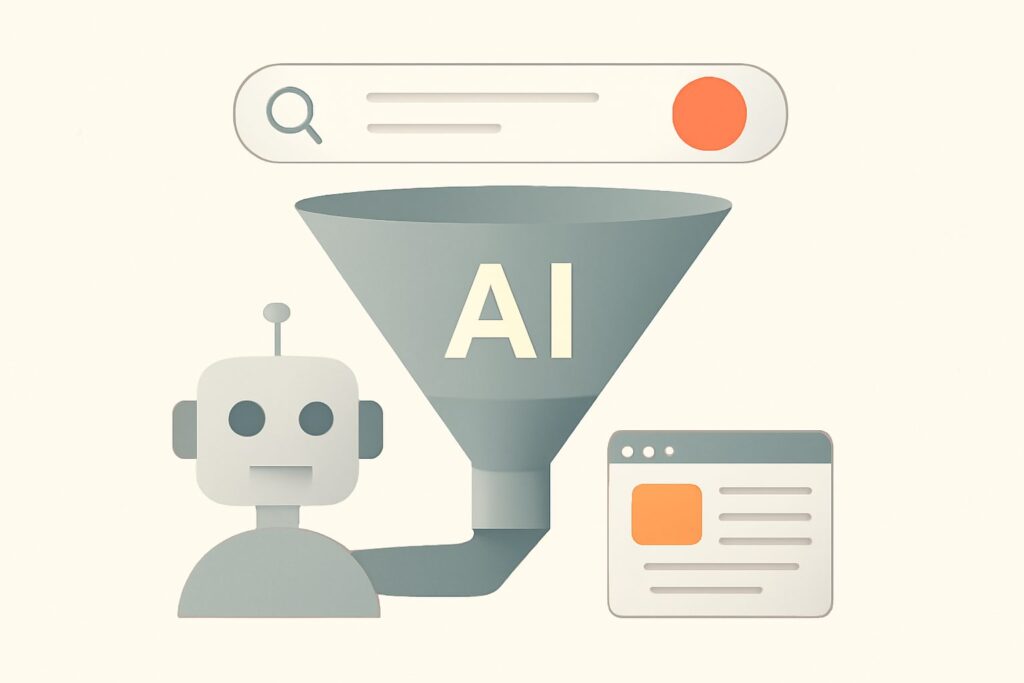
The lazy take on the ai search funnel is that the funnel is dead — that assistants collapsed awareness, consideration, and decision into one answer, so there’s nothing left to optimize. That’s wrong, and believing it is expensive. The funnel didn’t die. It moved upstream, into the model’s answer, where most of it is now invisible to your analytics. Buyers still move through awareness, research, and shortlisting — they just do more of it inside ChatGPT, Gemini, Perplexity, and Google’s AI surfaces before they ever land on a page you can measure. Your job is to map that journey, get named at each stage, and instrument the parts you used to take for granted.
The Funnel Didn’t Die — It Moved Inside the Model
For twenty years the buyer journey ran through a page of blue links. You ranked, they clicked, your analytics saw everything. The ai search funnel breaks that chain in one specific way: an answer layer now sits between the query and your site. A buyer asks a question, the model synthesizes an answer from many sources, and the buyer often finishes the step without clicking anything. You were in the funnel — you may even have been the source the model paraphrased — but no referral hit your logs.
This is why “the funnel is dead” feels true and isn’t. The stages still exist; the interface changed. Discovery, comparison, and validation now happen through a conversational agent that reads dozens of pages so the buyer doesn’t have to. The mistake is treating that as an end state instead of a new top-of-funnel you have to earn your way into.
Mapping the AI Buyer Journey to Four Stages
A useful way to think about the ai buyer journey is four moments, each one a place the model can include or exclude you:
- Prompt — the buyer describes a problem, not a keyword (“tools to track brand mentions in ChatGPT”). The model decides which sources to retrieve.
- Answer — the model synthesizes a response and names a handful of options. This is the new impression, and citation is the new ranking.
- Shortlist — the buyer asks a follow-up (“compare the top two”) or issues a fresh branded query. The model narrows the field.
- Verify — the buyer finally clicks through to confirm pricing, read a review, or start a trial. This is where the ai search funnel hands off to your actual site.
The traditional TOFU/MOFU/BOFU model still maps onto this cleanly. What changed is that the first three stages now happen mostly out of your view, and the fourth — the click you can measure — represents a much smaller, later slice of the journey than it used to.
Why Most of Your Funnel Is Now Invisible
Here’s the mechanic that trips up most teams. When a model answers without a click, the entire top and middle of your ai search funnel become dark. You can’t see the prompt, you can’t see whether you were cited, and you can’t see the competitors named alongside you. Your GA4 and Search Console show a shrinking pool of clicks and read it as declining demand, when the real story is that demand shifted to a surface those tools were never built to watch.
The dangerous version of this error is cutting content investment because “SEO traffic is down.” If buyers are researching you inside an assistant and only clicking at the verify stage, raw sessions understate your influence badly. The number you actually need — how often you appear and get cited in AI answers — isn’t in your web analytics at all.
How AI Decides Who Gets Cited
Getting into an AI answer is retrieval, not ranking, and the distinction matters. Assistants that browse (Perplexity, Gemini, ChatGPT with search, Google’s AI surfaces) run live queries, pull a set of candidate pages, and ground their answer in what those pages actually say. To be citable you have to be retrievable for the buyer’s phrasing, clearly answer the specific sub-question, and state facts in a way a model can lift without hallucinating.
Classic search signals still feed this. Google’s own systems — including Navboost, a real click-signal system surfaced in the 2024 antitrust documents — help decide which pages are trustworthy enough to ground an answer, so being a strong organic result remains a large part of being a cited one. What’s genuinely new is the packaging: self-contained claims, clear entity names, direct question-and-answer structure, and specificity a model can quote verbatim. Vague, throat-clearing prose gets skipped even when it ranks.
AI Overviews vs AI Mode vs Assistants
The geo funnel behaves differently across surfaces, and conflating them leads to bad strategy. Keep three things distinct:
- Google AI Overviews (formerly SGE) — the summarized answer box on a normal results page. It still shows links, so it’s a partial-click surface: you can be cited and still earn a visit.
- Google AI Mode — the separate, fully conversational search experience. Deeper synthesis, more follow-ups, fewer obvious click-outs.
- Standalone assistants — ChatGPT, Gemini, Perplexity, Claude. Each has its own retrieval behavior; some cite sources prominently, some barely at all.
Because behavior differs, presence in one tells you little about the others. A brand cited constantly in Perplexity can be invisible in Gemini. That’s why the ai discovery funnel has to be measured per engine, not as a single blended score that hides the gaps.
Top of Funnel: Becoming a Source, Not a Result
At the awareness stage the goal shifts from ranking a page to being the source a model reaches for. Practically, that means owning the definitional and “best tools for X” territory with content that states clear, quotable facts — what a thing is, who it’s for, how it compares — rather than burying the answer under an intro. It also means building genuine entity presence: consistent mentions of your brand across the independent sites, comparisons, and communities that models retrieve from. You can’t prompt-inject your way into an assistant; you earn it by being the clearest, most-referenced source on the topic.
One honest caveat on a popular tactic: llms.txt, a proposed file for telling models what to read, is an emerging convention, not a guaranteed lever. Google has said it does not use it as a ranking signal. Treat it as low-cost housekeeping, not a growth channel.
Middle of Funnel: Winning the Shortlist Moment
The comparison stage is where deals are quietly won or lost. When a buyer asks a model to “compare the top options” or names two competitors, the answer that comes back is your shortlist — and if you’re absent, you never get a chance to compete on the merits. Winning here means having strong, specific comparison content and being present in the third-party comparisons models trust. It also means monitoring branded and comparison prompts directly, because the phrasing buyers use (“X vs Y for small teams”) rarely matches the keywords you track.
This is one place a tool earns its keep. SEO Rocket’s competitor gap analysis surfaces the comparison and topic space where rivals appear and you don’t — the exact queries where a model is likely to name them instead of you — so you can close the gap with content built to be cited, not just to rank.
Bottom of Funnel: The Verify-and-Buy Handoff
The one stage that still reliably produces a click is verification. A buyer who has been sold on you inside an assistant comes to confirm pricing, scan reviews, or start a trial. This makes bottom-of-funnel pages — pricing, comparisons, docs, trial flows — disproportionately important, because they carry the traffic the funnel finally releases. Ironically, the shift to AI research raises the stakes on these pages: they now catch a pre-qualified buyer, so friction or a missing answer costs you a deal the model already half-closed.
Measuring an Invisible Funnel
You can’t manage what you can’t see, and web analytics simply doesn’t see the AI layer. The measurement that matters is AI visibility: across a set of buyer prompts, how often does your brand appear, and how often is it cited, in ChatGPT, Gemini, Google AI Overviews, and Perplexity — versus your competitors? That’s a presence-and-citation-share metric, tracked per engine over time, not a click count.
This is exactly the gap SEO Rocket’s AI-visibility tracking is built for: it runs your buyer prompts across the major assistants and reports where you show up, where you’re cited, and where a competitor is named instead — the otherwise-dark top and middle of the funnel made into a chart. For agencies, the same data feeds a client dashboard, so you can report AI discovery visibility alongside rankings instead of hand-waving about a surface nobody can measure.
A word of discipline on numbers: this space is full of invented statistics (“AI Overviews cut clicks by X%,” “N% of searches are now AI”). Don’t build strategy on them. Track your own presence over time as directional trend data — that’s real, it’s yours, and it’s the only ground truth for your specific market.
Building Content the Model Will Cite
Cite-worthy content is a specific craft. A worked micro-example: instead of a section titled “Our Approach” that meanders for 300 words, write a subhead that mirrors the buyer’s question (“How much does AI visibility tracking cost?”) and answer it in the first sentence with a concrete, quotable fact. Add a short comparison table or a tight list where it genuinely helps a model extract structure. Keep claims self-contained so a sentence lifted out of context is still accurate. This is the same principle behind SEO Rocket’s validation-gated AI writer — enforced structure, real section coverage, and a repair loop that catches thin drafts — because a page that reads like a clear answer is the page a model quotes.
This isn’t a trick layer bolted onto SEO. It’s the same helpful-content discipline that has always worked, tuned for a reader that happens to be a language model summarizing on a buyer’s behalf. The playbook that scaled a portfolio past 1,000,000+ ranking pages didn’t change its principles for AI search; it applied them to a new interface.
Frequently Asked Questions
What is the AI search funnel?
The ai search funnel is the buyer journey — awareness, research, shortlisting, and verification — as it now plays out inside AI assistants like ChatGPT, Gemini, Perplexity, and Google’s AI surfaces. The stages are unchanged, but the first three happen largely inside the model’s answer, out of view of your web analytics, and only the final verify-and-buy step reliably produces a click you can measure.
How is it different from the traditional SEO funnel?
The traditional funnel ran through clickable search results, so every stage left a trace in your analytics. In the AI funnel an answer layer sits between the query and your site, so a buyer can research and shortlist you without ever clicking. Discovery becomes citation rather than a ranking, and success is measured by how often you appear and get cited across engines, not by session counts alone.
How do you measure AI search visibility?
Track presence and citation share, per engine, over time. Run a representative set of buyer prompts across the major assistants and record how often your brand appears and is cited versus competitors. Tools like SEO Rocket’s AI-visibility tracking automate this; avoid relying on the invented industry-wide statistics that circulate for this topic, and treat your own trend data as the ground truth.