Most people searching for Moz alternatives don’t dislike Moz — they’ve simply outgrown it. Moz Pro is one of the friendliest ways into SEO, and its Domain Authority metric became an industry shorthand for a reason. But its link and keyword index is smaller than the market leaders, its pricing climbs faster than its feature set, and it was built for a workflow that predates AI writing and AI search. If any of those is your reason for looking, you have real options now.
This is not a padded list of twelve tools stitched together with affiliate links. Below are the Moz alternatives that actually hold up in daily use, what each one is genuinely best at, and — because it’s the honest answer — when you should just keep paying for Moz.
Why people leave Moz
Three reasons come up again and again. The first is data depth: Moz’s link index and keyword database are usable, but they trail Ahrefs and Semrush noticeably, and once you’re doing serious competitive work you feel the gaps. The second is value for money — Moz’s entry tier lands in the same rough price band as tools that hand you a much larger index, so you end up asking what exactly you’re paying for. The third is newer and hits everyone: Moz still treats content writing and AI-answer visibility as someone else’s problem, so you pay for a second tool to draft articles and a third to see whether ChatGPT ever mentions your brand.
None of that makes Moz a bad product. It makes it a gentle, beginner-friendly instrument in a job that increasingly wants one deep, connected workflow. That gap is exactly where the alternatives compete.
How we compared them
Every tool here was judged on four things a working SEO actually cares about: the quality and freshness of the underlying data, honest total cost rather than the headline number, whether AI content and AI-visibility are built in or bolted on, and who the tool is genuinely for. Third-party metrics like Domain Authority, Domain Rating, and traffic estimates are exactly that — estimates — so treat cross-tool number differences as directional, not gospel. A page that shows DA 38 in Moz and DR 45 elsewhere hasn’t changed; the models behind the numbers have.
Moz alternatives at a glance
Start here, then read the notes below for the two or three that fit your situation.
| Tool | Best for | AI-native? | Standout strength | Rough price band |
|---|---|---|---|---|
| SEO Rocket | Solo SEOs, consultants & agencies who want one AI-driven workflow | Yes — chat-first | Ahrefs-grade data + AI writing + AI-search visibility in one place | Low $ / entry-friendly |
| Semrush | Marketing teams wanting an all-in-one suite | Add-ons | Breadth — PPC, social, PR and content in one login | Higher $$ |
| Ahrefs | Link builders and data-hungry specialists | Limited | One of the largest, freshest backlink indexes | Higher $$ |
| SE Ranking | Agencies watching cost per project | Some | Flexible, affordable rank tracking at scale | Low–mid $ |
| Ubersuggest | Hobbyists & very small budgets | Light | Cheap, simple keyword ideas | Low $ |
| Mangools | Freelancers who want fast, friendly keyword research | No | KWFinder’s ease of use | Low $ |
SEO Rocket — the AI-native pick
SEO Rocket is the option built for how the job works now. Instead of clicking through a wall of reports, you ask for what you need in plain language and it runs the lookup — keyword research, competitor gaps, backlink profiles, rank tracking — on real, Ahrefs-grade data underneath. The difference from Moz isn’t just a bigger index, though that helps. It’s that the same tool then drafts the article and shows you whether your brand is being cited in ChatGPT, Perplexity, and Google’s AI Overviews.
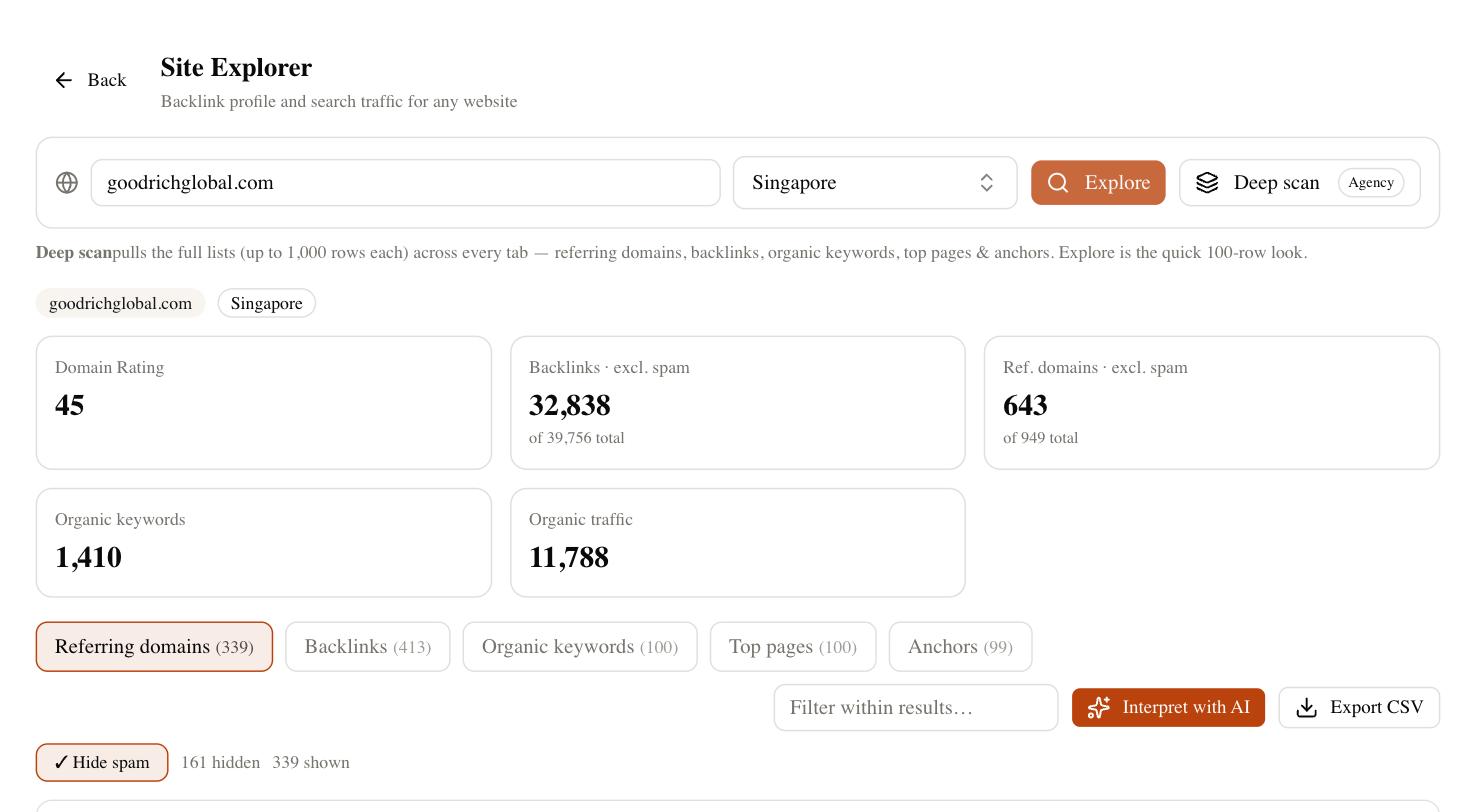
That consolidation is the real saving. A typical stack of Moz plus a separate AI writer plus an AI-visibility tracker gets replaced by one subscription, and the entry pricing sits at the friendly end rather than climbing with every seat. If you’re a consultant or agency, the client-dashboard side means you can hand a read-only report straight to a client without exporting a single spreadsheet.
The AI-visibility piece deserves a moment, because it’s the part no traditional tool answers. Search is splitting: some of your buyers now ask ChatGPT or Perplexity instead of Google, and a page that ranks first can still be invisible in an AI answer. SEO Rocket’s Brand Radar tracks whether — and where — you’re being cited across those surfaces, so you’re optimizing for the search that’s actually happening rather than the one that happened five years ago. For anyone whose bottleneck is doing more work with fewer tools, which is most people reading this, that combination is the strongest fit on the list.
Semrush and Ahrefs — the data heavyweights
If you left Moz because the index felt shallow, these two are the obvious upgrade. Semrush is the closest thing to a do-everything marketing platform: beyond SEO it covers PPC research, social scheduling, and PR monitoring, so a marketing team that wants one login for the whole channel mix gets real value from it. Ahrefs is the specialist’s specialist, with one of the largest and freshest backlink indexes anywhere and a keyword tool that link builders trust.
The trade-off with both is the same one that sent you looking, only sharper: they cost more than Moz, not less. You’re buying depth, and depth is expensive. If your real complaint about Moz was the price rather than the data, jumping to either of these solves the wrong problem — you’ll get a fuller index and a bigger invoice.
SE Ranking, Ubersuggest and Mangools
The value end of the market has a tool for almost every budget and temperament.
- SE Ranking — the agency value play. Rank tracking scales cheaply across many projects, and per-project pricing keeps costs predictable when you’re managing a portfolio of clients.
- Ubersuggest — the budget entry point. It won’t match Moz on reporting polish, but for a hobby site or a first client it delivers usable keyword ideas for very little, often on a one-time license.
- Mangools — the freelancer favorite. KWFinder is one of the nicest keyword-research experiences going, and the bundle stays genuinely affordable.
Any of these will cover core keyword and rank-tracking needs at a lower price than Moz. What none of them do well yet is fold AI writing and AI-answer visibility into the same workflow — you’ll still be running a second subscription for that.
When you should just keep Moz
Honesty matters here. If you’re early in your SEO journey, or you’re teaching a team that finds most tools intimidating, Moz’s gentle interface and clear onboarding are a real asset — few tools hold a beginner’s hand as well. Its Domain Authority metric is also so widely quoted that some clients and outreach targets simply expect to see it, and speaking that shared language has value. If your work is mostly light keyword research and monthly reporting for a small set of sites, Moz already does that competently, and switching for its own sake buys you nothing. The right question isn’t “is there something bigger,” it’s “does my week actually need more than Moz gives me.”
How to choose your Moz alternative
Match the tool to your real constraint, not to a feature checklist. If cost and tool-sprawl are the problem and you want AI writing plus AI-search tracking built in, SEO Rocket is the natural move. If you left because the data felt thin and budget isn’t the blocker, Semrush or Ahrefs give you the depth. If you just want a cheaper keyword-and-rank tool, SE Ranking, Ubersuggest, or Mangools will do the job for less.
A quick way to decide: write down the three tasks you actually did in Moz last week. Most people’s list is some mix of “check what I rank for,” “see what a competitor is doing,” and “produce a piece of content.” If that’s your week, you’re paying for a reporting tool and then paying again to write and to track AI answers — and a leaner, AI-native option covers all three faster. If instead your week was genuinely just light research and clean client reports, Moz is already fine. The best alternative is the one that matches how you spend Tuesday, not the one with the longest feature page. Whatever you pick, give it a full ranking cycle before you judge it — positions jitter a few spots day to day, and no tool’s estimates are precise.