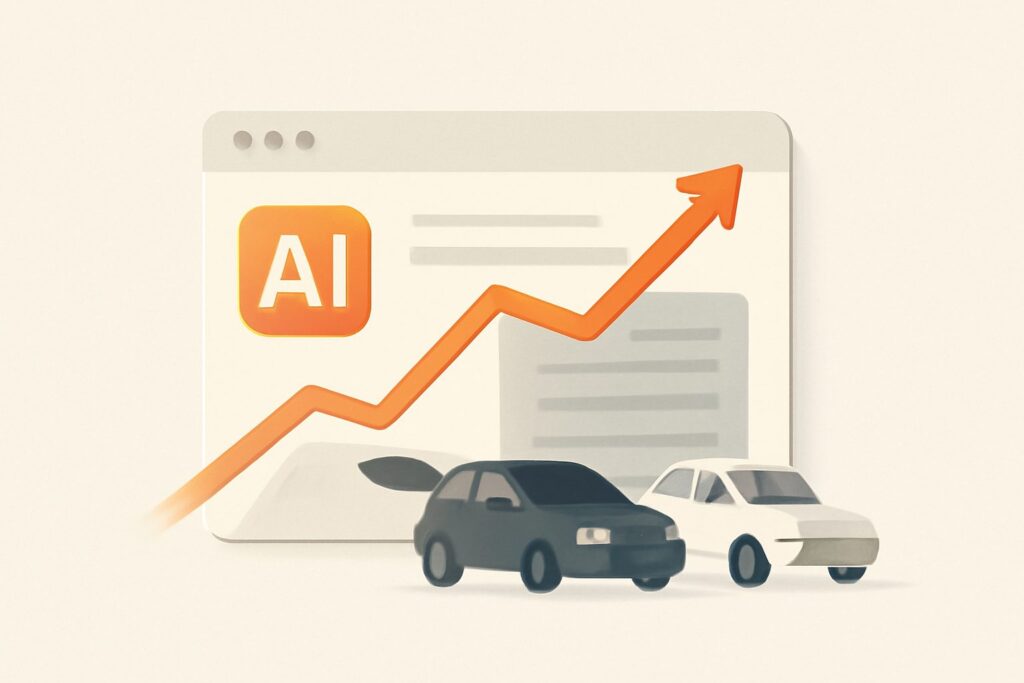
The panic about AI Overviews traffic loss is half right, which is the most dangerous kind of wrong. Yes, Google’s AI Overview sits above your blue link and answers some queries before the user ever scrolls. No, it does not evaporate your organic traffic across the board. The honest picture is uneven: certain query types bleed clicks badly, others are almost untouched, and a few actually send more qualified visitors than before. If you treat this as one uniform threat, you’ll either overreact and gut a channel that still works, or underreact and watch specific page types quietly decline. The job is to know which is which.
What AI Overviews Actually Change on the Page
An AI Overview is a generated summary that appears at the top of some Google results, stitched together from multiple sources and shown with citation links. When it fires, it pushes the traditional organic results further down the page. That’s the mechanical change: it’s not that your ranking disappeared, it’s that the first thing the user sees is an answer, not a list of links. For a query where the answer is a single fact or a quick definition, the user often has what they came for without clicking anything. That’s the click-cannibalization concern, and it’s real — pretending otherwise helps nobody.
But an AI Overview doesn’t fire on every query, and when it does fire it doesn’t always satisfy the searcher. The person researching a purchase, comparing options, or looking for a specific tool still clicks through, because a three-sentence summary can’t close that gap. The impact on your AI overviews traffic depends almost entirely on what your pages are ranking for.
Which Queries Actually Lose Clicks
The queries most exposed to click loss share a profile: the answer is short, factual, and complete. If someone searches for a definition, a conversion, a date, a simple “how many” or “what is,” the AI Overview can answer it in place and the searcher moves on. Informational top-of-funnel content that exists mainly to capture a quick answer is the category feeling the most pressure.
- Definitional and factual queries — “what is X,” “how many Y in Z,” simple conversions and lookups
- Quick how-to snippets — steps that fit in a paragraph the AI can reproduce without sending a click
- Thin informational pages that never had a reason to exist beyond ranking for one answer box
Notice these are the same pages that were already losing clicks to featured snippets years before AI Overviews existed. The trend didn’t start in 2024; AI Overviews accelerated an erosion that “position zero” began.
Which Queries Are Barely Touched
On the other side, plenty of search intent can’t be resolved by a summary. Transactional and commercial-investigation queries still drive clicks because the user needs to see the actual product, price, review, or booking page. Anything requiring a decision — comparisons, “best” lists where the user wants to judge for themselves, queries where trust and specificity matter — tends to keep its click-through, even when an AI Overview appears above it. Complex, multi-step, or account-specific tasks push the user to a real page too. If your traffic skews toward these intents, your exposure to AI Overviews traffic loss is lower than the headlines suggest.
Why Some Pages Gain From Being Cited
Here’s the part that gets lost in the doom cycle: an AI Overview cites its sources, and those citations are clickable. If your page is one of the linked sources, you can earn a visit from a searcher who now trusts you as the authority the AI drew from — often a more qualified click than a cold position-four listing. Being the cited source is a new, real form of visibility. It won’t replace the raw click volume of a page that lost its snippet, but it changes the calculus from “AI Overviews only take” to “AI Overviews redistribute.” The winners are the sources that get cited; the losers are the pages that were never distinctive enough to be worth citing in the first place.
How to Measure the Real Impact on Your Site
Do not diagnose this from vibes or from an industry stat you read somewhere — measure your own site, because the impact is page-specific. Start in Google Search Console: pull queries and pages where impressions held steady or rose while clicks fell. That gap is the fingerprint of an answer being satisfied on the results page — you’re still ranking and showing, but fewer people click. Segment by page type and intent so you can see whether the drop is concentrated in your thin informational pages (expected) or spreading into commercial pages (a real problem worth fixing).
The blind spot GSC can’t cover is the AI surface itself: it won’t tell you when ChatGPT, Perplexity, Gemini, or an AI Overview mentions or cites your brand without a tracked click. That invisible layer is exactly what SEO Rocket’s AI-visibility tracking is built to measure — how often your brand appears and gets cited across the generative engines, so you can see whether you’re winning the citation game even on queries where the raw click volume is shrinking. Pairing GSC click data with AI-visibility tracking gives you both halves of the story instead of guessing at the missing one.
Defending Your Traffic: Move Up the Value Chain
The durable response to AI Overviews traffic pressure is to stop competing for answers a machine can give away for free and start owning the depth a summary can’t. That means consolidating thin one-answer pages into comprehensive resources that earn the click by offering more than the overview can reproduce — original data, real comparisons, tools, first-hand experience, specifics. Information gain matters more than ever: if your page only restates what everyone else says, the AI has no reason to cite you and the reader has no reason to click. If it contains something unique, both do.
Practically, this is a content-quality and topical-authority play, and it’s measurable. Use SEO Rocket’s competitor gap analysis to find where rivals are getting cited and you aren’t, then close those gaps with content deep enough to be the source rather than the summarized. The validation-gated AI writer helps you produce that depth at a consistent standard instead of publishing more thin pages that were always going to lose to a generated answer.
What Not to Do
Don’t block Google’s crawlers to “protect” your content from AI Overviews — that also removes you from traditional rankings and citation eligibility, trading a partial loss for a total one. Don’t chase the daily rumor of a specific percentage traffic drop; the figures fly around inflated and un-caveated, and your site’s reality is knowable from your own analytics rather than a scary aggregate. And don’t abandon SEO on the assumption the channel is dead. The same playbook proven across 1,000,000+ ranking pages still works — it just rewards depth, distinctiveness, and citation-worthiness more sharply than it did when a thin page could rank on keywords alone.
The Bottom Line
AI Overviews change the shape of your organic traffic, not simply its size. Quick-answer pages lose clicks; commercial and decision-stage pages largely hold; cited sources gain a new kind of visibility. The mistake is treating it as one number to panic over. Measure your own pages in Search Console, layer in AI-visibility tracking to see the citation surface Google’s analytics can’t, and reinvest in content deep enough to be worth clicking. The traffic that leaves is mostly traffic that was only ever renting attention on a fact anyone could give away. The traffic worth having is still there for pages good enough to earn it.