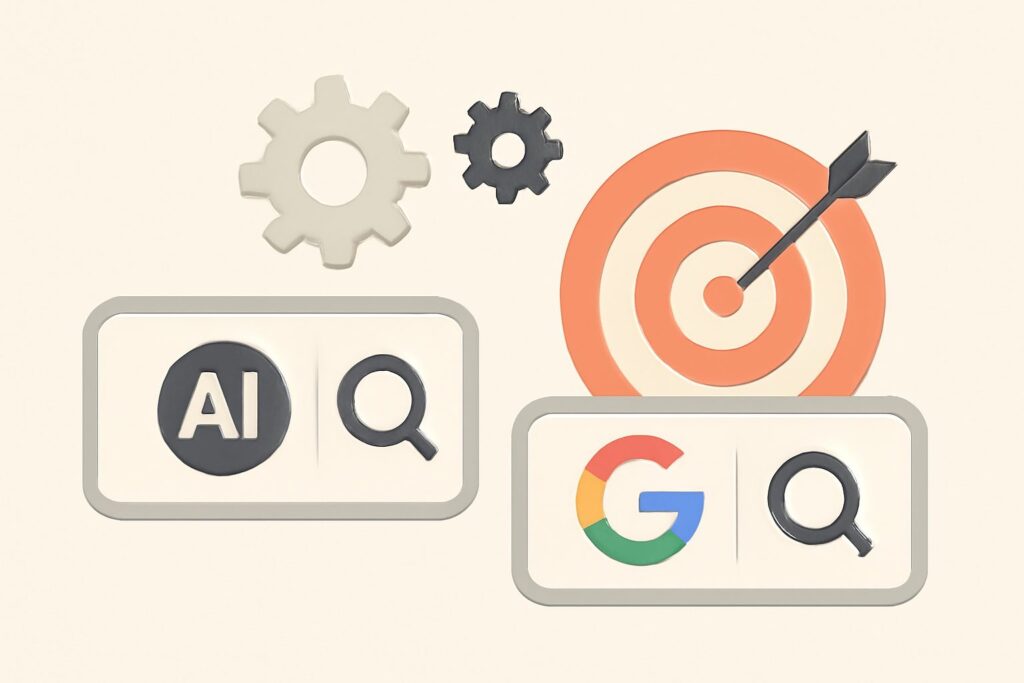
The AI search vs Google debate gets framed as a replacement story — chatbots kill the ten blue links, SEO is dead, start over. That framing is wrong on both ends. Traditional Google search isn’t going anywhere soon, and AI search didn’t arrive from another planet; much of it is built on the same crawling, indexing, and ranking machinery Google spent two decades refining. What actually changed is the interface between the searcher and the index, and that one change ripples into how you get found. Understanding the mechanism — not the hype — is what tells you where to spend effort.
How Traditional Google Search Works
Classic Google search is a retrieval system that returns a ranked list of documents. You type a query, Google matches it against an index of crawled pages using hundreds of signals — relevance, links, quality, freshness, user location — and hands back a list of links ordered by predicted usefulness. The user does the synthesis: they scan the results, click one or two, and assemble their own answer. Your goal as an SEO was to rank a page high enough on that list to earn the click. The unit of success was a position and a click.
How AI Search Works Differently
AI search — ChatGPT, Perplexity, Google AI Overviews, Gemini, Copilot — changes the last step. Instead of handing back a list for you to synthesize, the system retrieves relevant sources and a language model reads them, then writes a single synthesized answer, usually with citations. Under the hood it often still runs a search: many of these engines retrieve live web results, then generate on top of them. So the retrieval layer looks familiar, but the output is an answer, not a list, and the unit of success shifts from “ranked position and click” to “got cited in the answer.” That’s the core of AI search vs Google: same web underneath, a synthesizing layer on top.
Where They Genuinely Overlap
The comforting truth is how much carries over. AI engines that pull live results — including Google’s own AI Overviews — lean on the same fundamentals: crawlable pages, clear relevance to the query, authority and trust signals, and content that actually answers the intent. A page that ranks well in traditional search is far more likely to be retrieved and cited by an AI answer, because both systems are trying to surface the most useful, trustworthy source. You are not choosing between two disconnected disciplines. Strong traditional SEO is the foundation AI visibility is built on, which is why the “throw it all out” advice is so costly.
Where They Genuinely Diverge
The differences are real and worth naming precisely, because they change tactics.
- Output format — a list of links versus one synthesized answer, which means being “on page one” no longer guarantees a click if the answer resolves the query in place
- Query style — traditional search rewards short keyword queries; AI search invites long, conversational, multi-part questions, so content that answers specific sub-questions gets pulled in
- Citation over ranking — the win condition is being the source the model quotes, not just ranking near the top
- Extraction over matching — AI favors content it can lift clean, self-contained passages from, not just pages dense with the right keywords
- Follow-up context — conversational engines remember the prior turn, so answers build on each other in ways a stateless SERP never did
What This Means for Clicks
Here’s the honest tension in AI search vs Google. When an AI answers a query completely, the user may not click any source — the same click-cannibalization pressure AI Overviews put on quick-answer queries. But when the query needs depth, a decision, a purchase, or specific detail, the synthesized answer becomes a jumping-off point and the citation earns a highly qualified click. So the traffic picture isn’t uniformly worse; it’s redistributed toward content distinctive enough to be worth citing and worth clicking through to. Thin pages that only ever captured a quick fact lose either way. Deep, authoritative pages can win on both surfaces at once.
Do You Optimize for One or Both?
Both, and mostly with one motion. The practices that make a page citable by AI — clear structure, self-contained answers, genuine expertise, complete coverage of a topic, trustworthy sourcing — are the same practices that have made pages rank in traditional Google for years. The 2026 adjustment is emphasis, not replacement: write passages that stand alone as answers, cover the sub-questions a conversational searcher would ask, mark up your facts, and build genuine topical authority so both a ranking algorithm and a synthesizing model treat you as a trusted source. You don’t run two separate strategies. You run one strategy that respects how both interfaces consume it.
Measuring Success Across Both Surfaces
The measurement gap is the real operational difference. Traditional search is well-instrumented: Search Console and analytics show impressions, positions, and clicks. The AI surface is nearly invisible — when ChatGPT or an AI Overview cites you (or cites a competitor instead), your normal analytics stay silent. That’s why the two surfaces need two measurement layers. For traditional search you have rank tracking and Search Console; for the AI layer you need something watching the generative engines directly. SEO Rocket’s AI-visibility tracking fills that second gap, monitoring how often your brand is mentioned and cited across ChatGPT, Gemini, AI Overviews, and Perplexity so you can see your standing on the surface analytics can’t reach.
Run together, SEO Rocket’s rank tracking plus AI-visibility tracking give you the full scoreboard for AI search vs Google — where you rank, where you’re cited, and where a competitor is beating you on either one — instead of managing one surface blind.
The Bottom Line
AI search vs Google isn’t a fight to the death; it’s a new interface layered on largely the same web. Traditional search returns a list you synthesize yourself; AI search synthesizes the answer for you and cites its sources. They overlap in fundamentals — crawlability, relevance, authority, trust — and diverge in format, query style, and the shift from ranking to citation. The winning move isn’t to abandon SEO or to chase AI as a separate game, and it certainly isn’t to pick one surface and ignore the other. It’s to build content deep and distinctive enough to rank and be cited, then measure both surfaces side by side so you actually know it’s working rather than assuming. The same playbook proven across 1,000,000+ ranking pages still applies — it just answers to two audiences now, a ranking algorithm and a reading model, and the best pages satisfy both.