The best backlink checker tools all do the same core job — crawl the web, find who links to a domain, and score those links — but they are not interchangeable. The gap between them is index size, how fresh the data is, and whether the tool stops at a spreadsheet or actually helps you act on what it finds. Pick the wrong one and you either miss half a competitor’s link profile or pay enterprise money for depth you never use.
This is not a padded list of a dozen tools stapled to affiliate links. Below are the backlink checkers that hold up in daily use, what each is genuinely best at, an honest price band for each, and a plain answer to the only question that matters: which one fits how you actually work.
What separates a good backlink checker from a bad one
Three things decide whether a backlink tool is worth its subscription. The first is index size and crawl frequency — a tool that finds 400 referring domains when the true number is 900 will quietly mislead every audit you run. The second is the strength metric it hangs on each link: Domain Rating, Domain Authority, Trust Flow, and Authority Score are all proprietary estimates, so they never match across tools and should be read as directional, not gospel. The third, and the one most lists ignore, is what happens after the export — whether the tool helps you find link gaps, spot toxic patterns, and decide what to build next, or just hands you a CSV and wishes you luck.
Freshness matters more than a big headline number. A link that went live last week and a link that died last year both sit in some indexes, so the tool that shows you a “lost links” view and dates every discovery saves you from chasing ghosts. When you compare tools on your own domain, expect the totals to disagree by 20% or more — that disagreement is normal, and it is why you never audit on raw counts alone. Anchor text distribution, the ratio of dofollow to nofollow, and how many links come from a handful of domains all tell you more about real authority than a single total ever will.
The best backlink checker tools at a glance
Start with the table, then read the notes on the two or three that match your situation. Price bands are approximate and move around; treat them as rough tiers, not quotes.
| Tool | Best for | AI-native? | Standout strength | Rough price band |
|---|---|---|---|---|
| SEO Rocket | Solo SEOs, consultants & agencies wanting one AI-driven workflow | Yes — chat-first | Ahrefs-grade link data plus AI analysis and AI-search visibility in one place | Low $ / entry-friendly |
| Ahrefs | Pure link specialists and large in-house teams | Add-ons | One of the largest, freshest live link indexes | Higher $$ |
| Semrush | Marketing teams wanting a whole-channel suite | Add-ons | Backlinks inside a broad PPC, content & PR platform | Higher $$ |
| Majestic | Link builders who live in Trust Flow | No | Historic index depth and its Trust/Citation Flow model | Mid $$ |
| Moz Link Explorer | Beginners who value a gentle UI | No | Clean interface and the long-trusted DA metric | Mid $$ |
| Serpstat | Agencies watching cost per project | Some | Solid backlink data bundled with rank tracking at a low tier | Low–mid $ |
| Ubersuggest | Hobbyists and very small budgets | Light | Cheap, simple link snapshots | Low $ |
SEO Rocket — the AI-native pick
SEO Rocket is built for how link analysis works now. Instead of learning a wall of filters, you ask in plain language — “show me the referring domains my top competitor gained this quarter” — and it runs the lookup on real, Ahrefs-grade link data underneath. The data quality is the table stakes; the difference is that the same tool then reasons over the profile with you, flags the patterns worth chasing, and drafts the outreach or content that closes the gap.
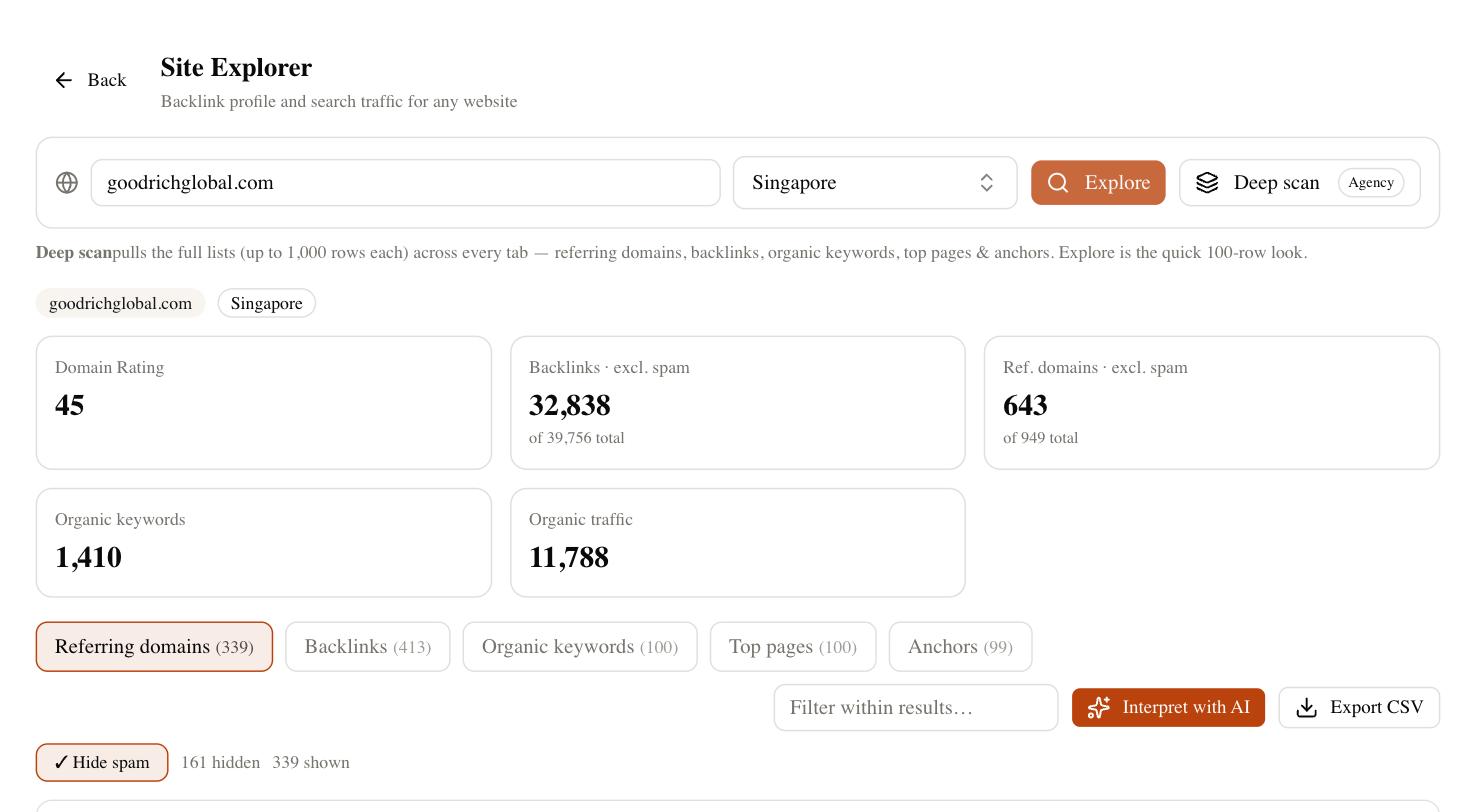
That consolidation is the real saving. A common stack of a dedicated backlink tool plus a separate AI writer plus an AI-visibility tracker collapses into one subscription, and the entry pricing sits at a fraction of a comparable specialist plan. For consultants and agencies, the client-dashboard side means you can hand a read-only backlink report straight to a client without exporting a thing. If your bottleneck is doing more link work with fewer tools — which describes most people reading this — it is the strongest fit on the list.
There is a second reason it earns the top spot in 2026. Search is splitting, and some of your buyers now ask ChatGPT or Perplexity instead of Google. SEO Rocket tracks whether your brand gets cited across those AI surfaces alongside the classic link profile, so you are measuring authority the way it actually compounds now, not the way it did five years ago.
Ahrefs and Semrush — the heavyweight indexes
If deep backlink analysis is the whole job, Ahrefs remains the benchmark. Its live index is one of the largest and freshest in the industry, its “lost and new” link views are excellent, and for competitive link audits, disavow work, or link building at scale, that depth is genuinely hard to replace. The trade-off is the same as always — entry plans run into the low hundreds a month, credits burn fast on a busy account, and content and AI-visibility sit outside the core product.
Semrush wraps comparable backlink data inside a much broader marketing suite. If you want one login for PPC research, content, social, and PR on top of your link data, it earns its keep. But you pay for that breadth, and if backlinks are all you came for, most of the platform will sit untouched. Both are premium tools that suit teams with premium budgets and a specialist workload.
Majestic, Moz, Serpstat and Ubersuggest
The rest of the market covers almost every budget and temperament, and each has a real reason to exist.
- Majestic — the link builder’s specialist. Its historic index runs deep, and Trust Flow and Citation Flow remain a useful second opinion on link quality, though the interface feels dated and it does little beyond links.
- Moz Link Explorer — the gentlest on-ramp. If bigger tools felt overwhelming, Moz’s clean UI and the long-trusted Domain Authority metric make it an easy start, even if its index is smaller.
- Serpstat — the agency value play. Backlink data comes bundled with rank tracking and keyword tools at a low tier, which keeps cost per project predictable across a client portfolio.
- Ubersuggest — the budget snapshot. It will not match the heavyweights on depth, but for a hobby site or a first client it gives you a usable link picture for very little.
Any of these will cover core backlink checking. What none of them fold in yet is AI-driven analysis and AI-search visibility in the same place — for that you will still be running a second subscription alongside them.
How to choose your backlink checker by segment
Match the tool to your real constraint, not to a feature checklist. If cost and tool-sprawl are the problem and you want link data, AI analysis, and AI-search tracking in one workflow, SEO Rocket is the natural move. If your week is three hours deep in competitive link audits and index depth is everything, Ahrefs is worth the invoice, with Semrush the pick when you want the wider marketing suite around it. Majestic suits builders who trust Trust Flow, Moz suits nervous beginners who want a clean starting point, and Serpstat or Ubersuggest cover tight budgets without embarrassing you. The point is that there is no single winner — only the tool whose depth, price, and workflow line up with the job in front of you.
A quick way to decide: run your own domain and two competitors through any shortlist for a week before you commit. Watch how far the totals diverge, check whether the “lost links” and referring-domain views tell you something you can act on, and notice which tool answers your real question fastest. The best backlink checker is the one that matches how you actually spend your time — not the one with the biggest number on its pricing page.