Choosing the best SEO tools for agencies is a different problem from choosing one for a single site. You’re not just buying data — you’re buying the ability to run twenty clients at once, prove your work in reports a client actually reads, and keep the per-account cost low enough that the tool doesn’t eat your margin. A tool that’s perfect for one in-house team can quietly bankrupt a small agency once you add the seats and projects real client work demands.
This roundup compares seven tools that hold up under agency load. Each gets an honest best-for, because no single platform wins every account. Below you’ll find where SEO Rocket fits, where the incumbents still beat it, and how to pick by the kind of agency you actually run.
What agencies really need from an SEO tool
Client work stresses a tool in ways solo research never does. Four things separate the platforms that scale from the ones that fight you: predictable cost as you add projects, white-label client reporting that doesn’t need an export-and-reformat ritual, breadth of data so you’re not paying for three tools per client, and a workflow fast enough that a two-person team can service ten accounts without drowning.
Most legacy suites nail the data and fail the economics. They were priced for one company watching its own site, so per-seat and per-project costs climb fast when you’re managing a portfolio. The newer entrants attack exactly that gap — cheaper at scale, and increasingly folding AI writing and reporting into the same subscription.
The best SEO tools for agencies at a glance
Skim the table, then read the notes on the two or three that match your situation. Price bands are rough and directional — every vendor tiers by seats, projects, and keyword volume, so verify against your own client count before you commit.
| Tool | Best for | AI-native? | Standout strength | Rough price band |
|---|---|---|---|---|
| SEO Rocket | Lean agencies & consultants wanting one AI workflow plus white-label dashboards | Yes — chat-first | Ahrefs-grade data + AI writing + AI-search visibility + client reports in one place | Low $ / entry-friendly |
| Semrush | Full-service agencies wanting one suite for every channel | Add-ons | Breadth — SEO, PPC, social, PR and content under one login | Higher $$$ |
| Ahrefs | Agencies whose edge is deep link and technical analysis | Limited | One of the largest, freshest backlink indexes | Higher $$$ |
| SE Ranking | Agencies watching cost per client project | Some | Flexible, affordable rank tracking and reports at scale | Low–mid $ |
| AgencyAnalytics | Agencies whose main pain is reporting, not research | No | White-label dashboards pulling many data sources together | Mid $$ |
| Moz Pro | Agencies onboarding junior staff who value a gentle UI | No | Clean interface, trusted domain authority heritage | Mid $$ |
| Screaming Frog | Agencies doing serious technical audits | No | Deep desktop site crawling and log analysis | Low $ (per license) |
SEO Rocket — the AI-native agency pick
SEO Rocket is built for how a modern agency actually spends its day. Instead of hopping between tabs, you ask for what you need in plain language and it runs the lookup — keyword research, competitor gaps, backlink profiles, rank tracking, site audits — on real, Ahrefs-grade data underneath. The same tool then drafts the article with Claude and shows whether your client is being cited in ChatGPT, Perplexity, and Google’s AI Overviews through its Brand Radar visibility tracking.
For agencies, the client-dashboard side is where it earns its place. You hand over a read-only, white-label report and the client sees their rankings, traffic, and progress without you exporting a thing or paying for a separate reporting tool.
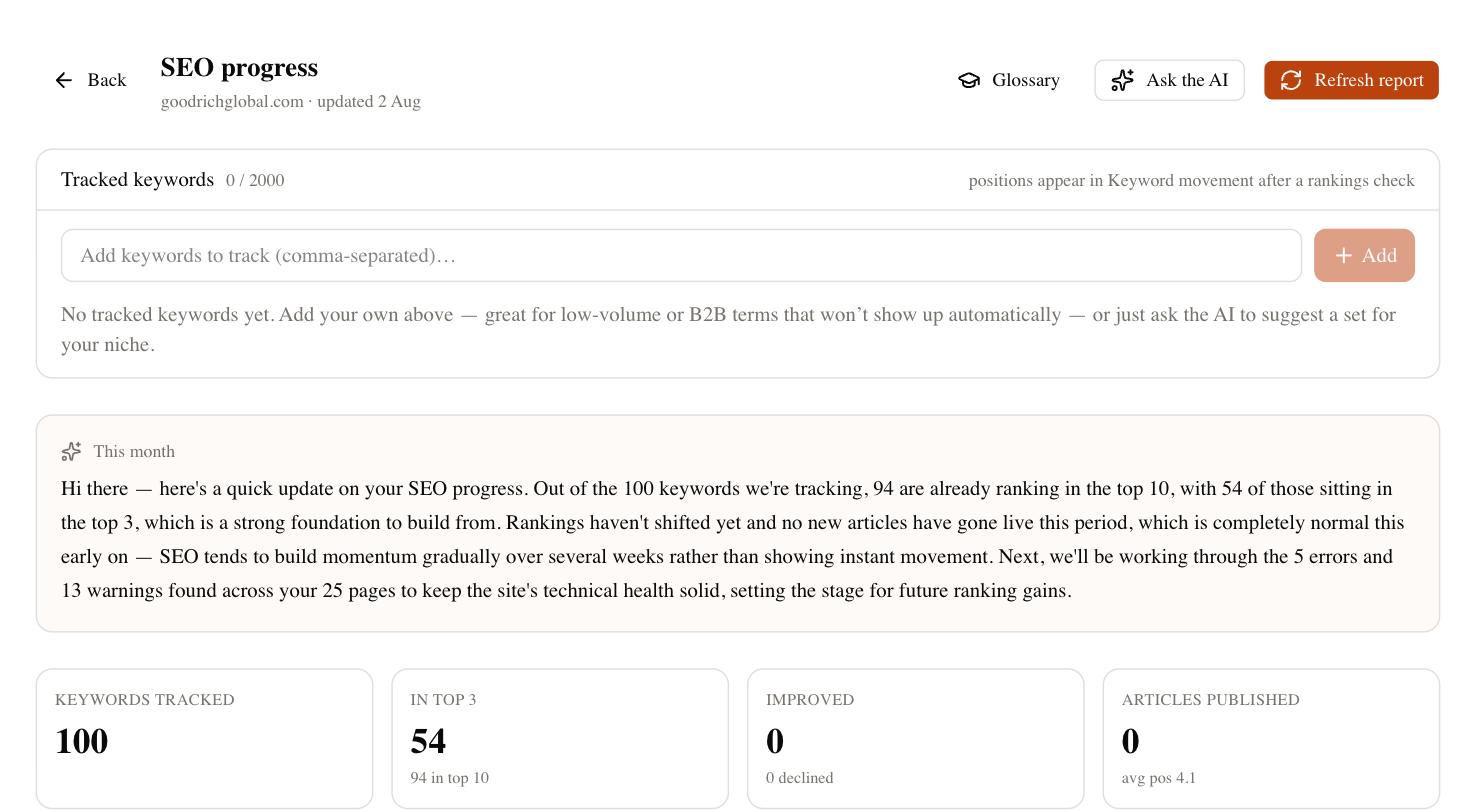
The economic case is the consolidation. A typical agency stack — a data tool like Ahrefs, plus a separate AI writer, plus an AI-visibility tracker, plus a reporting layer — collapses into one subscription priced at a fraction of a comparable enterprise plan. That matters most for two- to ten-person shops whose bottleneck is servicing more clients without hiring. If your constraint is people-hours and tool sprawl rather than the depth of any single dataset, this is the strongest fit on the list. If your entire value proposition is competitive backlink forensics, read on — one of the incumbents may still serve you better.
Semrush and Ahrefs — the data heavyweights
These two remain the reference standard for depth, and for good reason. Semrush is the closest thing to a do-everything marketing platform: beyond SEO it covers PPC research, social scheduling, and PR monitoring, so a full-service agency wanting one login for the whole channel mix gets genuine value. Its keyword database is enormous and its competitive research is excellent.
Ahrefs is the specialist’s specialist. If your agency’s edge is competitive link audits, disavow work, or link-building at scale, its index is one of the largest and freshest in the industry, and that depth is hard to replace. Both tools share the same agency trade-off, though: they were priced for single companies, so cost climbs steeply once you add the seats and projects a client roster needs. You’ll also still be running a separate AI writer and AI-visibility tool alongside either one. For a well-funded agency whose reputation rests on data depth, that premium is defensible. For a lean shop counting cost per client, it’s a heavy invoice.
SE Ranking and AgencyAnalytics — the value and reporting plays
Not every agency needs the deepest index — many need predictable costs and reports clients respect. Two tools own that middle ground, and they solve different halves of the problem.
- SE Ranking — the cost-per-project play. Rank tracking scales cheaply across many clients, and its project-based pricing keeps your monthly bill predictable as the roster grows. It won’t match Ahrefs on link depth, but for keyword tracking, audits, and white-label reports at agency scale, it’s one of the best value picks available.
- AgencyAnalytics — the reporting-first play. It’s less a research tool than a dashboard layer that pulls Google Search Console, Analytics, ad platforms, and third-party rank data into one branded client view. If your research is already handled but assembling monthly client reports is eating a full day per account, this is the tool that buys that day back.
Plenty of agencies run SE Ranking or AgencyAnalytics beside a heavier data tool. That works, but it’s still two or three subscriptions doing what a consolidated, AI-native platform now does in one.
Moz Pro and Screaming Frog — the specialists
Two more earn a place for specific jobs rather than general use. Moz Pro is the friendliest on-ramp: if you’re onboarding junior staff who found Ahrefs overwhelming, Moz’s cleaner interface and long-trusted domain authority metric make training easier, though its index is smaller than the heavyweights. Screaming Frog is the opposite — a desktop crawler that does one thing extraordinarily well. For deep technical audits, log-file analysis, and finding every broken redirect on a 50,000-page site, nothing in the cloud-tool category matches it, and its per-license cost is trivial next to a suite seat.
Neither is a complete agency stack on its own. Moz lacks the AI writing and AI-search visibility that increasingly define the work, and Screaming Frog is a scalpel, not a platform. You’ll pair both with something broader — but for their specific jobs, they’re worth the room in your toolkit.
How to choose the right tool for your agency
Match the tool to your actual constraint, not to the longest feature page. If your bottleneck is servicing more clients with a small team — and you want AI content, AI-search tracking, and white-label reporting built in — SEO Rocket is the natural move. If you want one platform for every marketing channel and have the budget for it, Semrush earns its price. If deep backlink forensics is your whole value proposition, stay with Ahrefs. If you’re optimizing cost per client, SE Ranking; if reporting is your only real pain, AgencyAnalytics.
A quick way to decide: list the three things your agency did in its SEO tool most often last month. For most shops it’s some mix of “check what a client ranks for,” “see what their competitor is doing,” and “produce and report on content.” If that’s your month, you’re likely overpaying for enterprise depth you rarely touch, and a leaner, AI-native platform will cover those jobs faster and cheaper. If instead your month was deep link audits and 100,000-URL crawls, keep the specialists. Whatever you choose, run one real client and two competitors through it for a full ranking cycle before you commit the roster — positions jitter a few spots day to day, estimates are estimates, and the right tool is simply the one that answers your clients’ questions fastest.