
Content spinning is the practice of taking an existing piece of text — someone else’s article, or even your own — and running it through automated word-substitution or paraphrasing to produce a “new” version, usually with the goal of publishing many variations of the same underlying content across multiple pages or sites without writing anything from scratch. It’s a tactic with roots in the article-marketing era of SEO, roughly 2005 to 2012, when swapping synonyms into a template was often enough to dodge basic duplicate-content checks. It still exists today, now often powered by AI paraphrasing tools instead of the old “spintax” syntax, but the underlying problem hasn’t changed: spun content is derivative by design, and search engines have gotten much better at recognizing that, no matter how the sentences are worded.
How Content Spinning Actually Works
Classic spinning used something called spintax — a syntax where a sentence would contain bracketed alternatives, like {The dog ran|The canine sprinted|The pup dashed} across the yard, and a script would randomly pick one option each time the page was generated, producing thousands of “unique” combinations from a single source template. Modern versions skip the bracket syntax and instead feed source content through an automated paraphrasing tool or a poorly-prompted AI model, asking it to “rewrite this article so it reads differently” without adding any new information, research, or perspective. Either way, the output is structurally the same idea repeated in different words — no new facts, no new angle, no genuine expertise added, just a shuffled version of something that already existed.
Why It’s Tempting
The appeal is almost entirely about speed and volume. Writing genuinely useful, well-researched content takes real time — research, structuring, editing, fact-checking. Spinning promises to skip nearly all of that: point a tool at a competitor’s top-ranking article, or at your own thin page, and get a “new” article in seconds that can be published under a different URL, on a different site, or across a network of sites trying to build artificial backlink volume. For content mills and low-effort affiliate operations trying to cover as many keyword variations as possible with minimal cost per page, spinning looks like a shortcut to scale that a legitimate writing process can’t match.
Why It Reads Badly (and Why That Matters)
Spun content has a distinct, recognizable texture once you know what to look for: odd word choices where a common phrase gets swapped for an awkward synonym, sentences that are grammatically valid but subtly nonsensical, and a general sense that the text is technically readable but not actually saying anything with confidence or specificity. Readers pick up on this quickly, even if they can’t articulate exactly why a page feels “off,” and that shows up in behavioral signals — high bounce rates, low time-on-page, no return visits — all of which Google’s ranking systems can observe indirectly through aggregate user data and search result interactions, even without explicitly detecting the spinning technique itself.
How Google Actually Treats Spun Content
Google’s helpful content guidance and its broader spam policies both explicitly call out content produced primarily to manipulate rankings rather than to genuinely help a reader, and content spinning is a textbook example of that pattern regardless of whether a human or an AI tool did the spinning. Google’s classifiers are also good at detecting near-duplicate content across the web at scale — if a spun article is structurally and semantically close to an existing source (same points, same order, same examples, just reworded), that similarity is detectable through the same systems that catch plagiarism and scraped content, not just through obvious keyword-matching. Sites that lean heavily on spun content tend to see it show up as an algorithmic quality problem more often than a single manual action — pages simply don’t rank, or a site’s overall visibility declines gradually as more of its content gets classified as low-value.
| Signal | What it typically indicates |
|---|---|
| High similarity to an existing source article | Content likely derivative rather than original — a red flag for duplicate/near-duplicate detection |
| Awkward synonym substitution, inconsistent terminology | Classic signature of automated spinning, whether spintax or AI paraphrasing |
| No unique data, examples, or perspective | Fails Google’s “added value” bar for helpful content |
| High bounce rate, low dwell time relative to topic competitiveness | User behavior confirming the content isn’t actually satisfying search intent |
The Honest Verdict
Content spinning almost never produces durable rankings anymore, and even when a spun page briefly ranks for a low-competition long-tail term, it rarely converts, rarely earns links, and rarely survives the next quality-focused algorithm update. The economics don’t work either: the time saved on writing gets spent instead on cleanup, on filing reconsideration requests if a manual action hits, or on watching traffic quietly decline as more of a site’s pages get filtered out of meaningful visibility. There’s no version of this tactic that’s a good long-term bet in 2026 — it was already declining before AI paraphrasing tools existed, and Google’s content-quality systems have only gotten more capable of recognizing derivative work since.
What Actually Scales Instead
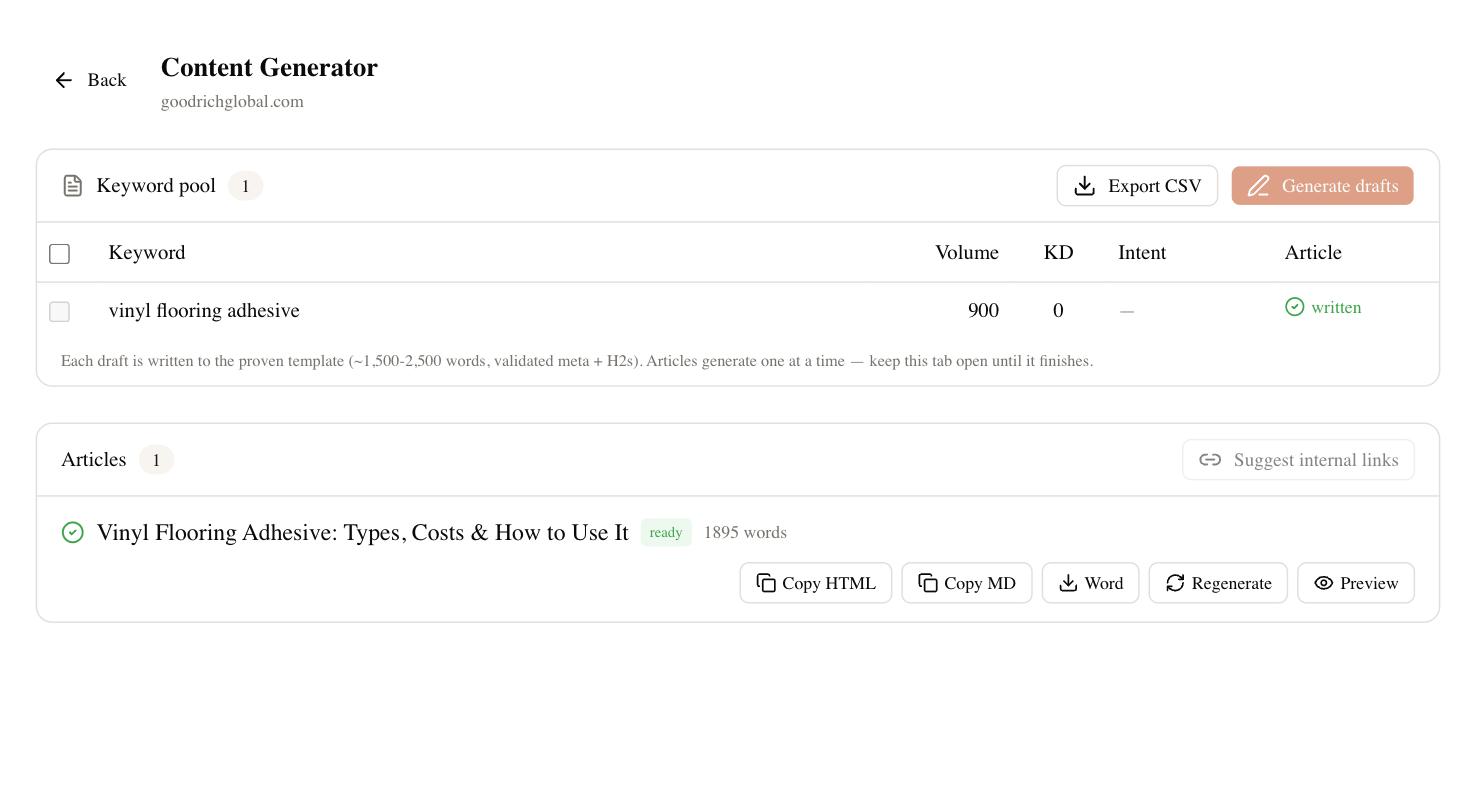
If the real problem is “I need more content, faster, without hiring a full writing team,” the answer isn’t spinning existing text — it’s using AI properly, as a drafting accelerator for genuinely new content built around real keyword and topic research, not as a paraphrasing engine for someone else’s article. That distinction matters enormously: an AI tool asked to write an original article about a topic, informed by real search intent data and structured to actually answer the query, produces something fundamentally different from an AI tool asked to reword an existing article. SEO Rocket’s Content Generator is built around the first approach — it produces original, SEO-validated articles grounded in real keyword and content-gap data from Ahrefs, rather than rewriting whatever is already ranking. Paired with Keywords Explorer and Content Gap analysis to identify genuine topic opportunities your competitors haven’t covered well, you get the speed content spinning promised without the derivative core that makes it fail.
A Simple Test for Your Own Content
If you’re auditing existing content and wondering whether it crosses into spinning territory, ask: does this page make a single point, claim, or piece of information that isn’t already stated, in some form, on another page ranking for the same query? If every idea in the piece already exists elsewhere and the only thing that’s changed is the wording, that’s spun content by definition, regardless of whether a human rewrote it manually or a tool did it automatically. The fix is always the same — add something genuinely new: original data, a distinct example, a clearer explanation, or expertise the source material doesn’t have.
Frequently Asked Questions
Is using AI to help write content the same as content spinning?
No. The distinction is what the AI is doing — drafting original content from research and structured intent data is not the same as paraphrasing an existing article to disguise it as new. The output quality and originality are what matter, not whether AI was involved at all.
Can content spinning trigger a manual action?
It’s more commonly caught algorithmically as a quality or duplicate-content issue rather than a specific manual action, though at scale — especially combined with other spam patterns like doorway pages or link schemes — it can contribute to a manual action too.
Does rewriting my own old content count as spinning?
Not if you’re genuinely updating and improving it with new information. Spinning specifically means producing superficially different text without adding real value, whether the source is your own content or someone else’s.
How can I tell if a competitor is using spun content?
Look for oddly stilted phrasing, inconsistent terminology for the same concept within one article, and content that covers identical points to a well-known source in the same order without adding anything new.
If you need to scale content production without relying on spun or thin pages, SEO Rocket’s Content Generator builds original, SEO-validated articles from real keyword and content-gap data. Start free at app.seorocket.ai.