
The Google Penguin update launched in April 2012 and fundamentally changed how link building worked as an SEO practice. Before Penguin, buying links in bulk, joining link exchange networks, and stuffing exact-match keyword anchor text were common — and often effective — tactics. Penguin was built specifically to detect and devalue that kind of manipulation, and it reshaped link building into the more careful, relevance-driven discipline it is today. This guide covers what Penguin targeted, how it evolved, and what building a safe, durable backlink profile looks like now.
What the Penguin update was
Penguin was a Google algorithm update focused specifically on link spam — unnatural or manipulative backlink patterns designed to inflate a site’s perceived authority artificially. It launched in April 2012 as a targeted response to years of link schemes that had become increasingly systematic: link farms, paid link networks, excessive link exchanges, and low-quality directory or forum-comment link spam, all engineered to move rankings rather than to reflect genuine endorsement.
What it specifically targeted
Penguin’s detection focused on patterns that were common in manipulative link building but rare in natural, earned link profiles:
- Purchased or exchanged links — links acquired primarily through payment or reciprocal arrangement rather than editorial merit.
- Link farms and private blog networks — clusters of low-quality sites built mainly to link out to a target site.
- Over-optimized anchor text — an unnaturally high proportion of exact-match keyword anchor text pointing to a page, a pattern rarely seen in genuine, organic link profiles.
- Low-quality directory and comment spam links — mass link placement across irrelevant directories, forums, or blog comment sections.
- Sudden, unnatural link velocity — a spike in backlinks inconsistent with a site’s normal growth pattern or content output.
The key distinction Penguin tried to draw was between links a site earned because other sites genuinely found its content valuable, and links a site manufactured to game rankings directly.
Who was affected
The initial 2012 rollout hit a wide range of sites that had leaned on aggressive link-building tactics, from small affiliate sites to well-established businesses that had used SEO agencies practicing exact-match anchor text schemes at scale. Because Penguin (unlike some other updates) applied a fairly direct penalty rather than a gradual quality reassessment, the impact for affected sites was often sharp and sudden — significant ranking and traffic drops appearing within days of a confirmed rollout. Recovery in the early years required actively disavowing or removing bad links and then waiting for Google to run the next Penguin refresh, which could take months.
Table: Penguin at a glance
| Aspect | Detail |
|---|---|
| Launch | April 2012 |
| Primary target | Manipulative backlinks and over-optimized anchor text |
| Early behavior | Periodic refreshes; penalized sites could wait months to recover |
| Penguin 4.0 (2016) | Became real-time and part of the core algorithm; devalues bad links rather than always penalizing the whole site |
| Current status | Ongoing, real-time part of core ranking systems |
The shift to real-time: Penguin 4.0
A major turning point came in 2016 with Penguin 4.0, which changed how the system worked in two important ways. First, it began running in real time as part of the core algorithm, rather than as a periodic update that required a full refresh cycle — meaning changes to a site’s link profile could be reflected in rankings much faster, in both directions. Before this change, the wait between Penguin refreshes was one of the most stressful parts of link cleanup work: a site could remove every bad link it had, submit a reconsideration request, and still sit in penalty limbo for months with no visibility into whether the cleanup had actually worked. Second, Penguin 4.0 shifted toward devaluing the effect of bad links more granularly, rather than defaulting to a blanket site-wide penalty in every case — meaning a spammy link is more likely to simply stop passing value, rather than dragging down rankings for the entire domain. This made Penguin less punishing in its mechanics while keeping its core purpose — discouraging manipulative link building — fully intact.
Penguin versus a manual action
It’s worth distinguishing Penguin, an algorithmic system, from a manual action, which is a penalty applied directly by a member of Google’s search quality team after a human review, usually in response to a report or an especially egregious violation. A site can be affected by Penguin’s algorithmic devaluation of certain links without ever receiving a manual action notice in Search Console, and vice versa. Manual actions for unnatural links tend to be more severe and require an explicit reconsideration request after cleanup, while Penguin’s real-time algorithmic devaluation since 2016 generally resolves on its own once the underlying link profile improves — no formal request needed. Site owners troubleshooting a sudden ranking drop should check Search Console’s Manual Actions report first, since the appropriate fix differs depending on which situation applies.
How to build links that align with Penguin
Because Penguin is now a continuous, real-time part of core ranking, there’s no separate “Penguin update” to brace for — but its standards apply to every link a site acquires, on an ongoing basis:
- Earn links through genuinely valuable content — original research, useful tools, or expert commentary that other sites want to reference on their own merit.
- Diversify anchor text naturally. A healthy link profile has a mix of branded, generic, and natural-phrase anchors — exact-match keyword anchors should be a small minority, not the majority.
- Avoid link schemes entirely — paid links, large-scale link exchanges, and private blog networks all carry real risk, not just of a Penguin-related issue but of a manual action.
- Audit your backlink profile periodically, especially after using outside SEO help in the past, since some agencies still rely on outdated or risky tactics.
- Disavow only when necessary and with care — Google’s disavow tool is for links you can’t get removed and that you believe are genuinely harmful, not a routine maintenance step.
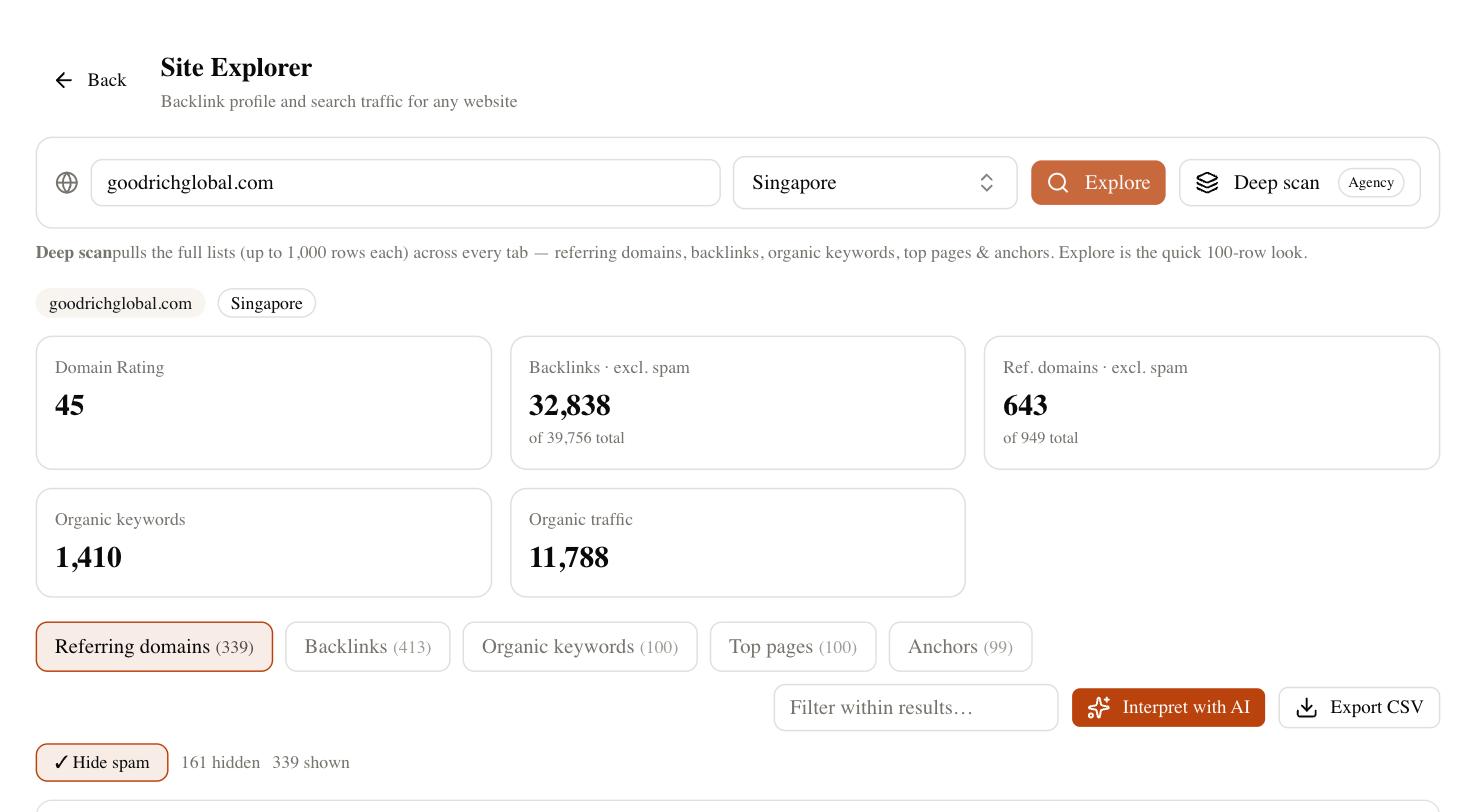
Reviewing a backlink profile by hand for spam signals is slow and easy to get wrong, especially on sites with thousands of referring domains. SEO Rocket includes a Site Explorer with backlink analysis and spam classification built in, so unnatural link patterns can be identified and addressed before they become a ranking problem, rather than after. A free plan is available, with paid plans from $49/month for ongoing backlink monitoring.
The lasting lesson from Penguin
More than a decade on, Penguin’s core message hasn’t changed even as its mechanics have: link building that exists purely to manipulate rankings is a fragile, high-risk strategy, while link building that grows naturally out of genuinely link-worthy content is durable by design. Sites that shifted their link strategy toward earning relevant, credible links after 2012 have generally weathered every subsequent Penguin refinement without incident. Sites that kept trying to game anchor text or buy links at scale have kept finding new ways to get caught, because catching exactly that pattern is the entire reason Penguin exists.
It’s also worth remembering that Penguin was never designed to punish having backlinks — the goal was never fewer links, it was more honest ones. A site with a modest but genuinely earned link profile has consistently outperformed, over the long run, a site with a large but manipulated one, precisely because Penguin (and the broader link-quality systems it’s now part of) is built to see through the difference. More than a decade after its 2012 launch, that remains the single most reliable piece of link-building advice available: build the kind of site other sites actually want to reference, and the links tend to follow on their own.