Google spam updates refer to the ongoing, continuously evolving set of algorithmic systems Google uses to detect and neutralise spam in search results — as distinct from the older model of occasional, discrete “spam update” announcements. Google has confirmed that most of this detection today runs through SpamBrain, an AI-based spam-prevention system that operates continuously rather than as a periodic event. Understanding how this actually works matters because a lot of outdated SEO advice still treats spam handling as something that happens in occasional big sweeps you either survive or don’t, rather than as an ongoing, largely automatic system running in the background at all times.
From periodic named updates to continuous detection
In earlier years of Google’s history, spam-related algorithm changes tended to arrive as distinct, occasionally named events — reflecting a period when Google would periodically roll out significant algorithmic changes specifically targeting spam techniques, then leave that system largely static until the next major spam-focused release. Google’s more recent approach, publicly described in its own documentation and blog posts, has shifted toward continuous, machine-learning-driven detection that updates and adapts on an ongoing basis rather than through occasional big named releases. Google does still periodically announce broader “spam updates” as rollouts of improvements to this system, but the underlying detection itself is understood to be running constantly, not just during announced rollout windows.
What SpamBrain is
SpamBrain is the name Google has given publicly to its AI-based spam-detection system, which Google has stated is used to identify and neutralise a broad range of spam types across Search. Google’s public statements describe SpamBrain as capable of detecting patterns associated with spam at scale, including sites and pages designed primarily to manipulate rankings rather than serve genuine users. Google has been relatively open that SpamBrain is central to how spam is now handled algorithmically, marking a shift from earlier, more narrowly-targeted spam algorithms toward a broader, adaptive detection system.
| Aspect | What Google has confirmed |
|---|---|
| Nature of the system | An AI-based spam-detection and prevention system, not a single static rule set |
| Scope | Used to detect a broad range of spam types across Google Search, not one narrow tactic |
| Operation | Runs on an ongoing basis as part of Google’s standard ranking systems, rather than only during discrete announced update windows |
| Stated goal | Keep spam out of search results and protect the quality and reliability of results generally |
The Link Spam updates (2021 and 2022)
Google has specifically announced dedicated Link Spam updates, including rollouts in 2021 and 2022, aimed at improving how well its systems identify and handle spammy links. These are a useful, well-documented example of how algorithmic spam handling actually functions in practice, and Google’s own communication around them is unusually explicit about the mechanism involved.
- The stated goal was to more effectively identify and nullify the effect of large-scale link spam, including paid links and other schemes designed to manipulate rankings through artificial link building.
- Google explicitly described the mechanism as neutralising the ranking value of spammy links — rather than issuing manual penalties to the sites that built or hosted them.
- This means a site that had spammy links pointing to it, or that built spammy links to try to manipulate its own rankings, would generally see those specific links simply stop passing ranking value, rather than the site being penalised outright as a whole in most cases.
- Google’s SpamBrain system was specifically credited as powering the detection behind these Link Spam updates.
This neutralisation-first approach is a meaningful shift in philosophy from Google’s older, more punitive-by-default link spam handling, and it’s worth understanding clearly because it changes what a site should actually expect and do if it discovers spammy or unnatural links pointing to it.
Algorithmic spam handling vs. manual actions
One of the most common points of confusion in SEO discussions of “spam updates” is conflating algorithmic spam detection with manual actions — these are genuinely different processes with different causes, different signals, and different remedies.
| Aspect | Algorithmic spam handling (e.g. SpamBrain, Link Spam updates) | Manual action |
|---|---|---|
| Trigger | Automated systems detect patterns at scale, continuously | A human reviewer at Google directly reviews a site and applies a penalty for a specific violation |
| Notification | Generally no direct notification — effects are visible only in ranking or traffic changes | Site owners are notified via Google Search Console‘s Manual Actions report |
| Typical effect | Often neutralises the value of specific spam signals (like links) rather than penalising the whole site | Can range from specific page demotion to removal of an entire site from the index |
| Path to resolution | Generally resolves automatically as the underlying spam signal is cleaned up or its influence naturally recalculated | Requires fixing the issue and, in most cases, submitting a formal reconsideration request through Search Console |
| Visibility to site owner | Low — inferred from data rather than directly disclosed | High — explicitly documented in Search Console with a stated reason |
A site owner who sees a ranking or traffic drop and immediately assumes it must be a manual penalty is often wrong — the far more common explanation today is an algorithmic quality or spam-detection adjustment, which shows up as a ranking change rather than a Search Console notice. Checking Search Console’s Manual Actions report is the fastest way to rule a manual action in or out before assuming the worst.
What counts as spam under Google’s guidelines
Google’s publicly available Spam Policies document the categories its systems (and, where relevant, human reviewers) look for. Common categories include:
- Cloaking — showing different content to search engines than to users
- Doorway pages built solely to funnel traffic to another destination
- Scraped or auto-generated content with little to no original value
- Link spam — buying links, participating in link exchange schemes, or otherwise manipulating link signals
- Keyword stuffing and other manipulative on-page tactics
- Sneaky redirects that send users somewhere other than what was indexed
- Abuse of user-generated content sections, like comment spam, to insert manipulative links
How to stay clear of both algorithmic and manual spam issues
Since Google’s own guidance is consistent that the durable defense against both algorithmic spam detection and manual actions is the same underlying practice — build for genuine users, not for manipulation — the practical steps line up accordingly.
- Never buy links or participate in link schemes. Even with a neutralisation-first approach reducing outright penalty risk, purchased links simply stop working rather than helping, making the spend wasted at best.
- Audit your backlink profile periodically. Understanding what’s actually linking to your site, including links you didn’t build yourself, helps you spot patterns before they become a liability.
- Avoid auto-generated or heavily scraped content. Content produced primarily to fill pages rather than genuinely inform readers falls squarely within Google’s spam policies.
- Check Search Console regularly. Catching a manual action early, if one occurs, shortens the path to resolution considerably.
- Disavow only when genuinely necessary. Given that SpamBrain and the Link Spam updates are designed to neutralise spammy links automatically, the disavow tool is generally best reserved for cases involving an actual manual action tied to links, per Google’s own guidance, rather than routine defensive use.
The evergreen takeaway
Google spam updates today aren’t a periodic event to brace for and recover from — they’re the visible surface of a continuous, AI-driven system that’s always running. The shift toward neutralising spam signals rather than defaulting to punitive site-wide penalties, most clearly illustrated by the 2021 and 2022 Link Spam updates, means the practical risk profile has changed: bad links are increasingly likely to simply stop working rather than actively hurting you, while manual actions remain reserved for clearer, reviewed violations. Either way, the same underlying discipline — building genuine content and earning links naturally — remains the most reliable protection against both.
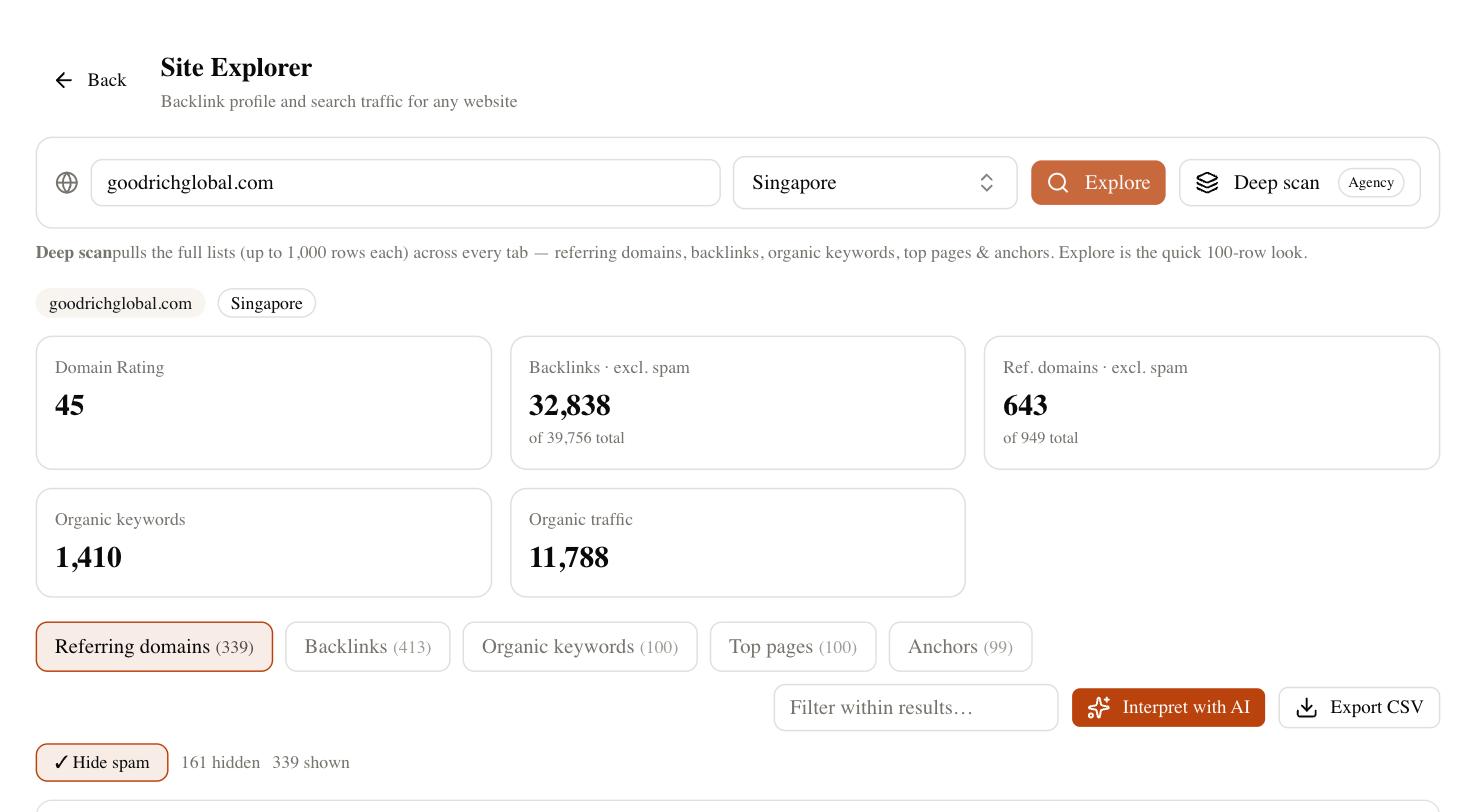
Understanding your own backlink profile, including whether any links look spammy or manipulative, is hard to do manually across hundreds or thousands of referring domains. SEO Rocket’s backlink analysis with built-in spam classification lets you ask directly — “check my backlink profile for spam risk” — and get a clear read without wading through raw export data yourself. Free plan to start, paid plans from $49/month: app.seorocket.ai.