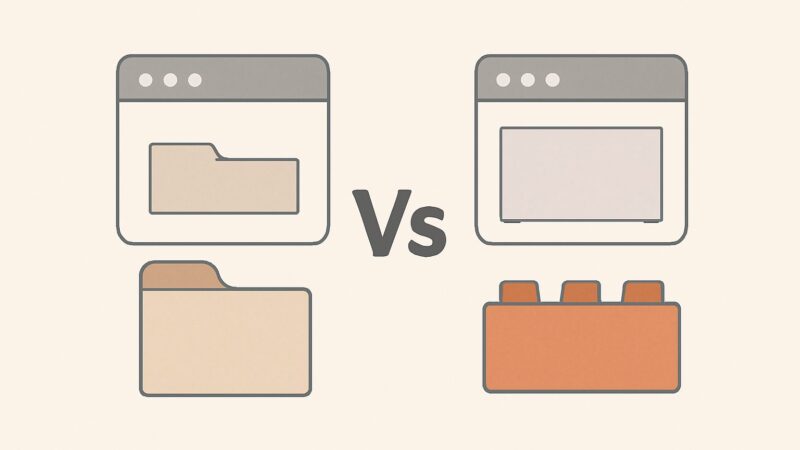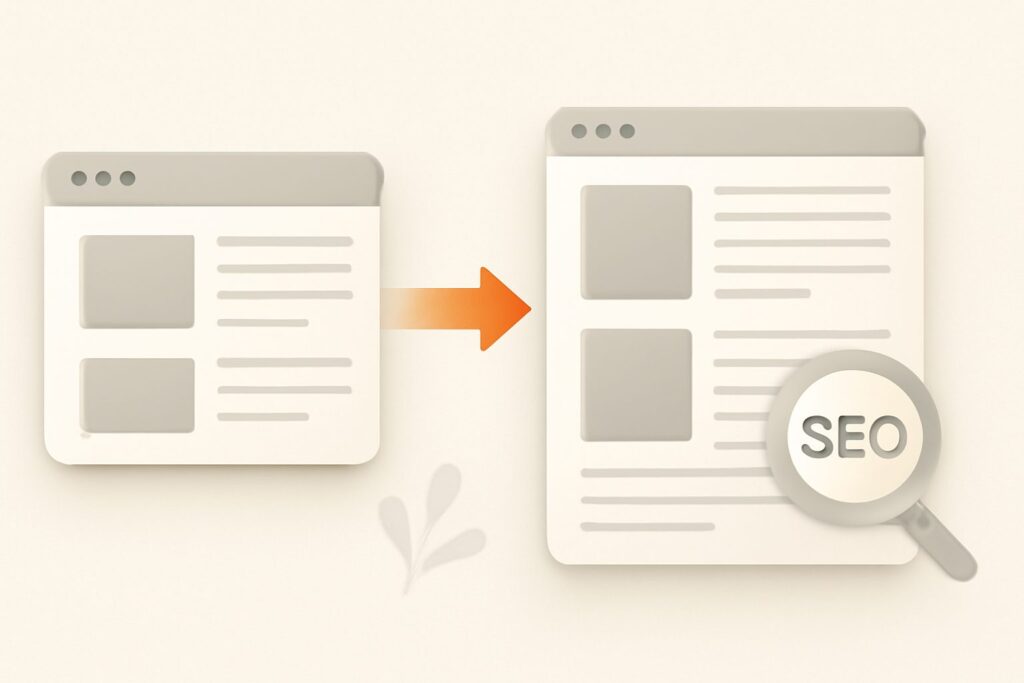
Merging two websites into one is a common outcome of a rebrand, an acquisition, or simply realizing you’ve been running two overlapping properties that compete with each other more than they help. Done carelessly, a merger can cost both sites their rankings at once — duplicate content gets flagged, redirects get missed, and the stronger domain’s authority gets diluted instead of reinforced. Done properly, a merge two websites SEO project can combine the best of both properties into a single site that outperforms either one alone. This guide covers when a merger makes sense and exactly how to execute one without losing the SEO equity you’ve built.
When Merging Two Websites Makes Sense
The most common triggers are a rebrand, where two previously separate businesses (or a business and an acquired competitor) need to operate under one name and one domain; an acquisition or merger, where two companies with their own websites become one company that shouldn’t confuse customers or search engines by maintaining both; and keyword cannibalization, where two sites you control keep ranking against each other for the same terms, splitting clicks and diluting authority that would be stronger concentrated in one place.
There are also weaker reasons to merge that are worth scrutinizing before committing. If two sites serve genuinely different audiences, markets, or purposes, merging them can create a confusing, bloated property that serves neither audience well. A merger should solve a real strategic or SEO problem — overlapping content, split authority, brand confusion — not just reduce the number of properties you have to manage for its own sake.
Content Audit and Mapping
Before any redirects go live, audit both sites completely. Crawl each one to get a full URL inventory, then pull performance data from Search Console and analytics for both — organic traffic, rankings, and backlink profiles per page. This tells you which pages on each site are actually valuable and which are thin, outdated, or redundant.
This is also the point to check technical parity between the two sites. If they run on different platforms, note anything that won’t transfer cleanly — custom schema markup, page speed characteristics, structured data types, or URL parameter handling that one CMS supports and the other doesn’t. Surfacing these gaps during the audit, rather than mid-migration, avoids last-minute scrambling to rebuild functionality the surviving site never had.
Next, map every page from the site being absorbed to its destination on the surviving site. Three outcomes are typical: a page merges into an existing equivalent page on the surviving site (common when both sites cover the same topic), a page moves over largely as-is because it fills a gap the surviving site doesn’t cover, or a page gets retired because it’s outdated, thin, or has no real audience — in which case it should redirect to the closest relevant living page, not to the homepage by default. Where two pages from different sites cover essentially the same topic, decide which one is stronger — more backlinks, better rankings, better content — and use that as the surviving version, folding in anything valuable from the other before redirecting it.
| Page on Site Being Absorbed | Action | Destination on Surviving Site |
|---|---|---|
| /pricing (weaker backlink profile) | Redirect, content merged into stronger page | /pricing |
| /guides/onboarding-checklist | Move as-is, fills content gap | /resources/onboarding-checklist |
| /about/old-team-page-2018 | Retire, outdated | /about |
| /blog/industry-report (strong backlinks) | Becomes the surviving version | /blog/industry-report |
Executing 1:1 Redirects
Once the content map is finalized, implement 301 redirects from every URL on the absorbed site to its mapped destination on the surviving site — a genuine one-to-one mapping, not a blanket redirect of the whole site to the surviving domain’s homepage. Blanket homepage redirects are one of the most common and most damaging mistakes in website mergers: they throw away the specific relevance each page had, and search engines generally treat mass irrelevant redirects with suspicion rather than passing full value through them.
Handle every URL in your inventory, including old blog posts, category pages, tag pages, and any legacy paths that might still carry backlinks or direct traffic — even ones that feel unimportant today. If a URL genuinely has no reasonable equivalent on the surviving site, redirect it to the most relevant parent category rather than leaving it to 404 or defaulting it to the homepage.
Handling Duplicate and Competing Pages
Mergers almost always surface pages that cover the same ground from both sites — two “ultimate guides” to the same topic, two pricing pages, two about pages. Once you’ve decided which version survives (per the mapping step above), the losing page should redirect, not just get a canonical tag pointing elsewhere while still remaining live and crawlable — a live, indexable duplicate sitting alongside a redirect target adds confusion, not clarity.
It’s worth resisting the urge to keep both versions live “just in case” while you decide, or to leave the decision until after launch. Every week two competing pages stay indexed side by side is a week search engines spend uncertain which one to trust, and that uncertainty doesn’t resolve itself — it has to be resolved by picking a winner and redirecting the rest.
Canonical tags are still useful during the transition for near-duplicate content that you’re intentionally keeping in both forms temporarily, or for syndicated content that legitimately exists in more than one place. But as a general rule for a merger, redirects — not canonicals — should be doing the heavy lifting of consolidation, since a canonical only suggests a preferred version while a redirect actually resolves the duplication.
Preserving the Stronger Domain’s Equity
In most mergers, one domain is clearly stronger — more backlinks, more domain history, more consistent rankings. That domain should almost always be the surviving one, with the weaker site’s content and redirects flowing into it, rather than the reverse. Migrating a strong domain’s content onto a weaker, newer domain forces you to rebuild trust signals that the stronger domain had already earned, which is a much slower and riskier path.
Preserve equity by keeping the surviving domain’s existing URL patterns and site architecture intact wherever possible, rather than restructuring everything simultaneously — a merger is already a significant change; layering a full URL restructuring on top of it at the same time multiplies risk without a proportional benefit. Also audit the incoming backlinks pointed at the absorbed site: high-value ones are worth reaching out about to update the link directly, in addition to relying on the redirect, since a direct link to the live surviving URL is always stronger than a redirected one.
Expected Dip and Recovery Timeline
Even a well-planned merger typically causes some short-term ranking volatility. Search engines need to recrawl the redirected URLs, reprocess the consolidated content, and reassign authority to the surviving pages — that process takes real time and doesn’t complete instantly. Some fluctuation in rankings and traffic in the weeks following a merger is normal and expected, not necessarily a sign of a broken migration.
Monitor Search Console’s Coverage and Redirect reports closely during this period to confirm old URLs are being recognized as properly redirected and new consolidated pages are being indexed. Recovery generally tracks with a full crawl and reassessment cycle rather than happening overnight, so resist the urge to make major additional changes in the first few weeks purely out of impatience — that tends to introduce new variables that make it harder to diagnose what’s actually happening.
Because so much can go wrong quietly during a merger — a missed redirect, a duplicate left live, a broken internal link — ongoing monitoring through the transition matters as much as the planning itself. SEO Rocket helps you monitor rankings and technical health continuously through and after a website merger, so issues get caught while they’re still easy to fix. There’s a free plan to start, with paid plans from $49/month: app.seorocket.ai.