“Is SEO worth it?” is one of those questions that gets a dishonest answer from almost everyone you ask. Agencies selling SEO say yes, always, unconditionally. Frustrated business owners who tried it once and saw nothing say no, it’s a scam. The truth is less satisfying but far more useful: SEO is worth it for some businesses, in some conditions, on some timelines, and a waste of money for others. This article tries to give you the honest version, including the cases where SEO is genuinely the wrong call.
What “worth it” actually means
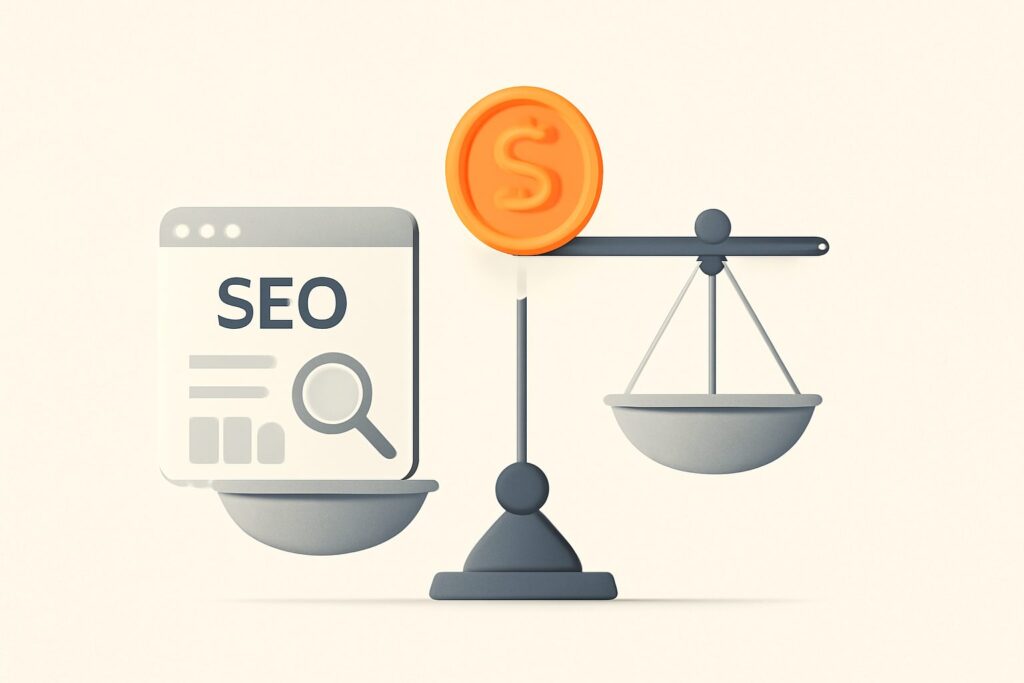
Before comparing costs and returns, it helps to define the question properly. “Worth it” is not a yes/no property of SEO itself — it’s a relationship between three things: how much organic search traffic is available for your keywords, how much each visitor is worth to you once they convert, and how much time and money you can commit before you need a return. Get any one of those wrong and the answer flips. A business with high customer lifetime value and patience can make mediocre SEO pay off. A business with thin margins and a three-month runway can make excellent SEO look like a failure, simply because it never had time to compound.
The case for SEO
The strongest argument for SEO is compounding, unpaid distribution. Unlike paid ads, where traffic stops the moment you stop paying, a well-ranked page keeps earning clicks for months or years after the work is done. This is why SEO tends to look bad in month one and excellent by month eighteen — the economics are backloaded. Other advantages worth naming honestly:
- Intent capture. Someone typing a specific problem into Google is often further along in their decision than someone scrolling a social feed, so organic traffic frequently converts well.
- Lower marginal cost over time. Once a page ranks, each additional visitor costs close to nothing, compared to paid channels where cost scales roughly with volume.
- Trust and credibility. Ranking organically is still read by many buyers as a signal of legitimacy, separate from whatever ad budget a competitor has.
- Asset ownership. Content and rankings are assets you keep; you’re not renting attention from a platform that can change its algorithm or pricing overnight.
The case against SEO — where it genuinely doesn’t pay off
It’s just as important to be honest about when SEO is a poor fit, because plenty of businesses spend money on it and shouldn’t.
- Very low search volume niches. If almost nobody searches for what you sell — highly novel products, hyper-local one-off services, B2B tools with no established search behavior yet — there may not be enough demand to capture, no matter how well you rank.
- Extremely short runway. SEO realistically takes months to show meaningful results, and longer in competitive categories. A business that needs revenue in the next four to six weeks should look at paid ads, partnerships, or outbound first.
- Wafer-thin margins with low average order value. If a customer is worth $15 and content, tools, or agency fees cost more than that to acquire them profitably within your timeline, the math may not work until volume is very high.
- Categories dominated by entrenched incumbents with years of authority. Ranking above a handful of massive, decade-old domains for the exact same competitive terms can take disproportionate time and budget. It’s not impossible, but it changes the calculus — going after those exact head terms may not be worth it, even if a narrower long-tail strategy would be.
- Businesses that rely entirely on relationships or referrals. Some B2B and professional services genuinely close deals through networking, not search. For them, SEO might bring in a trickle of inbound leads but will never be the primary engine, and treating it as one leads to disappointment.
Cost, timeline, and what to actually expect
Being honest about “worth it” requires being honest about cost and time, not just upside. SEO costs show up as content production, technical work, link building or digital PR, and either staff time or agency/tool fees. None of that is free, and none of it produces guaranteed results — search algorithms change, competitors respond, and some keywords simply stay hard to rank for regardless of effort.
On timeline: it is reasonable to expect early technical fixes and quick-win content to show some movement within one to three months, but meaningful, revenue-relevant ranking improvements in a competitive space typically take six months to a year of consistent work. Anyone promising first-page rankings in a few weeks for a genuinely competitive term is not being straight with you. If your business cannot survive that runway without SEO revenue, SEO alone is not worth pursuing right now — even though it might be worth pursuing once you have more time.
Is SEO worth it for your type of business?
| Business type | Is SEO usually worth it? | Why |
|---|---|---|
| Local service business (plumber, dentist, lawyer) | Usually yes | High-intent local searches, high customer value, manageable local competition |
| Ecommerce with broad product catalog | Usually yes | Long-tail product and category terms compound across hundreds of pages |
| SaaS / B2B software | Often yes, but slower | High customer lifetime value offsets a longer, more competitive ranking timeline |
| Early-stage startup, pre-product-market fit | Usually not yet | SEO rewards patience and a stable offer; better to validate first, then invest |
| Very low-volume niche or novel product | Often not | Limited search demand caps the ceiling regardless of ranking quality |
| Business needing revenue within 4-6 weeks | No, not as primary channel | SEO’s timeline doesn’t match the need; use paid or outbound instead |
| Relationship-driven professional services | Worth a modest investment, not primary | Search can supplement but rarely replaces referral-driven pipelines |

How AI search changes the calculation, honestly
It’s worth addressing the elephant in the room: AI Overviews, ChatGPT, and other AI-powered search experiences are changing how some queries get answered, and click-through rates for certain informational searches have declined as a result. This doesn’t make SEO worthless, but it does shift where the value is. Purely informational, top-of-funnel content is under more pressure than transactional and local content, where users still click through to compare, book, or buy. It also means visibility now extends beyond the traditional ten blue links — being cited or referenced by AI tools (sometimes called generative engine optimization, or GEO) is becoming part of the same discipline as SEO, not a separate one. Tools like SEO Rocket track this AI-search visibility alongside traditional rankings, which is a genuinely useful signal now that “ranking well” and “being visible” aren’t perfectly the same thing anymore.
A fair verdict
So, is SEO worth it? For most established businesses with reasonable margins, a product or service people actively search for, and at least six months of patience, yes — it remains one of the better long-term returns on marketing spend available, because the traffic it earns doesn’t disappear the moment you stop paying for it. For businesses with no runway, no discoverable demand, or a sales motion that doesn’t depend on search, it is not the right first investment, and no amount of good execution will change that. The honest answer isn’t “always” or “never” — it’s “check your margins, your timeline, and your market before you commit,” and revisit the decision as those things change.
If you’re trying to figure out where you fall — whether there’s real search demand for what you sell, and how competitive it actually is — a quick audit is more useful than a guess. SEO Rocket offers a free plan that can help you see the actual keyword and competitive picture before you commit budget either way.