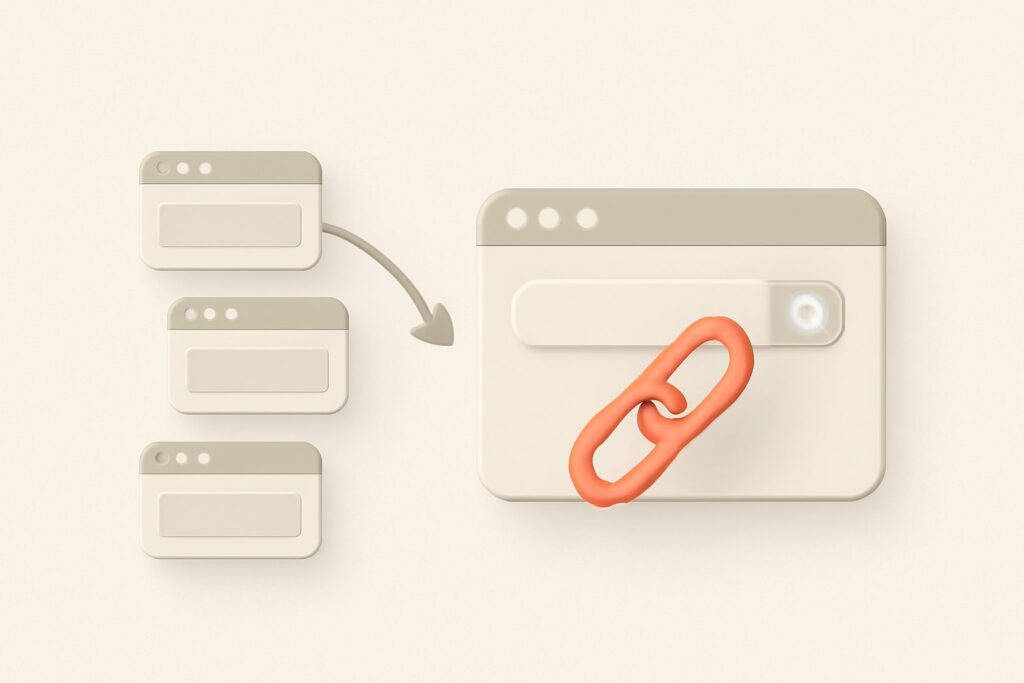
The referring domains vs backlinks confusion costs more link-building budgets than any other single misunderstanding, because the two numbers look interchangeable in a dashboard and are not interchangeable in Google’s index. A backlink is any single link pointing at your site. A referring domain is a unique website that links to you at least once. One site can hand you 400 backlinks; it is still one referring domain — and to a search engine, largely one vote. Get that relationship wrong and you will happily pay for volume that a ranking algorithm quietly rounds down to almost nothing.
The One-Sentence Difference That Changes the Whole Strategy
Total backlinks counts every individual link, including many from the same source. Referring domains counts the distinct sources behind those links. If a news site mentions you in a sitewide footer, you might collect thousands of backlinks overnight from one domain — impressive in a screenshot, close to meaningless as a ranking signal. The reason is simple: search engines are trying to measure how many independent parties vouch for you, not how many hyperlinks exist. Independence is the currency. A hundred links from one blogroll is one party repeating itself; a hundred links from a hundred sites is a hundred parties agreeing.
Why 100 Backlinks From 3 Sites Is Really Just 3 Votes
Here is the mechanism most guides skip. When multiple links point at you from the same domain, the marginal value of each additional link drops sharply after the first. The first link from a new domain carries the introduction — a source that never vouched for you now does. The tenth link from that same domain adds very little, because the relationship it signals already exists. This is why a profile of 100 backlinks from 3 referring domains behaves, for ranking purposes, closer to 3 endorsements than 100. The backlink counter says 100. The trust the algorithm can extract from it says roughly 3.
This diminishing return is exactly why cheap link packages that promise “500 backlinks for $30” are a trap even when the links are technically real. They almost always come from a handful of sites — directories, comment sections, a single spun-content network — so the referring-domain count barely moves. You bought a big backlink number and a tiny signal.
What Google Actually Counts
Google has never published its exact weighting, but decades of practitioner observation and its own guidance point the same direction: link diversity from relevant, independent sources matters far more than raw link count. PageRank, the original link-based model, flows value through individual links, so additional links from a domain are not literally worth zero. But the system is explicitly designed to resist manipulation, and stacking many links from one source is the oldest manipulation there is. The result is heavy dampening of repeat links and a strong reward for a new, credible domain entering your profile.
Two clarifications a genuine expert always adds. First, nofollow, UGC, and sponsored are hints, not strict directives — Google may still use a nofollow link as a signal, so a “nofollow” referring domain is not automatically worthless. Second, relevance and editorial context now outweigh both counts: one in-content link from a site in your niche, placed by an editor because it genuinely helps a reader, beats dozens of boilerplate links from unrelated domains.
Referring Domains Track Rankings — Raw Backlinks Less So
Across large-scale link studies and everyday practice, the number of unique referring domains tracks organic rankings noticeably better than total backlink count. That is not a law of physics; it is a consequence of the diminishing-returns mechanism above. Because referring domains measure independent endorsement, they are simply a cleaner proxy for the thing Google is trying to reward. When you audit a page that outranks you despite a smaller backlink number, look at referring domains — the winner usually has more distinct, more relevant sources, even with fewer total links. That is the whole game hiding inside the referring domains vs backlinks comparison.
When Total Backlink Count Still Matters
Referring domains is the better headline metric, but backlink count is not noise. It matters in a few specific ways:
- Deep-link distribution. A domain that links to five different pages of yours signals broader engagement than one that links to your homepage five times. Backlink count exposes which of your pages actually attract links.
- Anchor and context variety. Multiple links from a trusted partner, spread across natural in-content mentions, read differently from a single navigational link. Volume from a good source is not a bad thing — it is just capped.
- Velocity and stability. Sudden backlink spikes or collapses (a partner redesigns and drops your links) show up in the total before they show up in domain counts.
The rule of thumb: use referring domains to judge the strength of a profile, and use total backlinks to understand its shape and health.
The Metric Trap: Vanity Numbers vs Real Signal
Agencies and link vendors love the total-backlinks number precisely because it is easy to inflate. “We built you 2,000 links this quarter” sounds like progress. If those 2,000 links came from 40 low-quality domains, you gained 40 weakly relevant endorsements and a lot of reporting theater. Always translate a backlink claim into its referring-domain equivalent before you judge it. The honest question is never “how many links did we get?” It is “how many new, relevant, credible domains now reference us — and would a human editor have placed those links on purpose?”
How to Read a Backlink Profile Like a Practitioner
When you open any backlink report, run the same five checks in order:
- Referring domains first, backlinks second. The ratio between them tells you instantly whether volume is concentrated or diverse. A 50-to-1 backlink-to-domain ratio usually means footer links or sitewide widgets.
- Relevance of the top domains. Are the biggest linkers in or adjacent to your niche? Ten relevant referring domains can outweigh a hundred random ones.
- Dofollow vs nofollow split. A natural profile has both. All-dofollow looks bought; all-nofollow passes weaker signal.
- New vs lost domains over time. Growth in unique referring domains is the metric to trend. Losing domains faster than you gain them is an early warning.
- Toxic concentration. Clusters of links from spam networks, PBNs, or irrelevant foreign-language sites are worth investigating — Google ignores most of them, but dense patterns deserve an audit.
A Worked Example: Two Profiles, Identical Backlink Count
Picture two competitors, both showing 300 backlinks. Site A has 300 backlinks from 12 referring domains — an average of 25 links per source, which means a few sitewide placements are doing all the work. Site B has 300 backlinks from 210 referring domains — mostly one editorial link each, from a wide spread of niche blogs and publications. The dashboard headline is a tie. The reality is not close: Site B has roughly 210 independent endorsements to Site A’s effective dozen. In a ranking contest for the same keyword, Site B almost always wins, and no amount of extra links from A’s existing 12 domains closes the gap. This is the most useful lens the referring domains vs backlinks distinction gives you — it lets you see who is actually stronger when the surface numbers lie.
Domain Authority Is Not a Google Signal — Read It Carefully
One honest caveat before you optimize for any of this. “Domain Authority” (Moz) and similar third-party scores — DR, Authority Score — are useful comparative estimates built by SEO tools, not metrics Google publishes or uses. They are largely modeled on referring-domain quality and quantity, which is why they move when your unique-domain count grows. Treat them as a directional thermometer for the health of your profile, never as the target itself. Chasing a vendor’s authority number is optimizing for the map instead of the territory; grow real, relevant referring domains and the third-party scores follow on their own.
How to Grow Referring Domains, Not Just Backlinks
The strategic implication is clear: stop counting links and start acquiring distinct, relevant sources. That means earning coverage from sites that have never linked to you before, not squeezing more links out of the ones that already have. The durable tactics all point the same way — publish genuinely link-worthy assets (original data, tools, definitive guides), do real relationship-driven outreach to publications and creators in your niche, reclaim unlinked brand mentions, and pursue resource-page and broken-link opportunities where an editor has a real reason to add you. Every one of those adds a new domain, not a repeat link.
This is where tooling earns its keep, and where it should be honest about its limits. SEO Rocket analyzes your backlink profile and referring domains on real Ahrefs data, then runs a competitor link-gap analysis — surfacing the exact domains that link to your rivals but not to you, which is the single best prospect list in link building. Its backlink audit flags the toxic clusters worth a closer look, and rank tracking shows whether new referring domains are actually moving positions. What it does not do — and no honest tool should claim to — is the outreach. The email that convinces a real editor to add a real link is human work, and that relationship-building remains the moat. The playbook behind SEO Rocket has been proven across 1,000,000+ ranking pages, and none of it relied on buying link volume; it relied on winning one credible domain at a time and letting the counts compound.
Frequently Asked Questions
Is it better to have more referring domains or more backlinks?
More referring domains, in almost every case. Because search engines heavily discount repeat links from the same source, a profile with many unique, relevant referring domains signals more independent trust than one with a high backlink count concentrated in a few sites. Grow distinct domains first; backlink volume from good sources is a bonus, not the goal.
How many referring domains do I need to rank?
There is no fixed number — it depends entirely on the keyword’s competition and your content quality. The realistic method is comparative: check the referring-domain counts of the pages currently ranking on page one for your target term, and aim to match the weaker ones while beating them on relevance and content. A link-gap analysis makes this concrete rather than a guess.
Do multiple links from the same domain help at all?
A little, but with steep diminishing returns. The first link from a new domain carries the most weight; each additional link from that same domain adds progressively less. Extra links can still help by pointing to different pages or adding natural in-content context, but they will never match the value of a link from a brand-new relevant domain.