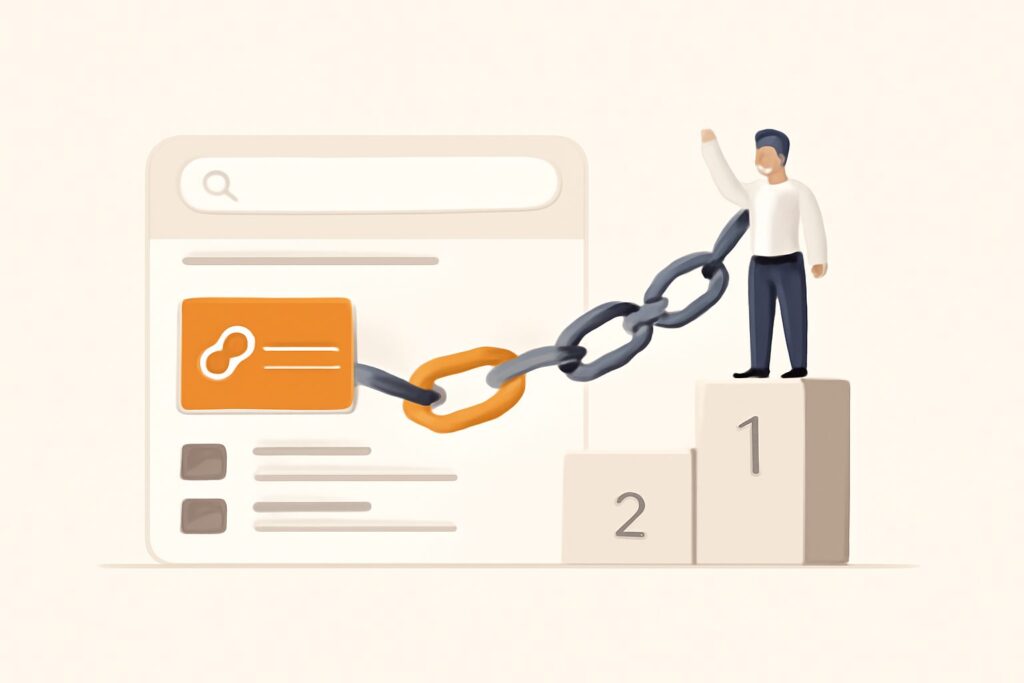
Ask how many backlinks to rank and you’ll get a number back — 50, 100, “it depends” from someone who then sells you a package of exactly 100. All of those answers are wrong for the same reason: there is no universal figure, because a backlink isn’t a currency with a fixed exchange rate. The honest answer is a method, not a number, and the method is knowable, repeatable, and specific to the one keyword you actually want. This guide gives you that method — how to reverse-engineer the real target from the SERP in front of you, why referring domains matter far more than raw link count, and where links stop being the bottleneck entirely.
There Is No Magic Number — and the Question Misleads
The reason nobody can tell you how many backlinks to rank for “your keyword” is that ranking is competitive, not absolute. Google isn’t checking whether your page clears a link threshold; it’s comparing your page against the specific set of pages already ranking for that query. Ten links might dominate a quiet long-tail term and be laughable against a commercial head term where every page on page one has hundreds of referring domains. The same ten links, same quality — wildly different outcomes — because the benchmark moved.
So the correct question is never “how many backlinks do I need?” in the abstract. It’s “how many, and of what quality, relative to the pages I’m trying to overtake?” Once you frame it competitively, the number stops being a mystery and becomes something you can measure directly off the results page.
Referring Domains, Not Backlinks, Are the Real Unit
Before you count anything, fix the unit. A “backlink” is a single link. A “referring domain” is a unique website linking to you, regardless of how many times it does. This distinction is the single biggest source of confusion when people ask how many backlinks to rank, because the two numbers can differ by an order of magnitude — a page with 4,000 backlinks might have them from only 40 domains.
Google treats these very differently. Fifty links from one site is closer to one vote than fifty; the tenth link from the same domain adds almost nothing. Fifty links from fifty different relevant sites is fifty distinct signals of trust. That’s why every serious analysis counts referring domains, not total backlinks. When a tool or a competitor brags about “10,000 backlinks,” the useful number is hiding underneath: how many unique domains? Anchor your entire estimate to that figure.
The Actual Method: Reverse-Engineer the SERP You Want
Here is the process that replaces guessing. It takes twenty minutes and gives you a defensible target instead of a superstition.
- Search your exact target keyword and list the pages ranking in positions 1 through 10 — the real ones, not ads or a knowledge panel.
- Pull the referring-domain count for each ranking page (page-level, not the whole site) using a backlink index.
- Ignore the outliers. The number-one result is often a giant brand with authority you can’t match quickly; the number-ten result is your realistic benchmark. Take the median of the page-one set, then look hard at the weakest page that still ranks.
- That median — in referring domains — is your working target. To break into the pack you generally need to be in the neighborhood of the weaker half, not the leader.
Notice what this does: it converts “how many backlinks to rank” from a sales pitch into an arithmetic answer specific to your keyword. If the weakest page-one result ranks with eight referring domains, you don’t need a hundred links — you need roughly eight to twelve genuinely relevant ones plus a page that matches intent. If every page on page one has 200-plus, you now know this keyword is a two-year project or the wrong target for a young site.
A Worked Micro-Example
Say you’re targeting “project management software for architects.” You check the SERP and find the ten ranking pages have referring-domain counts of, roughly: 140, 95, 60, 45, 38, 30, 22, 18, 15, 11. The number-one result (140) is a category leader — set it aside. The median sits around 34, and the softest page still ranking has 11. Your realistic entry target is therefore something like 12–20 relevant referring domains pointed at a page that genuinely serves that audience, not the “you need 100 links” figure a vendor would quote.
Now contrast a long-tail term like “how to invoice as a freelance architect.” You run the same check and find pages ranking with 2, 1, 4, 0, 3 referring domains. Here the honest answer to how many backlinks to rank is: close to zero. The bottleneck isn’t links at all — it’s simply publishing a better, more complete page than the thin ones currently ranking. Spending on links here is pouring water into a full glass.
Why the First Link From a Domain Matters Most
Backlinks obey steep diminishing returns, and understanding the curve stops you overspending. The first referring domain in a niche moves you meaningfully. The tenth moves you less. The hundredth, on a page that already has ninety, is almost imperceptible. This is why a small site can leapfrog a bigger one on a specific page: closing the gap from 3 domains to 15 is a large relative jump, while a competitor going from 180 to 195 barely registers.
The practical takeaway is to think in gaps, not totals. You don’t need to match a competitor’s absolute link count — you need to close the distance to the point where your superior page-level relevance and content quality can carry the rest. Chasing raw volume past the median of the SERP is usually wasted budget.
When You Need Zero Backlinks — and When You Need Dozens
Links are one ranking factor among many, and their weight varies enormously by query. Low-competition, long-tail, and informational terms frequently rank on content quality and topical relevance alone — pages with no external links routinely sit on page one when nothing better exists. Commercial, high-intent, high-value head terms are the opposite: the money is obvious, everyone competes, and links become the deciding factor because the content is already near-parity across competitors.
So the real skill isn’t building links — it’s diagnosing whether links are even your constraint. If the pages beating you have weak content and few links, write a better page. If they have strong content and a wall of referring domains, links are the gap. Answering how many backlinks to rank starts with answering whether you need any at all for this particular keyword.
Quality and Relevance Override Raw Count
Two sites with the same referring-domain count can rank a world apart, because Google weights the editorial context of a link far above its existence. A single link from a respected industry publication, inside relevant body content, from a page that itself has authority, can outweigh dozens of directory listings, forum signatures, and footer links. This is also why bought link packages disappoint: they inflate the raw number while adding little of the signal Google actually values.
When you qualify a prospective link, weigh topical relevance to your page, the linking page’s own authority and traffic, whether the link is editorial (given in real content) versus mechanical (a list, a footer, a paid placement), and the surrounding anchor and context. Ten links that pass those tests beat a hundred that don’t. Note too that “domain authority” is a third-party Moz metric, not a Google signal — useful as rough shorthand, but don’t mistake it for what the search engine measures.
Links Are a Proxy, Not the Cause — Read the Correlation Honestly
Every study showing pages with more referring domains rank higher is real, but it’s correlation, and the causation runs partly the other way. Genuinely useful, comprehensive pages earn links because they’re good — and rank for the same reason. The links didn’t manufacture the quality; the quality attracted both the links and the rankings. Treat link count as a proxy for “have enough people found this worth citing,” not as a dial you crank to force position.
This is the honest caveat missing from most answers on the subject: hitting the median referring-domain count of a SERP with manipulated or irrelevant links won’t replicate the result, because you’ll have copied the number without the underlying signal. Google’s link systems increasingly neutralize manipulative links algorithmically — they pass no value rather than triggering a penalty — so the spend simply evaporates. And reciprocal link exchanges, private blog networks, and links bought at scale are link schemes that violate Google’s guidelines; the durable path is earning the count, not purchasing it.
How to Close the Gap Without Buying Links
Once you know your target referring-domain number, closing it is legitimate outreach work — the human, relationship-driven part that no tool automates for you. The reliable methods are honest: publish genuinely link-worthy assets (original data, tools, definitive guides) that give people a reason to cite you; find sites already linking to your competitors and pitch them your better resource; reclaim unlinked brand mentions; and earn editorial guest placements where they’re truly relevant. Reply rates are low and it’s a numbers game — no reputable process promises a guaranteed link or ranking.
What software genuinely speeds up is the analysis around that work. SEO Rocket runs backlink and referring-domain analysis on real Ahrefs data, so you can pull the exact page-level counts for a SERP instead of eyeballing. Its competitor backlink gap analysis surfaces the specific domains linking to your rivals but not to you — that is your prospect list — and the backlink audit flags toxic links worth disavowing. It won’t do the outreach or sell you links; it tells you precisely how many domains you’re behind and who to approach. That’s the difference between a proven playbook and a link package.
Putting It Into a Repeatable Workflow
The whole process compresses into a loop you can run per keyword: measure the referring-domain median of the live SERP, subtract what your page already has, and treat the difference as your outreach goal — adjusted down if your content clearly beats the field and up if it merely matches. Track referring domains and rankings over time rather than checking once, because both jitter and the payoff from a new link can take weeks to surface. This is the workflow behind a playbook proven across 1,000,000+ ranking pages: not a secret number of links, but the discipline of always benchmarking against the specific competition you can realistically overtake.
Frequently Asked Questions
How many backlinks do I need to rank on the first page of Google?
There’s no fixed number — it equals roughly the median referring-domain count of the pages currently ranking for your exact keyword, weighted by their quality. For a quiet long-tail term that can be zero; for a competitive commercial term it can be well over a hundred unique domains. Measure the SERP you’re targeting rather than trusting a universal figure.
Do backlinks or referring domains matter more?
Referring domains. Fifty links from one site count roughly as a single vote, while fifty links from fifty relevant sites are fifty distinct trust signals. Always benchmark unique linking domains, not total backlink volume, since the two numbers can differ by ten-to-one.
Can a page rank with zero backlinks?
Yes, routinely — on low-competition, informational, or long-tail queries where the competing pages also have few or no links. There, content quality and topical relevance decide the result, and a thorough, well-structured page can rank on its own. Links become decisive mainly on high-value commercial terms where content is already near-parity.
Are more backlinks always better?
No. Backlinks show steep diminishing returns, and low-quality or irrelevant ones add little while risking devaluation. Ten relevant, editorial links usually beat a hundred directory or paid links, and pushing past the SERP’s median is typically wasted budget better spent on content and relevance.