SEO for startups is a fundamentally different exercise from SEO for an established company, and most generic advice — “publish consistently,” “build backlinks,” “target competitive keywords with a solid content strategy” — quietly assumes you have things most startups don’t have yet: a team, a budget, and above all, domain authority. This guide is about what actually works when you have none of those and a founder or one marketer doing SEO in the gaps between everything else.
Why SEO for a startup is a different game
Three constraints define early-stage SEO, and ignoring any of them is why most startup SEO efforts stall out after a few months of unrewarded effort:
- No domain authority. A brand-new domain has no backlink history and no trust signal in Google’s eyes. Competing for the same keywords as an established competitor with years of links is not a fair fight, and won’t be for a while regardless of content quality.
- No time. Early-stage teams are shipping product, not writing content calendars. Anything that requires more than a few hours a week, indefinitely, will get deprioritized the moment things get busy — and things always get busy.
- No budget. No budget for a content team, a link-building retainer, or expensive tooling. Whatever strategy you pick has to work with founder time and maybe one freelance writer.
The strategy that fits these constraints looks very different from an enterprise SEO playbook: fewer, more targeted pages; keywords chosen for low competition and high buying intent rather than volume; and content that leverages the product itself rather than requiring a content team to produce from scratch.
SEO vs. paid ads: the honest tradeoff
Paid ads and SEO solve different problems, and conflating them is where a lot of startup marketing spend goes to waste. Paid ads are rented attention — turn the budget off and traffic goes to zero the same day. SEO is owned distribution that compounds, but it has a lag: a new page rarely ranks meaningfully in the first month or two, and durable rankings on anything competitive typically take two to four times longer than that. This isn’t a reason to avoid SEO — it’s a reason to run it in parallel with paid channels, not instead of them, especially pre-product-market-fit. Ads can validate which messaging and keywords actually convert before you invest writing time into organic content around them; SEO then builds the long-term asset once you know what’s worth building.
The other honest point: SEO only pays off if the content ranks for terms people actually search with commercial intent, and if your product can convert that traffic. A perfectly optimized blog post for a keyword nobody with buying intent searches is a sunk cost, not an asset.
Keyword strategy: bottom-of-funnel first, not volume first
The instinct for most startups is to chase the biggest keyword (“project management software,” “CRM for small business”) because the volume looks compelling. This is almost always the wrong first move — those terms are dominated by category leaders with years of authority, and even a great page won’t rank for a long time. The keywords worth targeting early are the ones with real buying intent and comparatively low competition, even if the volume looks small individually:
| Keyword type | Example | Why it works early |
|---|---|---|
| Alternative/comparison | “[competitor] alternative” | Searcher already knows the category and is actively comparing — high intent, and competitors rarely defend this term well |
| Head-to-head | “[you] vs [competitor]” | Bottom-of-funnel, decision-stage traffic; low competition if the competitor hasn’t written it |
| Integration pages | “[your product] + [tool] integration” | Near-zero competition, and searchers are often existing users of the other tool — pre-qualified |
| Use-case pages | “[your product] for [specific job/industry]” | Long-tail, low competition, and matches how a real buyer actually searches when evaluating fit |
| Broad category term | “best project management software” | Deprioritize until you have real domain authority — high effort, low near-term return |
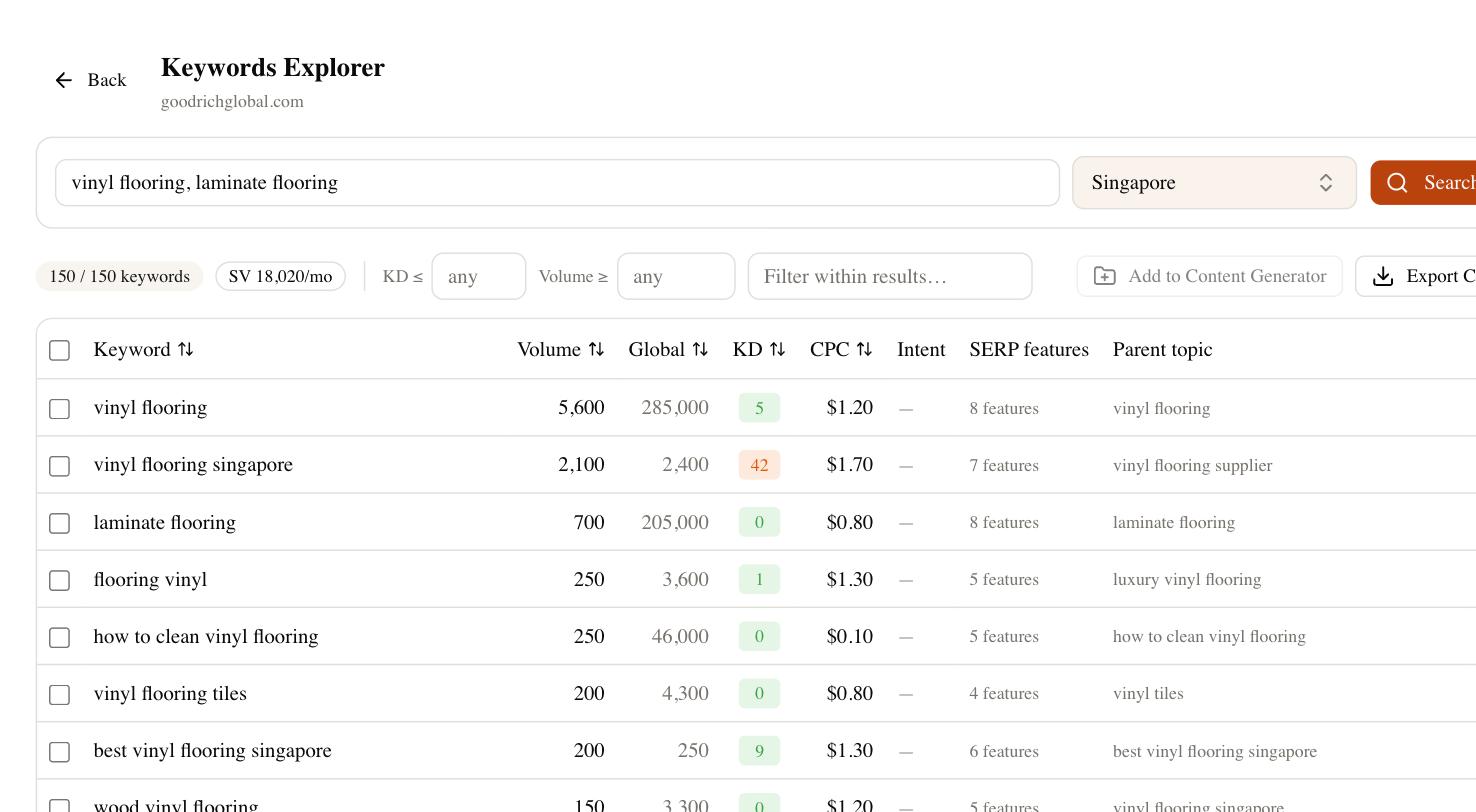
A practical way to find these: look at what your close competitors rank for that you don’t (a content gap analysis), and filter for terms with clear commercial intent and a keyword difficulty your domain can realistically compete for today, not in two years.
Product-led and programmatic content
The most efficient content a startup can produce is content the product itself generates. If you have structured data — templates, calculators, comparison data, directory-style listings, integration docs — that data can become dozens or hundreds of genuinely useful pages without a writer producing each one from scratch. This is how many SaaS companies built early organic traffic: not through blog volume, but through programmatic pages (e.g., “[tool A] vs [tool B]” generated from a comparison dataset, or a template gallery where each template is its own indexable page) that are useful in their own right, not thin SEO filler.
The caveat that separates this from spam: each page has to earn its place with real, distinct value. Google’s algorithm and its human quality raters are both explicitly tuned to detect programmatic pages that are just a template with variables swapped in and no substance. If a page wouldn’t be useful to someone who lands on it directly, it shouldn’t exist just to catch a keyword.
Technical foundations on modern JS stacks
Most startups today ship on React, Next.js, or similar frameworks, and a few technical issues show up often enough to be worth checking early rather than discovering six months in:
- Rendering strategy: client-side-only rendering can leave content invisible or delayed to crawlers. Server-side rendering or static generation for anything you want indexed is the safer default.
- Metadata per route: unique titles, meta descriptions, and canonical tags per page, not one static set inherited site-wide from a template.
- Sitemap and robots.txt: generated and kept current automatically as new pages (especially programmatic ones) are added — a manually maintained sitemap goes stale fast.
- Core Web Vitals: JS-heavy stacks are prone to layout shift and slow load if not watched; this is a ranking factor and, more importantly, affects conversion.
- Duplicate content from app routes: filter/sort parameters, staging subdomains, or preview URLs getting indexed alongside the canonical page.
None of this needs to be perfect on day one, but a basic technical audit before investing heavily in content production saves months of wasted effort — no amount of good content ranks if the page isn’t being crawled or indexed correctly.
Realistic timelines: what to actually expect
| Timeframe | Realistic outcome |
|---|---|
| 0-3 months | Foundations laid (technical setup, initial keyword research, first pages published). Little to no meaningful organic traffic yet — this is normal, not a failure signal. |
| 3-6 months | Long-tail and low-competition pages (alternatives, integrations, use-cases) start getting indexed and picking up early rankings and trickle traffic. |
| 6-9 months | Consistent, compounding organic traffic from the long-tail pages; enough data to see which content types and topics are actually converting. |
| 9-12 months | Domain authority has grown enough from consistent publishing and natural link accumulation to realistically start competing for moderately competitive terms. |
If a plan promises meaningful organic traffic inside 60-90 days on a brand-new domain in a competitive category, treat it skeptically. It can happen in near-zero-competition niches, but it’s the exception, not the baseline to plan around.
When SEO is not the right channel yet
Being honest about this matters more than any tactic above. SEO is probably not the right investment for a startup right now if:
- You haven’t found product-market fit yet. SEO content built around messaging that will change in three months is wasted effort — validate the message with faster channels first (outbound, ads, communities).
- Your buyers don’t search for your category. Some products are sold, not searched for — if your best customers come from outbound, partnerships, or word of mouth and rarely Google anything related to the problem, SEO will be a slow, low-yield channel regardless of execution quality.
- You have zero capacity for even a few hours a week, consistently, for the next six-plus months. Sporadic effort (a burst of posts, then nothing for months) essentially resets progress and rarely compounds.
- You need revenue in the next 30-60 days. SEO is not a short-term lever. If that’s the immediate need, paid acquisition or outbound will get there faster, and SEO can be layered in once there’s runway to let it compound.
A 90-day SEO plan for a one-person startup team
| Phase | Focus | Key actions |
|---|---|---|
| Days 1-30 | Research and technical base | Keyword research prioritizing alternative/vs/integration/use-case terms; competitor content gap check; fix indexing, sitemap, and metadata basics |
| Days 31-60 | First content wave | Publish 5-10 bottom-of-funnel pages (alternatives, comparisons, key integrations); set up basic rank tracking on target terms |
| Days 61-90 | Expand and measure | Add use-case pages based on real customer language; evaluate which published pages are getting impressions/clicks; double down on what’s working, cut what isn’t |
Where a tool like SEO Rocket fits
For a startup with no dedicated SEO hire, the hard part usually isn’t writing — it’s knowing which keywords are actually worth the writing time, and not finding out six months later that a page was never going to rank. That’s the layer a chat-first tool on real Ahrefs data is useful for: Keywords Explorer to find genuinely low-competition, high-intent terms instead of guessing; content gap analysis to see exactly what competitors rank for that you don’t; a technical audit to catch the rendering, sitemap, and metadata issues above before they quietly cap your traffic; and rank tracking so you know within weeks, not months, whether a page is gaining ground. It doesn’t replace the judgment calls above about whether SEO is the right channel yet — but it removes a lot of the guesswork once you’ve decided it is.
SEO Rocket has a free plan to start with, paid plans from $49/mo: app.seorocket.ai.