A useful ai seo strategy 2026 starts by ignoring most of what’s written about it. The genre is full of breathless predictions and “SEO is dead” headlines, and almost none of it tells you what to change on Monday morning. This is the opposite: a grounded look at what actually shifted, what didn’t, and where you should spend the limited hours you have.
The honest summary is that search got a second front. Google is still where most of your traffic comes from, but a growing slice of your buyers now ask ChatGPT, Perplexity, or Google’s own AI Overviews before they ever see a blue link. Your ai seo strategy 2026 has to serve both without pretending the old one stopped working.
“SEO is dead” — the nuance nobody puts in the headline
Every few years someone declares SEO dead, and every few years it isn’t. What’s different now is that the claim has a kernel of truth worth taking seriously. When an AI answer resolves a query on the page, the user may never click through, and that zero-click behavior does erode traffic for informational, top-of-funnel content.
But “some clicks disappear” is not “SEO is dead.” The queries most likely to be answered without a click were often the ones that converted worst anyway — quick definitions, unit conversions, simple facts. The queries that carry commercial intent, that need comparison, trust, or a specific product, still send people to real pages. The work shifts toward content that earns the click and, increasingly, toward being the source the AI cites in the first place.
What actually changed under the hood
To plan for it, you need to understand the mechanism rather than the marketing. Large language models don’t crawl the web live for every answer. They lean on a mix of training data and, when connected, a retrieval step that pulls in current pages to ground the response. Google’s AI Overviews and Perplexity both do a version of this retrieval-and-summarize move, drawing from pages that already rank and that clearly, factually answer the question.
The practical consequence is that classic SEO signals still feed the machine. A page that ranks well, loads fast, states facts plainly, and carries genuine authority is exactly the kind of source these systems prefer to quote. There is no separate secret “AI SEO” channel to game. There is your content, made clearer and more quotable, showing up in more places.
The fundamentals that didn’t move
Before chasing anything new, confirm the boring things still hold. They are still the foundation of any credible ai seo strategy 2026, and skipping them to sprint after AI visibility is how sites end up invisible in both places.
- Search intent — match what the searcher actually wants, not the keyword’s literal words. This matters more under AI, not less, because retrieval rewards pages that answer the real question directly.
- Genuine topical depth — thin content loses even with links, and it certainly doesn’t get cited. Cover a subject completely enough that a machine could summarize your page and be right.
- Technical health — crawlability, clean structure, fast pages, and sensible internal linking. If a bot can’t parse you cleanly, an AI answer won’t either.
- Real authority — links and brand mentions from places that matter. This is slow and unglamorous, and it’s still what separates a cited source from an ignored one.
Building the strategy: what to add for AI search
Once the fundamentals are solid, layer on the parts that address AI answers specifically. None of these are exotic; they’re mostly good writing discipline enforced harder.
Write answers that stand alone. For each important question, put a direct, factual answer in the first paragraph of the relevant section, then expand below it. Retrieval systems and skim-reading humans both reward the same structure. Use clear headings phrased the way people actually ask, so a machine matching a query to your page has an obvious anchor to grab.
Be quotable and be specific. Vague, hedged prose gets skipped; concrete figures, named steps, and plain definitions get lifted into answers. Add structured data where it fits — FAQ, product, and how-to markup won’t rank you by themselves, but they make your facts machine-readable, which is half the battle in getting surfaced. And keep your facts current, because AI systems visibly prefer sources that look maintained over ones that look abandoned.
Measuring what you can’t see: AI visibility
Here’s the uncomfortable part. Traditional rank tracking tells you where you sit in Google’s blue links, but it says nothing about whether ChatGPT mentions your brand or whether Perplexity cites your page. You can rank first and still be absent from the AI answer sitting above you — and until you measure it, you won’t know.
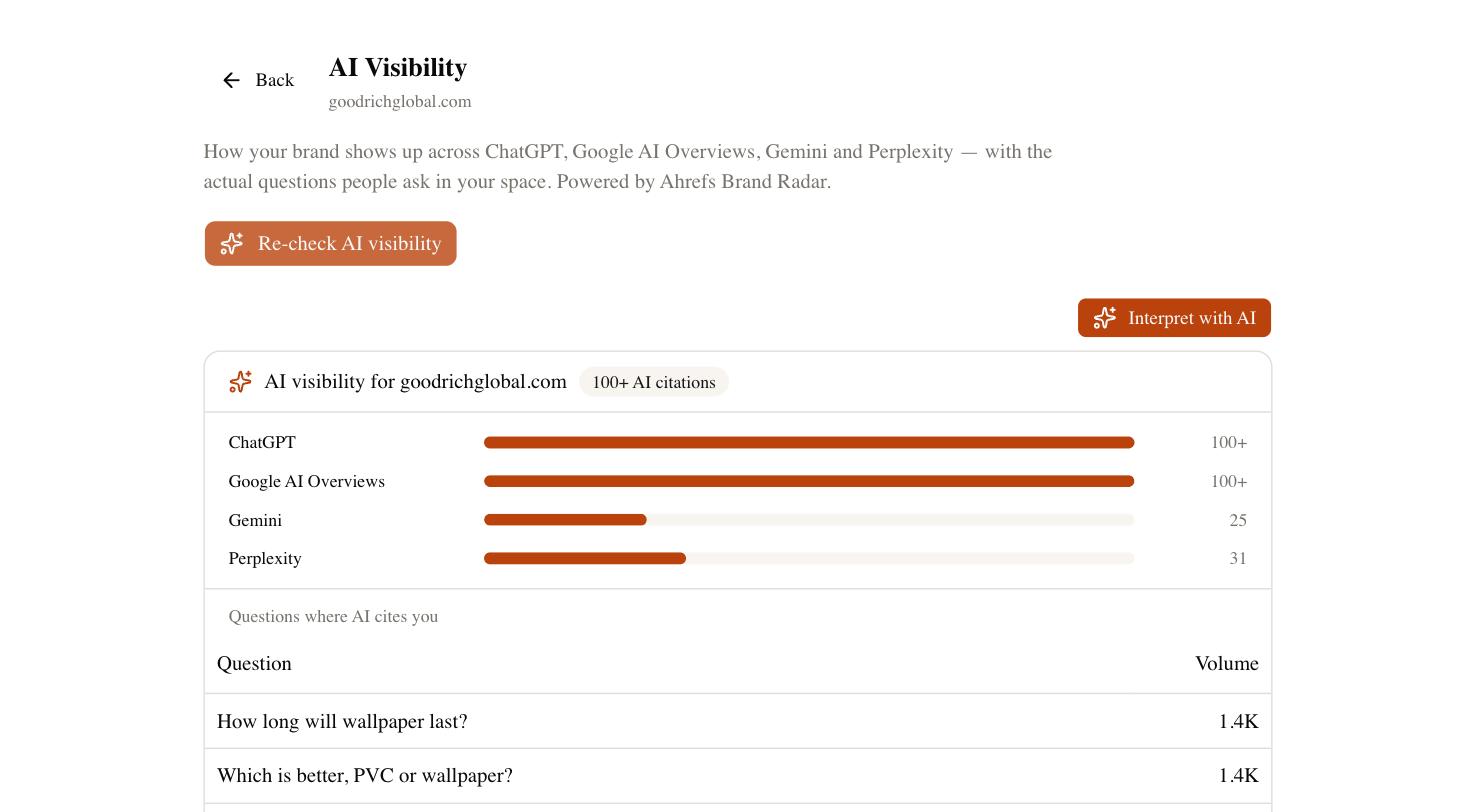
This is the gap SEO Rocket’s Brand Radar is built to close. It tracks whether — and where — your brand is being cited across ChatGPT, Google AI Overviews, and Perplexity, alongside the conventional rank tracking, keyword research, and competitor-gap data you’d expect from an Ahrefs-grade tool. The point isn’t a vanity dashboard; it’s that you can’t improve a surface you can’t see. Once you know which prompts mention a competitor and not you, you know exactly which content to strengthen. Treat those readings as directional rather than precise — AI answers vary run to run — but the trend is what you’re steering by.
Where AI writing helps, and where it quietly hurts
AI writing tools are genuinely useful, and they’re also how a lot of sites are about to sink. The upside is real: drafting, outlining, and clearing a blank page go far faster, and a tool with your real keyword and competitor data underneath can ground a draft in facts instead of guesses. Used that way, it’s leverage.
The failure mode is publishing the raw output. Undifferentiated AI text — the kind with no firsthand insight, no specific numbers, no point of view — is exactly what search systems are learning to discount, and it’s the last thing an AI answer wants to cite. Use AI to accelerate the work, then add the things a model can’t: your own experience, real examples, an honest opinion. The article you’re reading follows that rule, and so should yours.
What to actually do this quarter
Skip the five-year prediction and do the next ninety days. First, audit your top twenty pages for the fundamentals — intent, depth, technical health — and fix what’s broken before adding anything. Second, rewrite the key sections of your money pages to answer their core question in the opening lines, so both humans and retrieval systems can grab a clean answer.
Third, start measuring AI visibility now, even roughly, so you have a baseline to improve against rather than a guess. Fourth, point your AI writing at drafts and outlines, never at final copy, and put a human’s judgment on everything that ships. Do those four things and your ai seo strategy 2026 will be ahead of most of your competitors — not because you predicted the future, but because you handled the present without the hype.