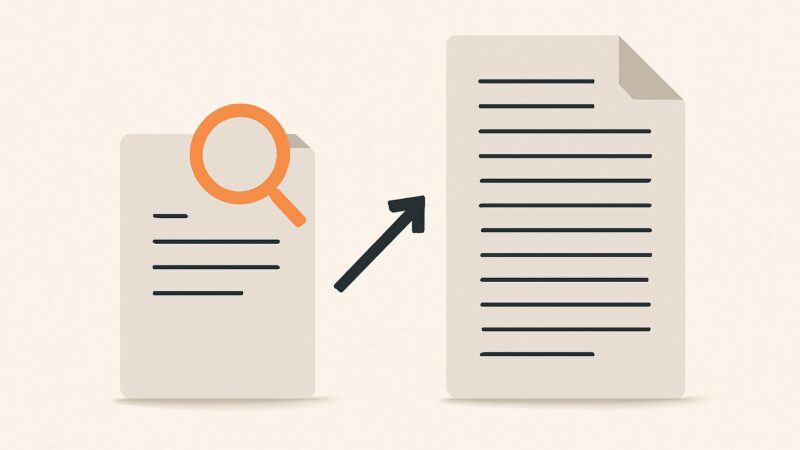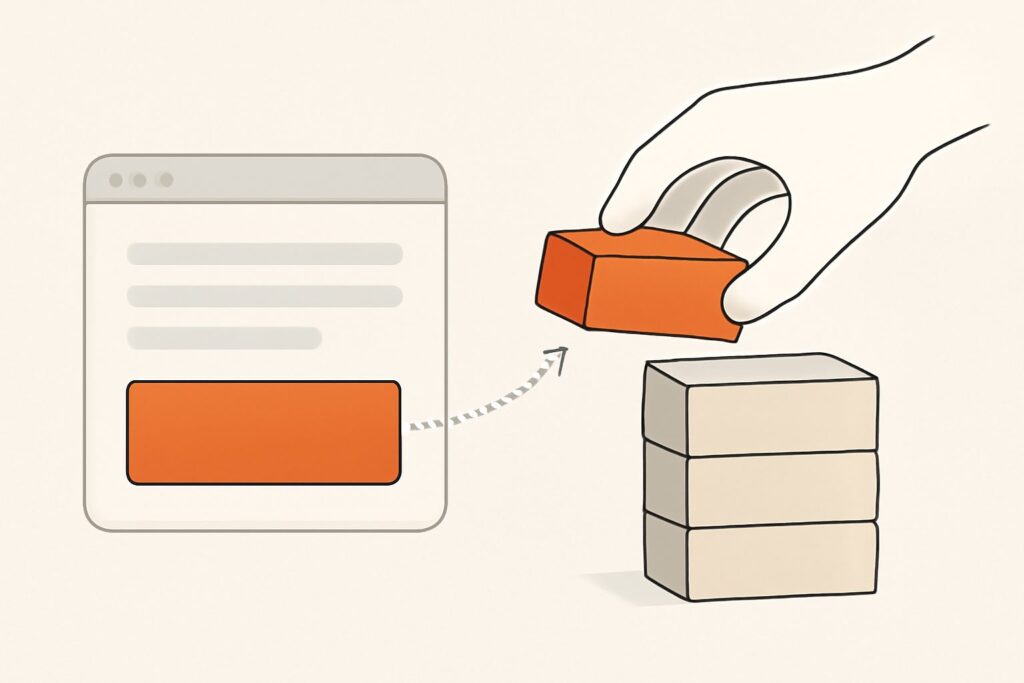
Most advice about content chunking stops at “break your text into short paragraphs and add subheads.” That’s not wrong, but it’s the surface of a much more consequential idea. Chunking used to be a readability tactic for humans who skim. Today it’s also the mechanism by which machines decide what your page is worth — Google’s passage ranking scores individual passages, retrieval-augmented generation (RAG) pipelines slice pages into embedded fragments, and AI answer engines lift one self-contained block to quote. When you chunk content well, you’re not just helping a person scan; you’re making each unit of your page independently retrievable. Get that right and the same structural discipline pays off twice.
Why “just use short paragraphs” misses the point
Short paragraphs improve scannability, but length is a symptom, not the goal. You can write four two-sentence paragraphs that still ramble across three unrelated ideas, and you can write one dense 90-word paragraph that nails a single question completely. The lazy take optimizes for whitespace. Real chunking optimizes for self-containment: each block should express one idea so completely that it survives being lifted out of the page and read on its own. That is the exact condition both a skimming reader and a retrieval system impose on your writing — neither reads top to bottom, so every chunk has to stand up alone.
What content chunking actually is
Content chunking is the practice of organizing a page into discrete, self-contained units — a paragraph, a list, a subsection under a descriptive heading — each answering one sub-question and each intelligible without the surrounding context. The concept comes from cognitive psychology: working memory holds only a handful of items at once, so we group information into meaningful chunks to reduce load. Web readers do the same thing physically, scanning in an F-shaped pattern and stopping only where a heading or bolded phrase signals relevance.
What changed is the second audience. A modern page is consumed by two very different readers with the same underlying need. Humans scan for the block that answers their question. Machines — passage-ranking algorithms, RAG retrievers, AI Overviews — do a structurally identical thing: they split the page into fragments, score each fragment against the query, and surface the best one. Chunk for one and you’ve largely chunked for the other, because both are asking the same thing of every block: does this stand alone and answer something?
The self-contained chunk test
Here’s the single rule that upgrades everything else. For any chunk on your page, ask: if a stranger read only this block, with no heading above it and no paragraph before it, would it make complete sense and answer a real question? If yes, it’s a good chunk. If it opens with “This means…” or “As mentioned above…” or a dangling “it” whose referent lives two paragraphs up, it fails — and it fails for the machine too, because when a RAG pipeline embeds that fragment or Google isolates that passage, the missing context isn’t there to rescue it.
The test forces three habits: name the entity in the chunk instead of pronouns pointing elsewhere, front-load the answer in the first sentence, and keep each chunk to one idea. It sounds mechanical, but it’s the difference between content that gets quoted by an AI answer engine and content that gets skipped because no single passage was extractable.
The anatomy of one good chunk
A well-formed content chunk usually has four parts, even if they’re compressed into a few sentences:
- A retrieval anchor — a descriptive heading or a bolded lead phrase that states the question the chunk answers (“How long should a chunk be,” not “Length”).
- A front-loaded answer — the direct claim in the first sentence, so a skimmer or a snippet grab gets the payoff immediately.
- Self-contained context — the named subject and any term a reader needs, defined in-chunk rather than assumed from earlier.
- One idea, fully closed — no bleeding into the next topic; when the idea changes, the chunk ends.
Notice that this is exactly how a strong featured-snippet paragraph reads, and how a good FAQ answer reads. That’s not a coincidence — snippets and AI citations are just chunks that won.
Sizing chunks: practical decision rules
There’s no magic word count, but there are workable thresholds. Use these as defaults, not laws:
- Paragraphs: aim for 40–100 words, two to four sentences. Above ~120 words on screen, split — you’re almost certainly covering more than one idea.
- Sections under an H2/H3: one question per heading. If a section needs three distinct sub-answers, it needs three sub-chunks (a list, or H3s), not one long block.
- Lists: reach for a list when you have three or more parallel items; each bullet becomes its own micro-chunk and each should be self-contained.
- Sentences: keep the load-bearing first sentence of each chunk under ~25 words so the answer lands before the reader’s eye moves on.
The decision rule that matters most: chunk on idea boundaries, not on length. Count ideas, then let length follow. A page that respects idea boundaries reads well at any paragraph length; a page chopped purely by word count often severs a single thought across two blocks — the worst outcome, because now neither half stands alone.
Chunking for AI retrieval and passage ranking
This is where chunking stopped being cosmetic. Google’s passage ranking can pull a single relevant passage from a page that isn’t otherwise about the query, which means a well-formed chunk deep in a long article can rank on its own merits. Separately, AI systems that summarize or cite the web run on retrieval: they break pages into fragments (often on heading and paragraph boundaries), convert each to an embedding, and fetch the fragments closest to the query to ground their answer. A page that’s one undifferentiated wall of text gives these systems no clean seams to cut on, so they either chunk it badly or skip it.
The practical implications are concrete. Put the answer near the top of its section, not buried after three sentences of throat-clearing. Repeat the key entity in the chunk instead of relying on a pronoun, so an isolated fragment still names its subject. Use headings that read like the questions people actually type. And keep one claim per block, because a fragment that hedges across two ideas embeds fuzzily and retrieves for neither. None of this is gaming a system — it’s writing that happens to survive being cut into pieces, which is what every reader (human or machine) does to your page anyway.
The semantic HTML layer machines actually read
Chunking isn’t only about prose; it’s about the markup that signals where chunks begin and end. Retrieval systems and browsers lean on your HTML structure to segment the page, so the tags carry real weight. Use a single H1, then a logical H2/H3 hierarchy that never skips levels — headings are the primary boundary both skimmers and chunkers use. Wrap genuine lists in ul/ol rather than faking them with line breaks, mark up FAQs as real question-and-answer pairs, and use semantic elements (article, section) instead of a soup of anonymous divs. Clean structure is what lets a machine chunk your page the way you intended instead of guessing.
A worked before-and-after
Take a paragraph you’ll recognize from a thousand blog posts:
“When it comes to internal linking, there are many things to consider. It can really help your rankings if done properly, and it’s something a lot of people overlook. As we discussed, this ties back to how Google crawls your site, and it’s important to get it right for the reasons mentioned above.”
Lift that out of context and it says nothing. There’s no answer, the subject hides behind “it,” and it leans on “as we discussed” and “mentioned above.” Now the chunked version:
“Internal linking passes ranking signals between your pages and shows Google which pages matter most. Link from high-authority pages to the ones you want to rank, using descriptive anchor text that names the target topic. A page with no internal links pointing to it is nearly invisible to crawlers, no matter how good it is.”
The rewrite front-loads the answer, names the subject in every sentence, and stands completely alone. That second version can win a snippet, get cited by an AI answer, or be the passage Google ranks — because it passed the self-contained chunk test. Same information, radically different retrievability.
Where chunking goes wrong
Discipline can tip into damage. Over-chunking atomizes everything into staccato one-liners and disconnected bullets until the page loses argument and flow — narrative, nuance, and cause-and-effect need connective tissue that pure fragmentation destroys. Not every page should read like a reference card; a persuasive essay or a deep technical explanation earns longer, linked reasoning. The other failure is heading inflation: slapping a subhead on every two sentences to look “structured” fragments a single idea across three boundaries and confuses the very chunkers you’re trying to serve. The fix is the same test in reverse — if two adjacent blocks only make sense read together, they were one chunk and should be merged.
Building chunking into your workflow
Chunking is a habit you enforce at draft time and audit at scale. When you write, outline by questions first — each H2 or H3 is a question, each answer is a chunk — so structure precedes prose instead of getting retrofitted. When you audit an existing site, the tell-tale symptoms are long pages with almost no headings, paragraphs over 150 words, and sections that never front-load an answer. A real-crawler site audit like the one in SEO Rocket surfaces exactly those pages — thin, wall-of-text, or structurally flat — so you know which URLs to restructure first instead of eyeballing a whole library.
For net-new content, the guardrail is structural. SEO Rocket’s AI article writer runs validation gates that enforce a minimum section count, real heading structure, and title and meta limits, with a repair loop that rejects a draft that comes back as one undifferentiated block — so scaled output still ships as properly chunked, scannable pages rather than a wall of tokens. The gate doesn’t replace an editor’s judgment about flow and voice; it guarantees the skeleton is right before a human refines it. And because chunk quality shows up as ranking and snippet behavior over time, pairing it with rank tracking tells you whether a restructure actually moved the passages you cared about. This kind of structural rigor is part of the same playbook proven across 1,000,000+ ranking pages — the boring discipline that compounds.
Frequently asked questions
What is content chunking in SEO?
Content chunking in SEO means structuring a page into discrete, self-contained units — paragraphs, lists, and sections under descriptive headings — each answering one sub-question and each intelligible on its own. It helps human readers scan and lets search and AI systems isolate and rank individual passages, which is how snippets and AI citations are chosen.
How long should a content chunk be?
Chunk on idea boundaries first, then let length follow: paragraphs of roughly 40–100 words (split above ~120), one question per heading, and lists whenever you have three or more parallel items. The load-bearing first sentence should stay under about 25 words so the answer lands before a skimmer’s eye moves on.
Does content chunking help with AI and RAG systems?
Yes. RAG pipelines and AI answer engines split pages into fragments, embed them, and retrieve the ones closest to a query. A self-contained chunk — answer front-loaded, subject named in-block, one idea only — embeds cleanly and retrieves well, while a rambling wall of text gives these systems no clean seam to cut on and often gets skipped.
Can you over-chunk content?
Absolutely. Atomizing everything into one-line fragments and inflating headings onto every two sentences destroys narrative flow and splits single ideas across boundaries. If two adjacent blocks only make sense read together, they were one chunk — merge them. Chunk on genuine idea boundaries, not to hit a visual quota.