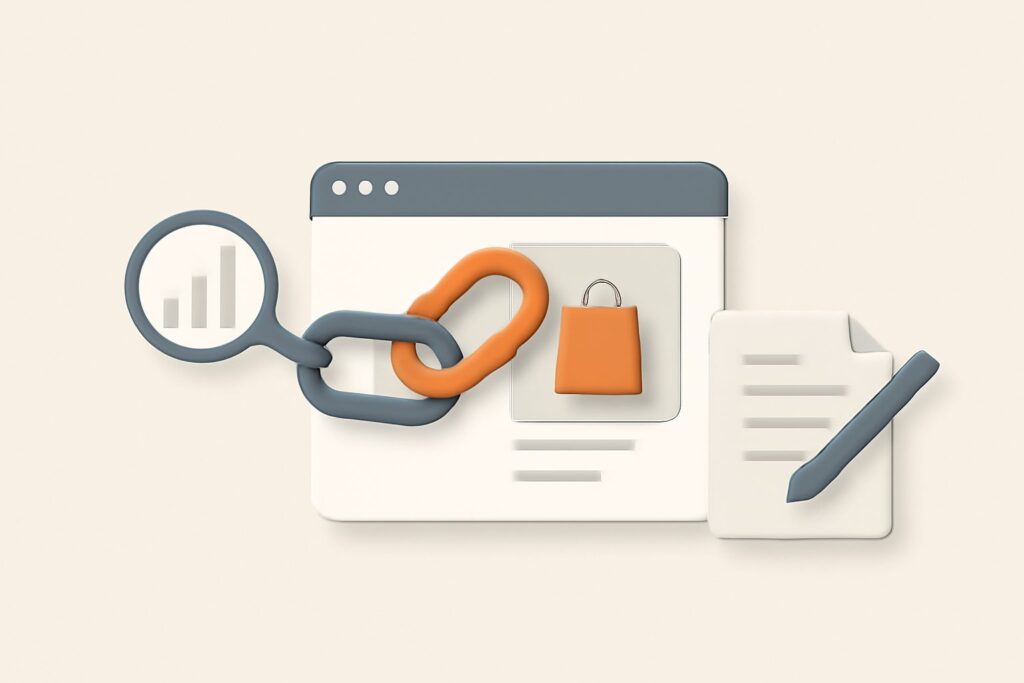
Most ecommerce link building tactics fail for one structural reason that has nothing to do with effort: nobody wants to link to a page that exists to sell them something. A blogger will happily cite a study, a calculator, or a genuinely useful guide. They will almost never link to your “Buy Waterproof Hiking Boots — $129” product page, because a link is an editorial recommendation and that page recommends only that the reader open their wallet. Understand that asymmetry and ecommerce link building stops being a grind of begging for links to unlinkable pages, and becomes a two-part system: earn links to things people actually cite, then move that equity to the pages that make money.
Why Ecommerce Is Structurally Hard to Link To
Content sites earn links because their best pages are the product — an article is inherently citable. An online store’s most valuable URLs are its category and product pages, and those are the least citable pages on the internet. This is the core problem every set of ecommerce link building tactics has to solve, and generic advice (“write great content, links will come”) ignores it entirely. Great product copy does not earn links; it converts visitors. The two jobs are different, and conflating them is why so many store owners spend months building nothing.
There’s a second structural issue: scale. A catalog of 5,000 SKUs cannot earn 5,000 sets of ecommerce backlinks. You will never win editorial links to individual variant pages. So the realistic goal is to concentrate authority — build links to a small number of link-worthy destinations and a few flagship category pages, then distribute that authority internally to the long tail of product URLs that could never attract it directly.
The Hub-and-Spoke Model: Where Links Should Actually Point
The highest-leverage of all ecommerce link building tactics is deciding, before you pitch anyone, where the link should land. Three targets, in order of how easily each earns links:
- Linkable assets — buying guides, original data, comparison tools, size charts, a genuinely useful resource. These earn the bulk of your ecommerce backlinks because they’re the only pages a publisher has a reason to cite.
- Category and collection pages — your real money pages for head terms (“running shoes,” “standing desks”). These earn a trickle of links via resource pages and roundups, but mostly inherit authority internally.
- Product pages — the hardest. Direct product page links come almost entirely from product roundups, supplier listings, and reviews, not editorial mentions.
Once a guide earns links, you funnel that equity with deliberate internal linking: the guide links down to the relevant category page, the category page links to its top products. This is why a well-structured internal link graph does more for product-page rankings than any outreach campaign aimed directly at the products. Google’s PageRank flows through your own site; a strong asset can lift a dozen commercial pages that never got a single external link of their own.
Product Roundups and Gift Guides: The One Direct Route to Product Page Links
If you want links pointing at actual product pages, “best of” roundups and gift guides are the most reliable source. Publishers constantly write “The 12 Best Cast-Iron Pans” and “Gifts for the Coffee Obsessive,” and each entry links to a product page. To get included, find the roundups that already rank for your category, confirm they update their lists, and pitch a specific, well-differentiated product with a clear reason it belongs — a genuine feature, an award, a price-to-quality angle. Do not pitch your whole catalog; pitch one product to one relevant list.
One honest caveat: a large share of these placements are now paid or affiliate-based, and many major-publisher roundups use rel="sponsored" or nofollow on outbound links. Those still send referral traffic and brand exposure, but they pass little or no ranking equity. Chase the editorially-earned inclusions on niche and mid-tier sites where a followed link is realistic, and treat the big-publisher placements as revenue and awareness rather than pure SEO.
Digital PR: Building Assets People Have to Cite
The most durable ecommerce backlinks come from assets built to be referenced. A store selling gardening supplies can publish original data (“we analyzed 4,000 orders — here’s when each region actually starts planting”), an interactive tool (a plant-spacing calculator), or a definitive guide that out-covers everything on page one. Journalists and bloggers link to these because they add something to their own stories. This is the engine behind nearly every store that ranks in a competitive niche without buying links.
You don’t need a huge budget — you need one genuinely useful thing and a list of people who cover your topic. Pair the asset with journalist-request platforms (the services that replaced HARO, like Connectively and Featured), where reporters actively ask for expert sources and product data. A relevant, quotable response often earns a link from a publication you could never have pitched cold.
Supplier, Manufacturer, and Stockist Links
One of the most overlooked store link building tactics is also the easiest: if you’re an authorized retailer of any brand, that brand almost certainly has a “Where to Buy,” “Stockists,” or “Find a Retailer” page. Many will list and link to you simply because you sell their products and asked. Same logic for trade associations, local business directories that are genuinely used (not spam farms), chambers of commerce, and any wholesaler whose distributor network they publish. These are relevant, contextual, and permanent — the opposite of the low-quality directory links that do nothing.
Reclaiming Links You’ve Already Earned
Before hunting for new ecommerce backlinks, capture the ones that already exist without a link. Two mechanisms:
- Unlinked brand mentions — someone wrote about your product or brand but didn’t link. Find these with a monitoring tool, then send a short, friendly note asking for the link. Conversion rates are high because they already chose to mention you.
- Broken and discontinued-product reclamation — when you discontinue a product, its URL often has links pointing at it. Don’t let it 404. Redirect it (301) to the closest live product or its category so the equity survives. Conversely, find competitors’ discontinued products that still have links, build the equivalent live page, and pitch the linking sites a working replacement.
This is unglamorous and it’s where a real-crawler site audit earns its keep: it surfaces the 404s, redirect chains, and orphaned pages that are quietly leaking authority you already paid to earn. SEO Rocket’s audit runs a genuine crawler over the catalog and flags exactly these failure modes — broken internal links, dead product URLs with inbound equity, and redirect chains — so link reclamation becomes a checklist rather than a guess.
Steal Your Competitors’ Link Sources
The fastest way to find realistic link targets is to look at where rivals already have theirs. A backlink gap analysis compares your profile against three or four competitors and surfaces every domain linking to them but not to you. Those are pre-qualified prospects — sites that link to stores like yours, in your niche, right now. Roundups you’re missing from, resource pages that list competitors, suppliers who link to a rival but not you: the gap report turns “who might link to us?” into a concrete list. SEO Rocket runs this on real Ahrefs data, so the gap reflects live backlink profiles rather than a stale export, and it doubles as a keyword-gap engine for the buying-guide topics that make the best linkable assets.
Guest Content and Niche Relationships
Guest posting still works when it’s relevance-first rather than volume-first. A single article on a respected site in your exact niche — with a contextual link to a relevant guide or category page — is worth more than fifty links from generic “write for us” farms that Google’s link-spam systems already discount to zero. The durable version of this isn’t one-off submissions; it’s relationships with the bloggers, reviewers, and niche publications that cover your product category, so mentions and links accrue naturally over time.
Tactics to Avoid (They Cost More Than They Return)
Some ecommerce link building tactics look like shortcuts and are really liabilities. Buying links outright, mass low-quality directory submissions, and sitewide footer link swaps are neutralized or penalized, not rewarded. Gifted-product and affiliate links must carry rel="sponsored" or rel="nofollow" under Google’s guidelines — pushing reviewers for followed links on gifted products puts them at risk and does nothing durable for you. And exact-match commercial anchor text (“buy cheap running shoes”) built at scale is a classic footprint. Natural profiles are anchor-diverse: brand, URL, and descriptive phrases dominate; money anchors are the exception, not the rule.
A Realistic Ecommerce Link Building Workflow
Put it together as a repeatable sequence rather than a scramble:
- Fix the leaks first — audit for broken and orphaned pages, redirect discontinued products, and reclaim unlinked mentions before spending on anything new.
- Map your targets — decide which one or two flagship assets and top category pages will absorb links, and plan the internal links that carry equity down to products.
- Mine the competitor gap — build a prospect list from domains linking to rivals but not you.
- Build one linkable asset — a data study, tool, or definitive guide worth citing — and pitch it via journalist requests and niche outreach.
- Work the easy wins — supplier stockist pages, relevant roundups, and genuine directories in parallel.
- Track what sticks — monitor which links index and hold, and watch the category and product rankings they’re meant to lift.
This is the shape of the playbook proven across 1,000,000+ ranking pages — including a flooring-ecommerce catalog where the wins came from assets and internal flow, not link buys. SEO Rocket wires the measurable parts into one workflow at roughly $50/month with a free tier: the site audit for reclamation, competitor backlink and content-gap analysis for prospecting, the validation-gated AI writer for producing genuinely useful buying guides at catalog scale, and rank tracking to confirm the links moved the pages that matter. It’s an SEO layer over your store, not a replacement for the outreach relationships you build by hand.
Frequently Asked Questions
Do links to product pages matter, or should I focus on the homepage?
Both matter, but for different reasons. Homepage and brand links build overall domain authority that lifts everything. Direct product page links are rare and valuable because they concentrate relevance exactly where you want to rank — but since they’re so hard to earn, most product-page authority realistically comes from internal links flowing down from category pages and guides that earned the external links.
Are gifted-product review links worth pursuing?
For traffic, brand awareness, and social proof, yes. For pure ranking equity, temper expectations: Google requires gifted and affiliate links to be marked sponsored or nofollow, so they pass little link value. Pursue reviews for the audience and referral clicks, and earn your followed, ranking-relevant links from editorial roundups, resources, and digital PR.
How long does ecommerce link building take to show results?
Expect three to six months before earned links meaningfully move competitive category and product rankings, longer in saturated niches. Link reclamation and supplier listings can show faster because they reinforce pages that already have some traction. The compounding comes later — a strong linkable asset keeps earning links for years after you publish it.